There is nothing beneath the Windows UI interface. The GUI is the primary subsystem of Windows, the command line is a separate subsystem. Windows has traditionally been built up around the Win32 API, which is GUI first.
It is of course possible to do things from the command line, and some advanced stuff may need the command line, but users should never need to drop out of the UI unless something has gone horribly wrong.
The Windows UI is incredibly powerful, with advanced diagnostic and logging capabilities, incredible performance monitoring tools, and system hooks everywhere that allow the entire UI to be modified and changed in almost any way imaginable.
The way Services work on Windows is not some (hotly debated) config files. It is through a UI. Management of hardware takes place through a UI. Pretty much everything short of running Ping has a UI around it.
I love the command line, if I am developing it is how I primarily work. And while doing so, younger devs look at me like I am crazy because they have customized the living daylights out of their UI tools (VS Code, Atom), to do amazing things that exceed what a command line can do, and of course those editors have a command line built in for when that is the best paradigm!
> and having it heavily disguised as an appliance is mandatory.
Something working so well that it becomes an appliance isn't a bad thing. It means the engineers who made it have put in so many fail safes and worked to make the code of high enough quality that it doesn't fall apart around itself all the time.
Heaven forbid I can upgrade my installed software and not have some random package break my entire system.
To clarify, beneath the GUI interface is the actual code that implements that interface.
> Something working so well that it becomes an appliance isn't a bad thing.
Not at all. I don't attempt to call or think my phone as an computer. Window's users, on the other hand, still call their PC computers. I guess that is ok if computers are appliances. It is just that there are still a big camp of people who use a computer as computer. That causes some confusions in the communication between.
It seems that 90% of computer use has moved into the web browser. Heck outside of writing code, almost everything I do is in a browser, and my code editor of choice happens to be built as fancy skinned web browser...
> To clarify, beneath the GUI interface is the actual code that implements that interface.
I'd say that everything moving onto the web has once again made the code underneath it all accessible to the end user, if they so choose.
(Ignoring server side)
This is an extremely (web) developer-centric viewpoint IMHO.
Try telling 3D modellers/sculptors, games programmers, audio engineers that 90% of their computer use has moved into a browser. They will look at you with a blank face since they all require traditional "fat" desktop apps to get their work done at professional level.
And those are just the examples I can find off the top of my head, I'm sure I could think of more.
Talking about 3D modelling, game programming and producers like they're the majority is a technologist-centric view.
Most computer use is by people who think the web is the internet and use 'inbox' as a verb.
So as stated that was the list of the top of my head. I just pulled from my personal list of hobbies, things that I use a computer for other than programming or automation.
Within 50 feet of me at work there are a whole bunch of electrical engineers who spend 90% of their time in some fat app for designing, I dunno, telco electrical stuff.
In the fishbowl next to that, are 50 network operations staff who spend 90% of their day in "fat" network monitoring applications.
I'm just pointing out if you look far enough there are plenty of people using apps outside a web browser for their daily work and hobbies.
In my nearly 25 career in IT I have never heard people use 'inbox' as a verb (as in 'inbox me?'). Sure some people must say it sometimes, but I think this is overstated and another example of programmer cliche or hyperbole.
I think most of those people dont use general purpose computers anymore
I'm talking about overall computer use. For certain professional fields, yes, apps still matter. But I'd take a guess that the majority of screen time with computers now days involves a web browser.
Heck as a programmer (not web), I am probably 50% in browser looking things up.
At most offices, computers are used for web browsing, and Microsoft Office.
I should have put web in square brackets eg. [web] to indicate "optional". You seem to fall into the category I was describing.
Use an IDE (other than Atom), eg. Visual Studio, Eclipse, IntelliJ? All fat apps.
Use VMware workstation or Virtualbox? Fat apps.
> At most offices, computers are used for web browsing, and Microsoft Office.
So is that 90% web browsing and 10% MS Office? BTW, Office365 is still fat application (or suite of them) last time I looked.
Yes there is .. Microsoft! For instance if you have a dir named "user" it will show up in your GUI as "User". In fact User, USER, user are all the same for you because MS transliterate on the fly. Did you know that you cannot access some directory because MS prevent it .. event with the 'dir' command from the DOS prompt .. only an 'ls' non-MS command can do that.
> Windows has traditionally been built up around the Win32 API, which is GUI first.
What did I just read?
And I cut my teeth as a developer on DOS, Sun OS (pre-Solaris), and HP-UX, and early Linux back in the day.
Just to clarify on what we think as problem could differ:
    C:\Users\hzhou>ls *.txt
    new  2.txt

    C:\Users\hzhou>ls new  2.txt
    ls: new: No such file or directory
ls: 2.txt: No such file or directory:)
I actually didn't know that dir supported multiple globs for filenames! I've never had a need for that.
Super cool.
Directory of C:\Users\fred
12/14/2017 04:44 PM 1,556 new 2.txt 1 File(s) 1,556 bytes 0 Dir(s) 75,989,876,736 bytes free
C:\Users\fred>dir new 2.txt Volume in drive C has no label. Volume Serial Number is BA05-C445
Directory of C:\Users\fred
Directory of C:\Users\fred
File Not Found
C:\Users\fred>
Ah I see, you have a file "new 2.txt", I was a bit confused.
Not sure what you mean by only 1 level of quoting being a problem, sorry.
This is highly ironical, given this thread.
Some people seems to advocate for programs to be better than humans at globbing filenames.
Outside of Make which has long and boring historical reasons for not supporting spaces well, just about every program is fine with spaces.
$ take this list of transactions and for each group of duplicate names show me the name and total dollar amount spent, sorted from highest to lowest
$ I think I have a SQL command for that. Are you feeling lucky? [y/n] y
Foo $25 Bar $20 Blah $15
$ Was this what you were looking for? [y/n]
A similar trend is happening in electronic communication: from letter to email, to text, to emoji's. The text is just one historical communication way and there's no reason it should be of any real interest to modern communicator as long as we have emojis ... wait, we've been there before.
The GUI, which can include arbitrary number of text boxes for command line style entry, is a superset of what the command line can do.
https://www.powergrep.com/screens/replace.png
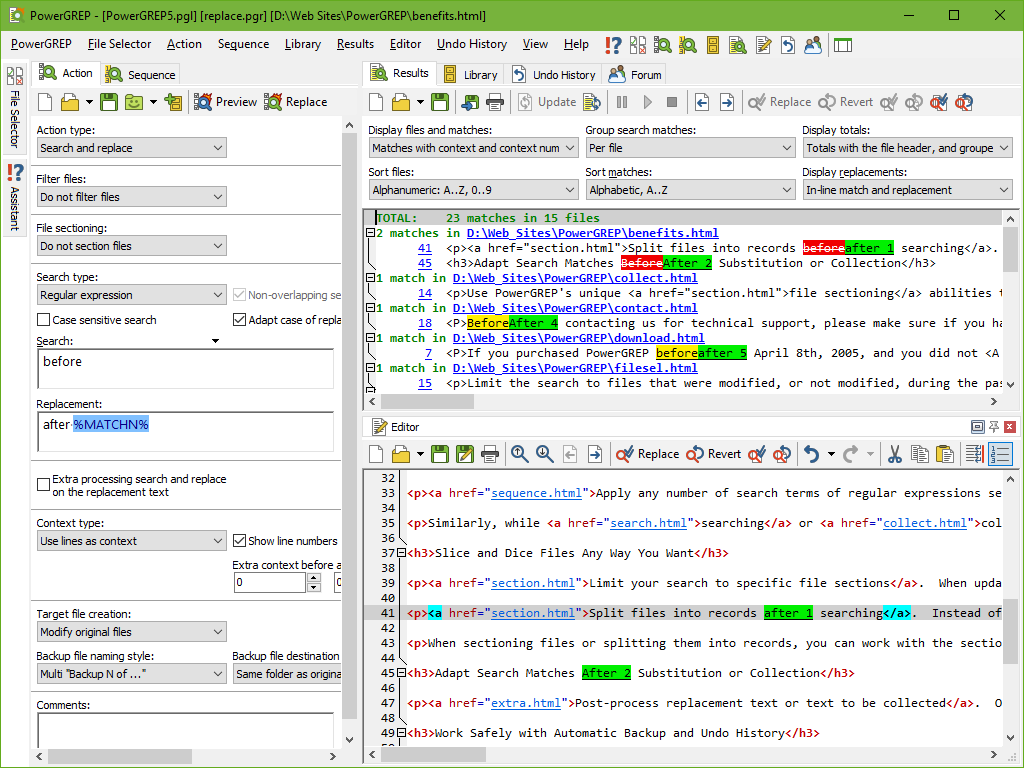
There is such a thing as a cluttered graphical interface, and some complexity cannot just be abstracted away.
> The GUI, which can include arbitrary number of text boxes for command line style entry, is a superset of what the command line can do.
That would be like saying that because I am able to write "First open this app by clicking on the upper-left icon, then click File, new File", would mean that text is a superset of the GUI because it can describe visual cues. An abstraction can always replace another, it does not mean it is a superset of it.
Take the source code for your GUI application, this is pure text. In the early days, there was shell code that would describe terminal GUI of sort to configure the linux kernel. This shell code is still commands read token per token with matching behavior. Because an abstraction can be traded for another (which could be argued to be a founding principle of computer science), does not mean that one is a superset of the other.
That is an excellent example that deserves a second look from a different aspect.
... it has trained a crop of computer users that are afraid of command lines and with an attitude of anything beneath the GUI interface is owned by and of someone else's problem. They are scared of computers more than ever. They are very scared of it and having it heavily disguised as an appliance is mandatory.