For a guitarist, it's almost impossible to explain the myriad tiny details that go into something as seemingly simple as picking a note. Troy's analysis of instructional videos by great players, where they obviously don't understand what they're doing, is kind of amazing. And a real eye-opener, for those of us who have played a long time.
(I also experience the "clicking" he refers to around 6:10 when I switch between QWERTY and Dvorak layouts. It takes about 15-30 seconds to switch, even after all the years I've been doing this, and I can "feel" it slide into place. This despite the fact that I use Swype (or whatever it is spelled as) on my phone all the time, which means I stay very familiar with the QWERTY layout every day... but somehow that qualifies as a different "thing", because I always get that instantly.)
It's probably different for everyone, in my case my brain has found the look of the keyboard to be the best predictor, for others it could be something else. But it's really interesting, sometimes it takes me a while before I notice that, indeed, this keyboard looks a bit like a Mac keyboard.
When I was a kid, I had a teacher who said that cutting paper wasn't a chemical change- no bonds were broken. That seemed odd to me, but after I had a PhD, I understood a few things better. That when you cut paper, mostly hydrogen bonds- bonds, but a particularly weak form of bonds- are broken, but threre is enough kinetic energy to break some covalent bonds too. This turns out to have huge implications (besides the fact that the teacher was wrong).
That covalent bonds are broken seems obvious if you ditch the paper and cut through a sheet of long-chain polyethylene. The scissors don't just stop if they're about to break a polymer chain.
Certainly, if an object millimeters across has a charge of 1 electron that isn't noticeable.
Most people would say that covalent bonds hold the protein together and they dominate the overall structure- for example, you wouldn't ever see a strained covalent bond, so you can easily eliminate all structures with strained bonds. This was long an assumption. However, work I did at Google using Exacycle demonstrated that, in fact, large collections of hydrogen bonds can in fact work in concert to stabilize proteins with strained covalent bonds (http://onlinelibrary.wiley.com/doi/10.1002/pro.2389/full), which overturned the assumption, and made a modest contribution to the prediction of protein folds, and protein design.
This is actually a well-known fact about motorcycle, and it's taught in driving schools. It's just that their is no bicycle driving school and people just figure it by themselves. I'm pretty sure it takes more time though.
[0]http://www.msf-usa.org/downloads/BRCHandbook.pdf (sec.4, pg.8)
When the wheel is forward of the axis of steering, you don't need to countersteer for small turns. When you turn the bars, the contact point on the wheel moves forward and to the side, dropping the front of the bike down and tilting it into the direction of the turn for you. That mimics the effect of countersteer. It's also one of the factors that makes some bikes, like mopeds, easier or harder to control.
During harder turns, the amount of lean created by the rake angle is less than required and you do need to countersteer. It's very hard to notice even when you're actively looking for it though.
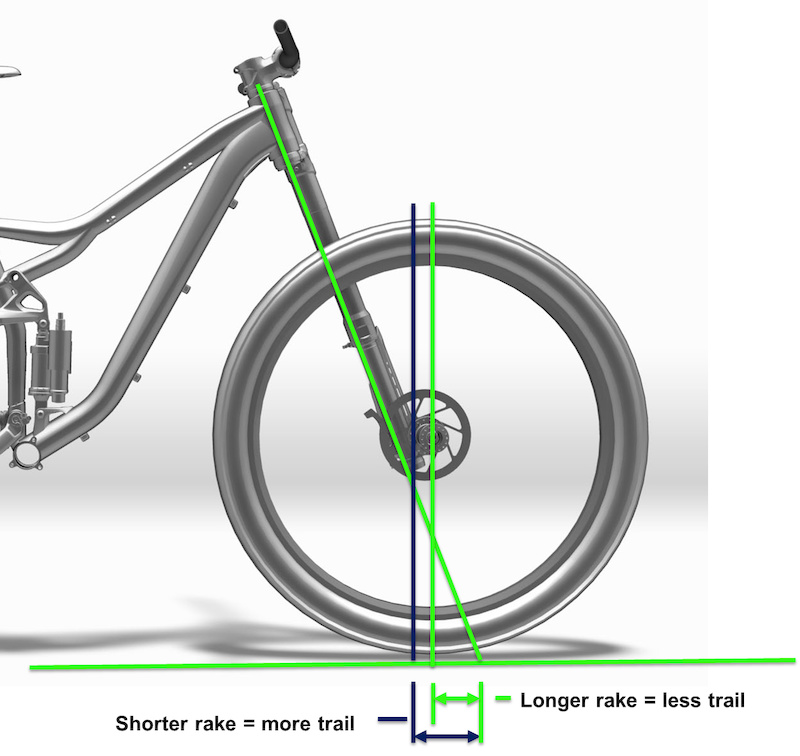
Anyway, learning to ride a moped was when I first consciously discovered countersteering. It made things a lot easier after that point.
1. Turn the steering wheel towards the lane you wish to enter,
2. Re-center the steering wheel,
3. Counter-steer the same amount as in step 1.
Step 3 is what people tend to forget about.
[1] https://99percentinvisible.org/episode/episode-37-the-steeri...
The author mentioned bicycles and inadvertently missed an opportunity to show another "unknown reality" that beautifully illustrates his point.
Consider typical adults (not physicists) with 20+ years of bicycle riding. If you ask them, "how does a bicycle turn?", they'd respond that "you just lean into the direction of the turn and it turns."
But that's not the complete picture of what actually happens.[1] If you were to capture the bicyclists with a high-speed camera, you'd notice that there's always a micro movement of countersteering to make the bike momentarily lose its balance and "fall into" the turn. Then there's an immediate correction of the steering to match the turn. This all happens in the span of milliseconds.
Even though the human body "discovered" the countersteering by way of kinesthetic feedback, the bicyclists' brains don't explicitly communicate this intermediate step to others. (Tacit knowledge.[2])
It's not always the case that we "simplify" reality for innocent purposes of pedagogy. (E.g. we tell "lies" to children about "numbers", "functions", etc and as they get older, we successively remove the layers of lies as they get into high school and college math.) Instead, we often don't even know the reality (e.g. bicycle countersteering) to consciously omit it.
That extra reality may not even be important. If one human is teaching another human, you can leave the "countersteering" detail out and it won't matter. The 200 years of people learning how to ride bicycles is evidence of that. However, if you're a robotics scientist and want to build a self-driven motorcycle, the reality of countersteering becomes a crucial detail.
[1] https://www.youtube.com/watch?v=llRkf1fnNDM
[2] https://en.wikipedia.org/wiki/Tacit_knowledge