Also, don't see how it would be the case that Americans or others lose faith in the dollar? Imagine tomorrow that it is revealed that the most core systems in the financial and banking industry were hacked 10 years ago and have been extensively manipulated by, say, Goldman Sachs. Or Walmart. Or whoever. Basically, any bank who says "there are 2 billion dollars in that account" fundamentally can't prove it. What then? When Walmart says 'we made $5 billion last year' and the rest of the world says 'prove it, and no we don't trust your funny-money IT systems'... what do we do then?
It wasn't a fleeting belief that caused Venezuela's hyperinflation, it was dutch disease wiping out most of their industry followed by oil prices plunging while demand for real goods and services remained static.
The level of spending outstripped the economy's ability to deliver, because the output of that economy is largely oil and oil suddenly wasn't worth very much any more (for reasons that had very little to do with venezuela).
Venezuela would be fucked for this reason with or without hyperinflation. Hyperinflation is simply a side effect of what they're going through. Gold-link their currency and people would be in just as much poverty thanks to their main export tanking - quite possibly even more.
The USD derives its value from an extraordinarily productive and innovative economy, that has led the world for a century, and has been the world's largest economy since the 19th century. The US economy has been highly functioning, and remarkably consistent on an averaged out basis, for approaching 200 years, more so than any other major economy. Venezuela's problem is precisely that their economy ceased to function properly, and its currency followed in line.
The US military exists solely because of that successful economy. One must inherently go before the other. US wealth and economic primacy did not originate from military strength, it originated overwhelmingly from trade, commodities, industry, invention during the 19th century. The US military was barely a third rate power when the US economy became the world's largest circa ~1890.
If military power played an outsized role in determining economic outcomes today, North Korea would be rich. Saddam's Iraq would have been incredibly affluent. Soviet Russia would have ruled the world economically. And Canada today would be bankrupt, as would Norway, Finland and Sweden. Japan would have wilted after WW2, instead they witnessed one of the greatest economic recoveries and booms in world history, almost entirely sans military; their boom wasn't because of Japan's ability to project military power. The US economy would not wilt if the US spent $450 billion (~2.3% of GDP) instead of $700 billion (~3.4% of GDP) on its military - the economy would benefit in fact, by redirecting resources to superior productive uses.
> What happens to the dollar when public consensus, trust and collective belief is weakened?
That has been a fantasy premise for about 3/4 of a century now. The Yen was going to crush the dollar. The Euro was going to overtake the dollar. The Yuan is going to crush the dollar. Meanwhile, dollar dominance is as strong as it has ever been. The US economy chugs forward, adding $600 to $800 billion a year in new economic output, still one of the core leaders in innovation and productivity. Venezuela's failure was one of State corruption and oppression, destroying any semblence of a functioning economic system, it's not because they needed a bit more military might to project with.
(An interesting lesson to take from the incredible energy consumption of Bitcoin is just how much trust is worth)
You may not need to trust that the central bank won't fire up its printing press, true. But you're absolutely trusting that someone somewhere will want to exchange your bitcoins for something other than bitcoins, and there's no inherent reason why they would.
I was replying to an argument that cryptocurrencies are superior to state-issued fiat because they don't require trust. IMO this is nonsense. Using anything with zero intrinsic value as a store of value is a gigantic leap of faith.
I trust USD issuing, the federal reserve, and American military for the most part (so does wall St, EU, Japan, and China).
They're just getting ready to take that system down to patch the WannaCry vulnerabilities, so you might want to check it quickly. They're not sure how long until they're back up.
Why do I trust it? Because it continues to work, can it fail? Sure, but there is little incentive for those in power to mess around as it would jeopardize the system.
> The money that never exists in any form other than on some computers
I'm not going to get into how money works - but your statement could be said about crypto, it only exists on some computer right? Just because it never existed before doesn't mean it won't have utility.
I think the legal system is the real place to fix things - there are certain mechanisms which influence how wealth works its way through the system. At the moment its misbalanced. It has little to do with the USD (well I benefit from USD, perhaps little countries elsewhere have a gripe with it).
The incentive for them does not extend to you, as illustrated in 2008. They fail, you pay.
Do you realize in our current economic climate that your dollar today is more valuable than the same dollar in 10 years? Would you like it to appreciate/depreciate in value as time goes on?
Bitcoin is a perfect hedge against the issues of state-issued currency.
The more likely it is for the institution to fail as the result of malfeasance, the more certain it is that any malfeasance would be covered up quickly and thoroughly.
Those systems also probably have more humans carefully monitoring their daily operation than any other kind of system anywhere. People really care about their money.
I'm not talking about inflation, I'm talking about political stability.
As we see in Venezuela, runaway inflation and economic collapse is the result of political instability and a collective loss of trust in leadership, not the cause.
US influence and power has been in decline since before 9/11, and the Iraq war showed that the US is on the wrong side of the inflection point.
This chart [0] demonstrates that the G-Zero [1] trend is accelerating.
[0] Global Leadership https://pbs.twimg.com/media/DT1e0feVoAA8Qd0.jpg:large
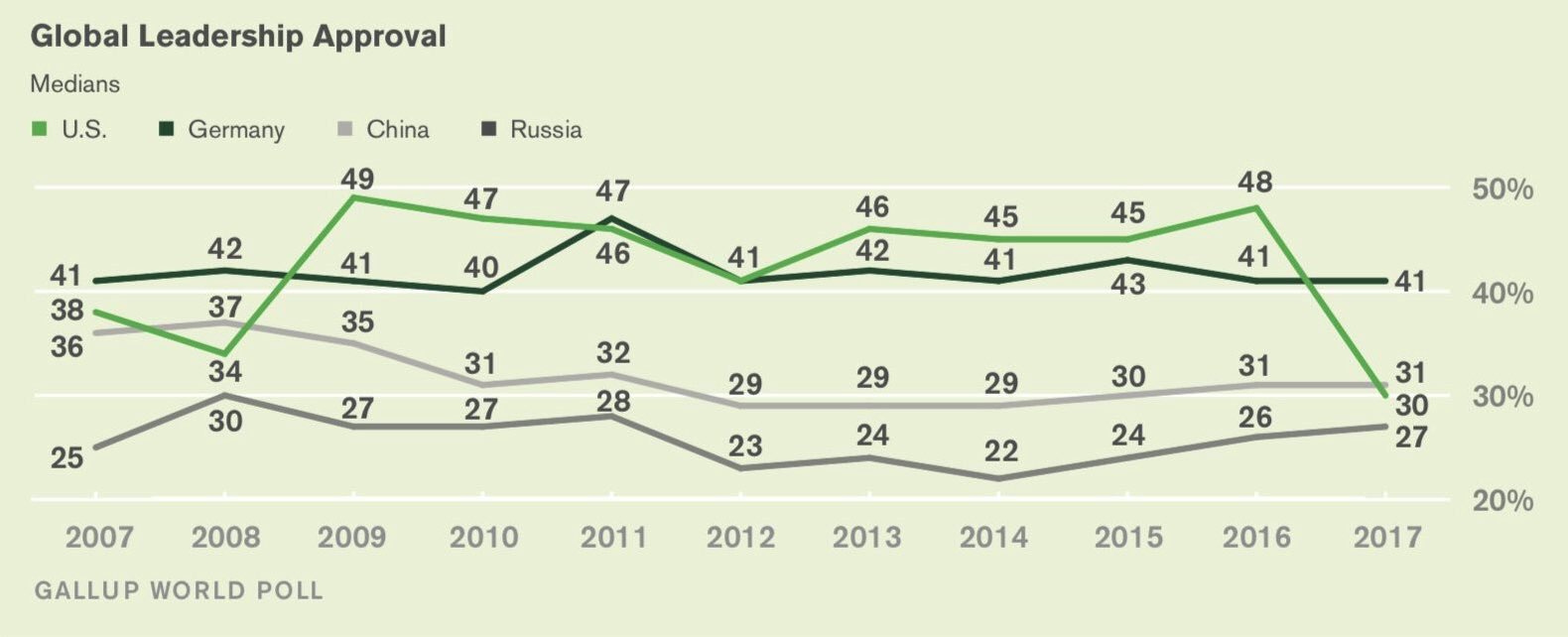
[1] G-Zero World https://www.foreignaffairs.com/articles/2011-01-31/g-zero-wo...
Of course, all good things come to an end eventually, and the US dollar hegemony really started after WW2. Crazy to think that a Soviet spy/asset (Harry Dexter White) helped setup the Bretton Woods accord which positioned the US dollar as the strongest in the world [0].
[0] "How a Soviet spy outmaneuvered John Maynard Keynes to ensure U.S. financial dominance" https://www.washingtonpost.com/news/wonk/wp/2013/03/14/how-a...
Crypto actually proves that money doesn't need to be backed by anything. It simply achieves value by being a) useful for transactions and b) scarce. The US dollar's scarcity is carefully handled by the Federal Reserve which is why it has stable value. In Venezuela, the government simply prints money to spend without a thought to managing scarcity, and hyperinflation is the natural result. Collective belief is important, yes, but it's simply a belief about the future scarcity of the currency.
Well no, since it's not used as currency in any meaningful scale.
This, IMO, is what economic bubbles are predicated upon. It's hard to build value in our economy as more people are pushed to the side, so let's give away home loans and tether people in with good feelings, based upon poor reasoning!
It started with an arbitrary collective belief; we all just want nuclear family type lives in these all-services included by nearby strip mall, burb communities. Which is ... patently untrue. But people need a home so if that's where the action is!
And some quaint or wonk starts to see through this with data, and invents credit default swaps.
It's a crappy example; I'm tired, no coffee, and this is HN, not some economic summit, the kernel of truth I believe is there is this: Bubbles are the result of pushing social norms into the purview of utilitarian decision making for the species as a whole.
Money is a purely social construct. It's only worth something when people collectively believe and trust that it's worth something.
It's a popular idea that dollars and euros derive their value because taxes are paid in that currency, or because it's backed by the state's military power.
Venezuela shows that neither of these are the source of the currency's value.
Collective belief is a pretty fragile foundation to build an economy on, hard to build and easy to destroy.
Another term for "collective belief" is "consensus". We're witnessing a disintegration of political and economic consensus not only in Venezuela, but also in the US.
What happens to the dollar when public consensus, trust and collective belief is weakened?
This is why I find the decentralized, trustless consensus of cryptocurrencies to be especially attractive at this moment in history.