* Bottlenecks are always being addressed. If you spend your time anywhere but the bottleneck operation, you're not increasing the capacity of the line.
* Quality issues can call back thousands of units and kill production for an afternoon. Hopefully the quality department catches everything, but without 100% testing they will be missing things. 100% testing of everything would drive costs up an insane amount, so sampling is done. Bad product slips through sometimes.
* The labor resources need to be effectively split so everyone is doing their task for the same period of time on the assembly line (and sub-assembly lines).
* Workers need to be trained and qualified for the positions they're doing. It could be as easy as 5 minutes of training on the new job content or as much as sending people to a training program because you can't hire the labor trained already.
* Fork truck drivers running into things can shut down an area during the accident investigation, preventing the typical restocking path (which is also finely timed out). Fork trucks run into things way more than most people would guess.
* Some production equipment breaks requiring unscheduled downtime. If you have redundant systems, you need to prioritize which units get processed next. You're already almost guaranteed to shut down production if you're running a lean operation.
* A supplier misses a delivery deadline. Especially on large assemblies like a car, you can't easily do more assembly and then add the part later. There's an order everything has to be assembled in. Yeah, you get to charge the supplier a shutdown rate, but that won't make your customer happy.
> This is a common challenge in lean manufacturing. Holding inventory is expensive in many ways, but having 0 on-hand inventory means every minor production hiccup is felt. Finding a balance to make supply chain, production, and management happy is a challenge.
* The sales people sold a product or feature which doesn't currently exist, so between design and production you've got to figure it out. Suddenly the line which was going to be streamlined with minimal product variety has 35 possible combinations rather than 4 and you have more logistics to deal with.
* A supplier abruptly stops supplying one of the products you are purchasing from them. You have 1 month to figure out a solution, send the trial runs through quality, write the work standards, etc.
* Procurement requests that a slightly different part is used from a supplier because it will save 5 cents/unit. Over 1,000,000 units that's $50,000 in savings. Do that on 15 parts in a big assembly and you're saving real money.
* The marketing campaign was more effective than anticipated, and demand for the next 3 months rose 25% (rather than the 10% boost anticipated). You now have to bump the production rate up an extra 15% which changes all the work instructions and line balancing, redo some workcells to allow for the increase in labor, increase traffic and congestion with the material handlers, buy/lease another fork truck, etc. There's a cascading effect. There's software which helps with the line balancing and possibly some of the internal material handling, but there's still some manual sanity checking of it all.
* The business is doing an IT transformation which can require anything from new/more computer systems on the line to completely retraining all of the staff on how to enter orders and production tracking into the system. Mentioning an ongoing Oracle installation will elicit condolences and heightened blood pressure from anyone who has been involved in one previously. I've seen Oracle implementations literally cause production employees of 20+ years walk off the job.
* The facility you're working in is land locked with no neighbor being willing to sell you land. Over 50+ years production lines were added, reconfigured, and removed. Shutting production down for 30 days to redo "everything" will cost tens to hundreds of millions of dollars and is only considered every decade or two.
That's a generalized list of issues I've seen while full time and on internships in a variety of industries.
Latency is a huge issue here. What you put into the Blast Furnace can take 8+ hours to propagate through. So when you are trying to react due to a quality issue can take a long time until you see the effect of the change you've just made. Online modelling and process simulation plays a big role here.
Supply is an issue as well getting an ore/coal shipment in can have 20+ day lead time. These boats are huge can take days to fully discharge them even things like docking space on the berth needs to be optimized and appropriately scheduled...
A lot of people can't grasp the sheer scale of our operation it is one thing to read a number on a page and another to walk the length of a conveyor and see what 500 Tonnes Per Hour actually looks like as it is going past you...
I think most people could look at one aspect and determine a fix for when that isn't working well, but it takes much more to understand how the whole system reacts and how to keep production going reasonably well.
Would you say there's a market for some kind of automatic braking / collision prevention addon for forklifts?
For safety, you have engineered controls and managerial controls (if I remember my training right). Engineered would be a system like you mention. The beam noted below is managerial. Engineered prevent the issue, managerial try to mitigate the issue (but it can still happen if procedure isn't followed).
Lots of the danger is caused by the lack of visibility forward. You'll actually see forklifts driving "backwards" a lot of the time. They can turn their head/back around and see almost full visibility.
Here's a view looking forward from the driver's perspective: http://www.cisco-eagle.com/blog/wp-content/uploads/2017/01/F... This one is showing off a camera system (never seen one in the 3 industrial settings I've worked in).

There are lights like this on many forklifts. They shoot a beam forward ~15-20 feet in front of or behind a forklift. They are super helpful for knowing where a forklift is before you turn a corner. https://sc01.alicdn.com/kf/HTB1nkQ0LFXXXXazXVXXq6xXFXXXx/202...
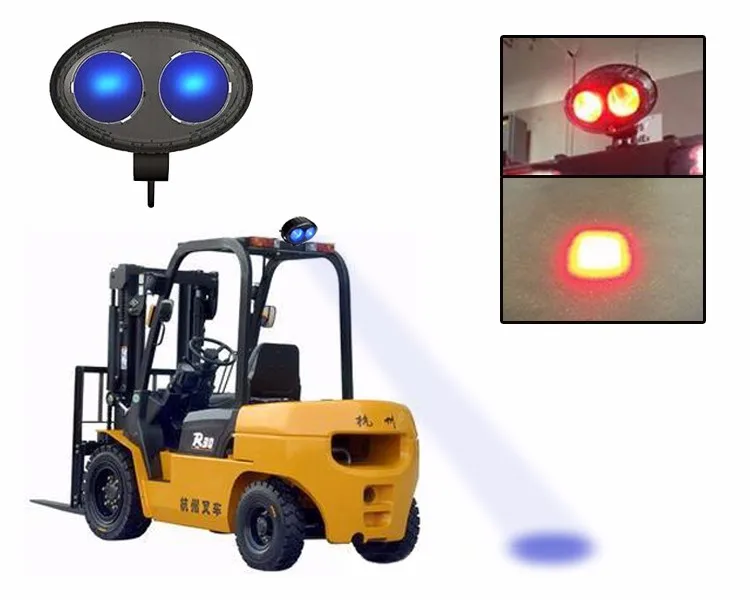
Mobile equipment injuries are often the largest reasons for First Aid's, OSHA recordables, and deaths in stereotypical "industrial" factories.
# Sad videos (NSFW)
Forklift driving over someone (dies): https://www.youtube.com/watch?v=7m_DOPex3CQ
Forklift lands on someone (likely dies): https://www.youtube.com/watch?v=aysU6PlUvJU
Factories to me are like software to software engineers.
* Complicated systems with certain requirements to meet (transactions/second | units/day)
* Uptime requirements (99.99% for some web services | 70% is great for really old equipment)
* Budget requirements (dev time cost | cost per unit)
* Unrealistic deliverables (seamless launch on a production server without testing in that specific environment | 110% capacity scheduled and ignoring the preventative maintenance outages that were scheduled)
* Changing requirements (Customer changed their mind on <major feature> | Marketing wants to launch the new product in 2 weeks rather than 3)
* A variety of demands and sub-optimal conditions (crappy server to deploy on | factory equipment from the 1940's)
* Appearance of simplicity to the uninformed ("UX mockup is done, so the software will be in production next week!" | "Just increase inventory levels and we wouldn't stock out our customers.")
* People with different incentives pulling for different objectives (Non-technical manager doesn't get why code isn't done on time | Production is pissed that Quality won't release a set of parts)
At the end of the day, looking at and understanding the larger system is what makes an industrial engineer or software engineer effective. At first glance it may not seem like doing <x> will make a big difference, but <x> can either be a simple fix that was overlooked earlier or it can mean undoing hundreds of hours of work. That's true in programming and on the factory floor.
# Other IE Things
ERGONOMICS: Haven't even mentioned that yet. Workplace injuries often fall into an IE/mfg eng. role as well. Rather than doing the exact same thing all day long, it's not uncommon to switch jobs with a coworker after 4 hours. This gives the muscles required for Job #1 a chance to recover and repair before they're damaged too much. Doing the same thing all day can lead to repetitive stress injuries (and is simply more boring).
Fixing Drawings: Lots of times the prints (part drawings) will have assumed tolerances such as +/- 0.01" for lengths. If the designer simply marks "18 inches", it must be 17.99-18.01". To achieve that on cutting stock material to length will require some pretty good measuring. If it would function fine at +/- 0.5", the cost of production just decreased significantly. Throw it into the bandsaw and quickly confirm with a tape measure and move on. Tolerances should be as loose as possible to still allow for full functionality of the part/assembly. Going any tighter than required drives the cost up very fast. This is a common battle between manufacturing engineers and mechanical/design engineers. At Iowa State the mechanical engineers were briefly introduced to Geometric Dimensioning and Tolerancing (GD&T) around sophomore year while the IE's had ~1/3 of a class focused on it. There are thousands of ME's who know nothing at all about tolerancing and are making products more expensive because of it. I'm kinda passionate about this one. Tons of stuff has horrible tolerances
Order Quantities: How many of each part should be delivered from suppliers? What's the economic order quantity? [1] We have formulas for some of the more straightforward questions in this area, but things can get more dicey with something as simple as a bulk order discount. Is it worth ordering a bit more to get a price break considering the additional warehouse space required? That little modification makes the decision much more difficult.
Part Presentation: How will everything be presented to the assemblers on the assembly line? Just the orientation of a part can have a big impact on how fast something can be assembled.
Assembly Assistance: How will the parts be held during assembly? What can be done to make the assembly faster? Not threading the entire length of the bolt, tapering holes so screws drop in almost effortlessly, jigs to hold the parts, dummy-proofed systems so the parts physically cannot be assembled incorrectly, reductions in the number of pieces, etc.
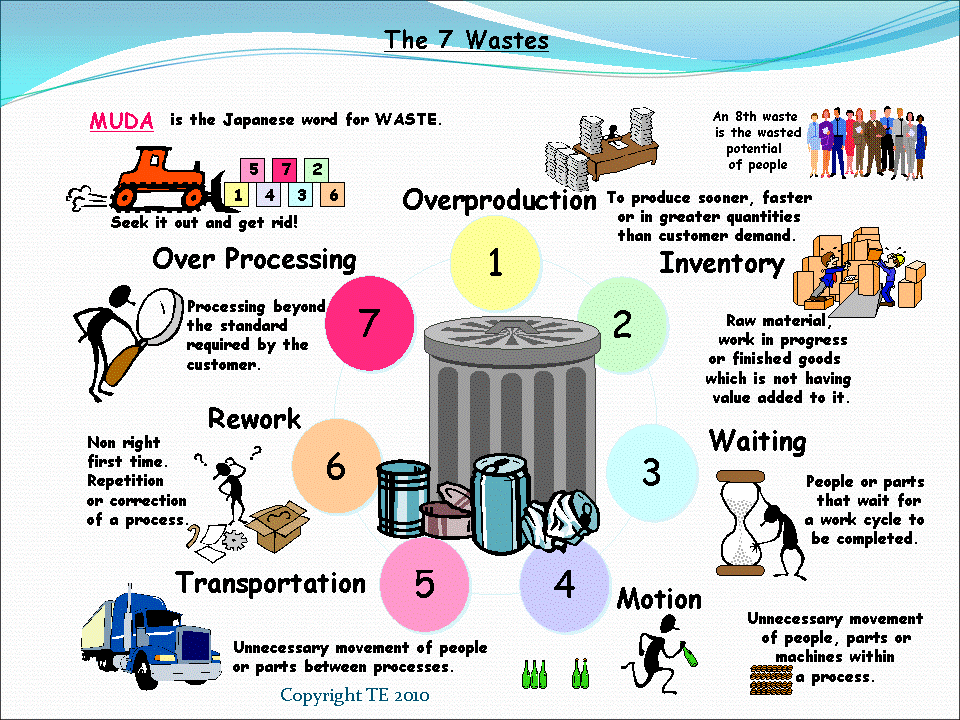
Reducing Waste: In lean manufacturing, there are 7 wastes: Overproduction, Inventory, Waiting, Motion, Transportation, Rework, and Over Processing. [2] Reducing or eliminating these has a substantial impact on profitability. If you have a 5% profit margin on widgets and you scrap a widget, you just wiped out the profit from 19 good widgets. Bad quality is expensive.
Project justification: We have $40 million available for CapEx. What should we do with it? We have a set of possible projects, what combination will get us furthest towards our overall goals? What's the payback time on the investments? If it's more than 2 years, it won't get approved in most companies. The 2 year ballpark changes based on how conservative the company is and the overall economy, sometimes dropping to a matter of a few months for full payback during recessions. These calculations involve working with finance and accounting to determine the value of investments taking into account wage rates, overhead, cost of the project, and the discounted cash flows going forward.
Optimization: Is the way we're doing things mathematically optimal? As my professor put it, you want to run your system optimizing on profit so that a competitor cannot come into the market, get all the same suppliers and deals, then beat you on profit or cost to the customer. Pages 3-14 of this presentation demonstrate the introduction to optimization accompanying his explanation of why it matters. [3] Additional sets of slides available at [4]
Produce in-house or outsource?: Outsourcing can sometimes mean a company which specializes in that particular type of part will make it. This can reduce cost because your company doesn't have to be the subject matter expert on everything. It's also harder to get a response from a vendor regarding a quality issue than someone inside your same company.
# The "E" in IE
Finally, to refute an argument I've heard too often, IE's (at least from Iowa State) are not basically business majors. I had more practical business info thrown at me than an Aerospace or Mechanical engineer typically would, but the coursework is largely similar to other engineering programs.
There are programs I know of in which IE's are glorified business majors, but the Iowa State program is "Industrial and Manufacturing Systems Engineering". ISU and Penn State in particular have a strong manufacturing emphasis. During undergrad, ISU IE's took Calc 1-3, DiffEq with laplace transforms, thermo 1, chem 1 (no lab), physics 1 and 2, materials engineering 1, and statics. Beyond that the engineering majors typically diverge into major-specific content.
For us, that includes classes on optimization, ergonomics, engineering economics, material removal processes (machining mostly), solidification processes (casting and injection molding with an awesome hands-on lab), engineering drawings, production systems (order quantities and stuff like that), stochastic systems (includes some factory simulation), quality assurance, and a rough 200 level calc-based statistics class.
I hope putting the info out there a bit more will make people more aware of the breadth of what we work on. I'm more than happy to answer any other manufacturing or IE questions.
[1] https://en.wikipedia.org/wiki/Economic_order_quantity
[2] http://leanmanufacturingtools.org/wp-content/uploads/2013/06...
[3] https://drive.google.com/file/d/0B4afywTc7GYfMGdoYm5ZcTdIU2s...
Back in my school IEs are called “Imaginary Enginners.” So they made shirts that said “We may be Imaginary Engineers but we’ll be your boss someday.”
I am putting together a few more examples in a sibling comment right now.