News for hackers. Stuff that matters.
Re:24/192 Music Downloads Are Very Silly Indeed (2012) by tomc1985 on Tuesday August 29, 2017 @05:30PM (#15127761)
While the extra quality is lost on listeners, from experience I've found that super-HQ source material can change your results (for the better) when fed through distortion/compression/warming effects processors
Re:24/192 Music Downloads Are Very Silly Indeed (2012) by sp332 on Tuesday August 29, 2017 @05:44PM (#15127861)
Sure, when you're editing music it can be helpful to have super high sample rates and lots of bits to work with. But for listening, it's just a waste of space.
Re:24/192 Music Downloads Are Very Silly Indeed (2012) by kobeya on Tuesday August 29, 2017 @05:55PM (#15127943)
He was talking about listening.
Re:24/192 Music Downloads Are Very Silly Indeed (2012) by sp332 on Tuesday August 29, 2017 @05:57PM (#15127962)
tomc1985 said "fed through distortion/compression/warming effects processors" which is editing, not listening.
Re:24/192 Music Downloads Are Very Silly Indeed (2012) by tomc1985 on Tuesday August 29, 2017 @06:05PM (#15128023)
Yeah, editing
Re:24/192 Music Downloads Are Very Silly Indeed (2012) by ioquatix on Tuesday August 29, 2017 @07:25PM (#15128486)
Lots of pre-amps can do this in real time, and some installation audio systems do it as part of pre-processing (e.g. compression, limiter, etc).
Re:24/192 Music Downloads Are Very Silly Indeed (2012) by jotux on Tuesday August 29, 2017 @06:44PM (#15128240)
This is specifically addressed in the link under the section titled "When does 24 bit matter?"
Re:24/192 Music Downloads Are Very Silly Indeed (2012) by mrob on Tuesday August 29, 2017 @05:34PM (#15127780)
Is that because of the HQ audio, or because the processing software introduces less artifacts at those sample rates/bit depths? I.e. could you get the same results by up-sampling CD quality audio?
Re:24/192 Music Downloads Are Very Silly Indeed (2012) by squeaky-clean on Tuesday August 29, 2017 @06:20PM (#15128134)
For distortion and compression, the only possible difference I can think of is aliasing, and yeah you could just oversample your input, then downsample again on the way out. This is really really common in most professional plugins, often with an adjustable amount to balance quality and CPU usage.

I also have some gear that aliases at a volume you can't hear, but when you plug it into an analog distortion pedal, the aliasing in the high frequencies becomes apparent. This would be avoided if it had a higher sample rate so the aliasing was far out of the audible range.

For other sorts of effects like spectral processing, pitch shifting, the extra detail above 22khz really does make a difference, especially if pitching down.

Re:24/192 Music Downloads Are Very Silly Indeed (2012) by TazeTSchnitzel on Tuesday August 29, 2017 @05:52PM (#15127913)
More bits means:

• Less quantisation noise, so your noise floor is a bit lower and therefore, when you're mixing stuff together, you accumulate less noise

• More numerical room to play with, you can scale or shift the volume up and down more without clipping and with less loss of accuracy

With 16-bit CD audio, you can't just convert to 24-bit and suddenly have less noise. You might get more room, though.

As for higher sampling rates (more kHz, if you will), I think Monty mentioned some benefit regarding less sharp aliasing filters (can have a larger transition band from 20–48kHz, say, rather than from 20—22.1kHz), but it's not something I understand the benefit of well.

Re:24/192 Music Downloads Are Very Silly Indeed (2012) by dspig on Wednesday August 30, 2017 @02:28AM (#15130084)
filters with a sharper cutoff will 'ring' more, smearing sharp changes in the signal out over time. It's a pretty subtle effect when it's all happening above 20 kHz though
Re:24/192 Music Downloads Are Very Silly Indeed (2012) by trevyn on Tuesday August 29, 2017 @05:44PM (#15127856)
I imagine it's because lossy codecs are tuned for human perceptual limitations, and when you process audio, it can "pull" areas of the sound that are otherwise hidden from your perception into perceptual ranges, analogous to how fiddling with the brightness/contrast of a highly compressed JPEG image can accentuate the artifacts.
Re:24/192 Music Downloads Are Very Silly Indeed (2012) by anyfoo on Tuesday August 29, 2017 @05:51PM (#15127905)
We are not really talking about lossy codecs here, though, are we?
Re:24/192 Music Downloads Are Very Silly Indeed (2012) by trevyn on Tuesday August 29, 2017 @05:54PM (#15127929)
Ah, my mistake. But perhaps you could consider 24/192 -> 16/48 a lossy codec in this context; the same argument does apply, for the same reasons.
Re:24/192 Music Downloads Are Very Silly Indeed (2012) by anyfoo on Tuesday August 29, 2017 @06:17PM (#15128114)
That way it does make sense, editing might require higher fidelity than we can perceive in the final project to avoid artifacts.
Re:24/192 Music Downloads Are Very Silly Indeed (2012) by kuschku on Wednesday August 30, 2017 @04:00AM (#15130450)
Actually, the article is not talking about it, but the topic very much is lossy codecs.

Specifically, if 24/192 AAC is worth it compared to 16/44.1 AAC (and the answer to that is yes, although the answer to 24/192 WAV is no)

Re:24/192 Music Downloads Are Very Silly Indeed (2012) by microcolonel on Tuesday August 29, 2017 @06:37PM (#15128207)
But what about lossless 16/44.1KHz audio? It's not a "compressed" version of 24/192Khz. Chances are that your 192KHz music will be low pass filtered anyway, 192KHz is a trick that sound chipset vendors added so that integrators wouldn't have to make high quality analog filters for their ADCs. There's likely nothing above 22.05KHz except shaped noise, production artifacts, and very, very quiet ultrasound noises which have nothing to do with the music.
Re:24/192 Music Downloads Are Very Silly Indeed (2012) by TheOtherHobbes on Tuesday August 29, 2017 @07:49PM (#15128597)
There's no such thing as lossless 16/44.1 because it's practically impossible to make an artefact-free antialiasing/reconstruction filter pair clocked at 44.1k.

The point of higher sample rates isn't to capture bat squeaks, but to relax the engineering constraints on pre-post filtering.

Nyquist is fine in theory, and if you've never actually tried to implement a clean filter you'll likely watch the xiph video and think "Well that makes sense."

If actually know something about practical DSP and the constraints and challenges of real filter design you're not going to be quite so easily impressed.

Likewise with higher bit depths. "Common sense" suggests that no one should be able to hear a noise signal at -90dB.

Common sense is dead wrong, because the effects of a single bit of dither are absolutely audible.

And if you can hear the effects of noise added at -90dB, you can certainly hear the effects of quantisation noise artefacts on reverb tails and long decaying notes at -30 to -40dB, added by recording at 16 bits instead of 24 bits.

Whether or not that level of detail is present in a typical pop or classical recording is a different issue. Realistically most music is heavily compressed and limited, so the answer is usually "no."

And not all sources have 24-bits of detail [1]. (Recordings made on the typical digital multitrack machines used in the 80s and 90s certainly don't.)

That doesn't mean that a clean unprocessed recording of music with a wide dynamic range made on no-compromise equipment won't show the difference clearly.

Speaking from experience, it certainly does.

[1] Technically no sources have 24-bits of detail. The best you'll get from a real world converter is around 22-bits.

Re:24/192 Music Downloads Are Very Silly Indeed (2012) by microcolonel on Wednesday August 30, 2017 @08:30AM (#15131519)
> you'll likely watch the xiph video and think "Well that makes sense."

What video? This thread is about an article.

> The point of higher sample rates isn't to capture bat squeaks, but to relax the engineering constraints on pre-post filtering.

I just said that, I think.

Re:24/192 Music Downloads Are Very Silly Indeed (2012) by davidgerard on Tuesday August 29, 2017 @06:35PM (#15128198)
Because modern production can involve hundreds or even thousands of digital effects. So 24-bit, or even 32-bit float just because you can, is standard.

As Monty demonstrates, it's a fraudulent waste to try to sell the result as a product to the end listener.

Re:24/192 Music Downloads Are Very Silly Indeed (2012) by tomc1985 on Tuesday August 29, 2017 @05:45PM (#15127868)
I think it's because processes that affect things at the individual sample level (which distortion/compression often do) have a lot more detail to work with. The author mentions this a bit in the article
Re:24/192 Music Downloads Are Very Silly Indeed (2012) by acchow on Tuesday August 29, 2017 @05:35PM (#15127788)
> Its playback fidelity is slightly inferior to 16/44.1 or 16/48, and it takes up 6 times the space.

The article is highly technical. Does anyone have a way to describe this phenomenon intuitively?

Re:24/192 Music Downloads Are Very Silly Indeed (2012) by hamandcheese on Tuesday August 29, 2017 @05:41PM (#15127833)
24/192 can capture audio well beyond what we can hear. These sounds can, though, lead to distortion that is within our hearing range, depending on the equipment used.

Therefore, rather than just being useless extra data, it can be actively harmful to the listening experience.

Re:24/192 Music Downloads Are Very Silly Indeed (2012) by tomc1985 on Tuesday August 29, 2017 @05:48PM (#15127891)
It's not that much different to think of than 480p vs 4K/2160p -- dramatically higher resolution, increasing the width and length of the 'grid' that sound is recorded into -- except that in the case of audio fidelity, quality after a certain point causes problems with playback systems, resulting in audible artifacts and distortion.
Re:24/192 Music Downloads Are Very Silly Indeed (2012) by pzone on Tuesday August 29, 2017 @06:02PM (#15127992)
That analogy works if you modify it:

- 480p vs 2160p is measuring the resolution of your cell phone propped up on a pillow at the other end of your living room

- experimental evidence shows that your eyesight is not good enough to pick up on the increased resolution, you've maxed out your sensory perception

- Your phone stutters trying to stream at 4k so the playback might actually be worse.

Re:24/192 Music Downloads Are Very Silly Indeed (2012) by mohn on Tuesday August 29, 2017 @10:24PM (#15129285)
The analogy with images is demonstrated in this screenshot [1], which is referenced in a StackOverflow answer on the topic of image scaling in web browsers [2].

When the high resolution image is downscaled poorly, some high (spatial) frequencies are aliased down into lower (spatial) frequencies, manifesting as blocky/jagged lines. The images are 2D data in the spatial domain, while the audio is 1D data in the temporal domain, but the aliasing of high frequency signal to lower frequency artifact is similar.

Viewing a high resolution image on a panel that has enough pixels to display it without scaling is analogous to listening to 192 kHz audio on a fantastic speaker system that can reproduce those high frequencies accurately, instead of causing distortion by aliasing them to lower frequencies. On the other side, viewing a high resolution image which has been downscaled poorly is analogous to listening to that 192 kHz audio on a realistic speaker system that cannot reproduce high frequencies, which results in those signals aliasing down into the audible range.

And as you say, there is a point where, for the viewer/listener's sake, it doesn't make sense to push for higher frequencies because even if you can build a panel/speaker that will faithfully reproduce those frequencies without aliasing, the eye/ear will not be able to perceive the additional detail.

[1] http://www.maxrev.de/files/2012/08/screenshot_interpolation_...
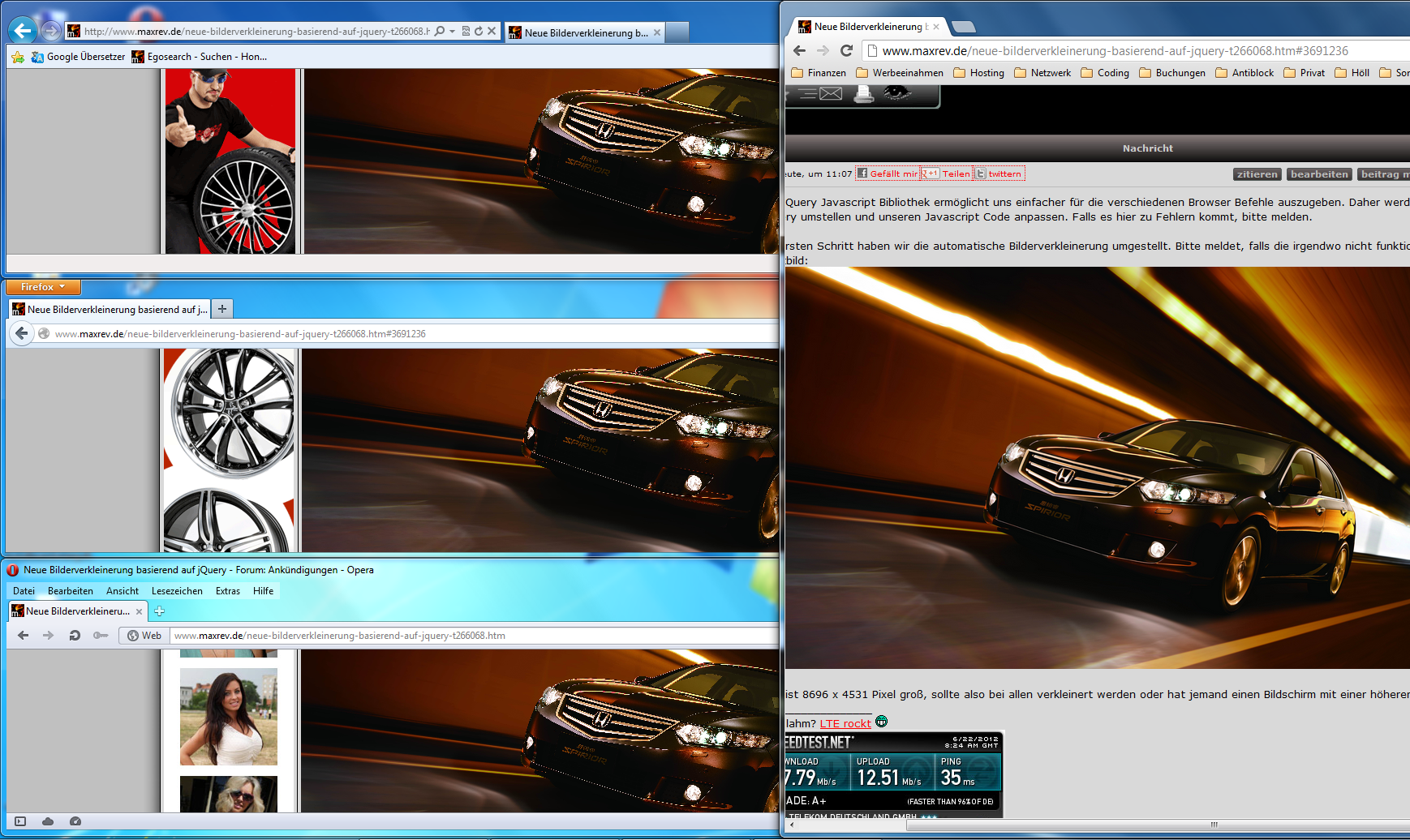
[2] https://stackoverflow.com/a/11987735

Re:24/192 Music Downloads Are Very Silly Indeed (2012) by dom0 on Wednesday August 30, 2017 @03:59AM (#15130443)
Technically this is not aliasing; rather, the large and varied non-linearities of a speaker can act like a frequency mixer, which is why you'll get a 3 kHz sound (the difference) when playing, say, 20 and 23 kHz.
Re:24/192 Music Downloads Are Very Silly Indeed (2012) by tomc1985 on Tuesday August 29, 2017 @06:07PM (#15128039)
All good points! Indeed all that extra data makes the decode stage that much more difficult. Same happens with audio too, but high-res audio isn't nearly as bulky as video or nearly as resource-intensive to decode
Re:24/192 Music Downloads Are Very Silly Indeed (2012) by DigitalJack on Tuesday August 29, 2017 @08:54PM (#15128883)
very good analogy.
Re:24/192 Music Downloads Are Very Silly Indeed (2012) by lgunsch on Tuesday August 29, 2017 @06:58PM (#15128309)
Increasing the bits doesn't increase the accuracy of the audio in terms of frequencies. It's 100% accurate regardless of bits. That's why trying to compare it to video resolution doesn't work. Bit depth is more akin to the screen brightness. If you turn down the brightness to 1 step from black, it's impossible to distinguish features in the image.
Re:24/192 Music Downloads Are Very Silly Indeed (2012) by acchow on Tuesday August 29, 2017 @07:03PM (#15128337)
But weren't those "outside our hearing range sounds that can distort our hearing range" present in real life when the recording was made? So I would have heard the distortions had I been there in real life?
Re:24/192 Music Downloads Are Very Silly Indeed (2012) by enneff on Tuesday August 29, 2017 @07:14PM (#15128408)
The problem is that your speakers were not designed to reproduce sounds at those frequencies, so instead of faithfully reproducing those sounds (that you can't hear anyway) they may emit unintended artifacts/distortion (that you can hear).
Re:24/192 Music Downloads Are Very Silly Indeed (2012) by rcthompson on Tuesday August 29, 2017 @07:19PM (#15128446)
The distortions are not present in the source. They occur because the speaker is a physical device subject to physical limitations and can't perfectly reproduce the waveform. In the process of trying to reproduce the ultrasonic signal, the speaker can produce audible distortions. If the ultrasonic signal is not there to begin with, then it can't possibly cause distortion.
Re:24/192 Music Downloads Are Very Silly Indeed (2012) by gothroach on Tuesday August 29, 2017 @07:16PM (#15128429)
The distortions he's talking about would be introduced during playback by DAC, signal processing, speakers, or amplification.
Re:24/192 Music Downloads Are Very Silly Indeed (2012) by zkSNARK on Tuesday August 29, 2017 @05:48PM (#15127892)
I doubt that is the case. Most systems which I have used actually sound better at the higher sampling rates. This is not because the sampling rates cause anything to sound better, but because the hardware works better at those rates. In a blind test, you wouldn't be able to decide which one you liked better, only that there is a difference. At least on the machines I have, there are some clearly audible differences.
Re:24/192 Music Downloads Are Very Silly Indeed (2012) by nullc on Wednesday August 30, 2017 @02:46PM (#15134799)
> you wouldn't be able to decide which one you liked better, only that there is a difference.

Yet people have been reliably _unable_ to do this.

The gold standard in listening tests for this is an ABX where you are simply trying to show that you can discern a difference.

When properly setup and calibrated people are unable to show that they can distinguish 48kHz and 192kHz.

Moreover, by the numbers, audio hardware tends to work less well at higher rates if they're different, because running them at higher rates makes their own internal noise shaping less powerful. (Though for anything done well the distinction should still be inaudible).

Finally, if you do have cruddy converters that sound significantly different at different rates nothing stops you from using a transparent software resampler (SSRC is well respected for good reason) to put the audio at whatever rate you want.. until you get better hardware. :)

Re:24/192 Music Downloads Are Very Silly Indeed (2012) by SmooL on Tuesday August 29, 2017 @05:54PM (#15127927)
"In a blind test, you wouldn't be able to decide which one you liked better, only that there is a difference"

That would have to be the noise. The math doesn't lie...

Re:24/192 Music Downloads Are Very Silly Indeed (2012) by zkSNARK on Tuesday August 29, 2017 @06:04PM (#15128013)
I'm not talking about noise or other artifacts from the conversion process. I am talking about differences in bass and treble balance that come from different engineering in the converters at different frequencies. In some converters, there are actually completely different circuits that engage for different frequencies. The converters that I have experienced do this, and they all have a noticeable effect on what we hear.
Re:24/192 Music Downloads Are Very Silly Indeed (2012) by pizza234 on Tuesday August 29, 2017 @05:45PM (#15127873)
The core is here: https://xiph.org/~xiphmont/demo/neil-young.html#toc_1ch

When you play something stored at 44 khz, there are no ultrasonic sounds recorded. At 192 khz instead, there are, and the speakers may push some of the ultrasonic sounds down to the audible spectrum, causing distortion that the human ear can hear.

Re:24/192 Music Downloads Are Very Silly Indeed (2012) by rubatuga on Tuesday August 29, 2017 @06:32PM (#15128184)
It’s mostly because speakers aren’t the best at reproducing ultrasonic frequencies that are captured by the high resolution audio files. You might have components of the speaker that have resonances that manifest the ultrasonic frequencies at a lower frequency.

Imagine the normal operation of a speaker as a swing, except you are pushing and pulling the swing all throughout the cycle as it goes up and down. Now, you can technically move the swing at a variety of frequencies if you’re holding onto it the whole time. However imagine as you push it back and forth (low frequencies), you also vigorously shake the swing at the same time (high frequencies). This would probably result in the chains rattling, similar to the unwanted distortions in the speakers caused by ultrasonic frequencies.

Re:24/192 Music Downloads Are Very Silly Indeed (2012) by fusiongyro on Tuesday August 29, 2017 @05:42PM (#15127843)
Basically, the sampling theorem says you can reconstruct the exact waveform with a certain number of samples. Adding a bunch more samples bulks up the file, but you didn't need them to restore the exact waveform. However, the unnecessary samples are in the file between you and the next sample you do need. At high enough levels of waste this creates an I/O bottleneck that hampers performance.

Another way to look at is that digital audio is not like digital imaging. There aren't pixels. Increasing the data rate does not continue to make the waveform more and more detailed to human auditory perception in the way that raising the pixel density does for human visual perception.

To describe it intuitively, forget your intuition that audio is like visual and start from "there is no metaphor between these two things."

Re:24/192 Music Downloads Are Very Silly Indeed (2012) by willglynn on Tuesday August 29, 2017 @05:51PM (#15127908)
Digital imaging definitely has sampling concerns too:

https://en.wikipedia.org/wiki/Aliasing

Even analog imaging has concerns that are better described in the frequency domain than the spatial domain:

https://en.wikipedia.org/wiki/Airy_disk

https://en.wikipedia.org/wiki/Optical_transfer_function

Re:24/192 Music Downloads Are Very Silly Indeed (2012) by fusiongyro on Tuesday August 29, 2017 @05:55PM (#15127932)
Interesting!
Re:24/192 Music Downloads Are Very Silly Indeed (2012) by astrange on Tuesday August 29, 2017 @09:01PM (#15128920)
Images and audio are pretty similar, and sampling theory works for both - a low-pass filter on audio and a blur filter on images is the same.

The difference is audio is "actually" bandlimited and frequency-based, but images are "actually" spatial. When you try using frequency math on images you get artifacts called ringing, which are easy to see with JPEGs or sharp scalers like Lanczos.

Of course audio isn't really frequency-based either, or else it would just be one sound repeated forever. So there's still ringing artifacts (called "pre-echo") and cymbals are the first to go in an MP3.

Re:24/192 Music Downloads Are Very Silly Indeed (2012) by dom0 on Wednesday August 30, 2017 @04:03AM (#15130464)
> The difference is audio is "actually" bandlimited and frequency-based, but images are "actually" spatial.

I.e. audio is sampled along one dimension, while images are sampled along two dimensions. Note that frequency-domain considerations play a crucial role in all optical design, including imaging sensors.

Re:24/192 Music Downloads Are Very Silly Indeed (2012) by astrange on Wednesday August 30, 2017 @11:02PM (#15137871)
It's a little more than that. A sine wave originates in the frequency domain but actually sounds like something, but images originating in the frequency domain are just noise and not pictures of anything.
Re:24/192 Music Downloads Are Very Silly Indeed (2012) by josteink on Wednesday August 30, 2017 @12:56AM (#15129809)
> Another way to look at is that digital audio is not like digital imaging. There aren't pixels.

For the mathematically inclined, this would probably be a good time to repeat: pixels are not little squares[1].

[1] http://alvyray.com/Memos/CG/Microsoft/6_pixel.pdf

Re:24/192 Music Downloads Are Very Silly Indeed (2012) by sitharus on Tuesday August 29, 2017 @05:47PM (#15127890)
> Increasing the data rate does not continue to make the waveform more and more detailed to human auditory perception in the way that raising the pixel density does for human visual perception.

Early low data rate codecs - such as the one used for GSM mobiles - are obviously inferior, but still functional. I think a better analogy is that an iPhone 7 has a 1 megapixel screen, so there's no difference between a 1 megapixel image and a 5 megapixel image, except one is much larger. Of course visually you can zoom in (or move closer in real life), but audibly you can't.

Re:24/192 Music Downloads Are Very Silly Indeed (2012) by fusiongyro on Tuesday August 29, 2017 @05:54PM (#15127922)
I get what you're saying, that if you remove the ability to zoom you can equalize things, but without that twist I think this preserves the essential problem with the analogy that Monty works so hard to correct. If your data rate is too low, you don't have enough samples to recreate the waveform. So you create an approximate. But there is a finite number of samples that you need to recreate all of the information in the waveform, so once you have that, there isn't any additional information there for you to obtain if you continue to increase the sample rate.
Re:24/192 Music Downloads Are Very Silly Indeed (2012) by DigitalJack on Tuesday August 29, 2017 @08:58PM (#15128905)
To be fair, phone audio signals have until recently been bandlimited to just a few KHz in centered around 3KHz.
Re:24/192 Music Downloads Are Very Silly Indeed (2012) by mikewhy on Tuesday August 29, 2017 @05:38PM (#15127809)
"Diminishing returns"?
Re:24/192 Music Downloads Are Very Silly Indeed (2012) by kazinator on Tuesday August 29, 2017 @09:36PM (#15129069)
In the amplitude domain, you definitely need more bits for that type of processing, and many other types.

Digital distortion basically simulates high gain with soft clipping, which basically takes a narrow slice of the amplitude domain and magnifies it. The extra resolution has to be there for that not to turn into ugly sounding shit with artifacts.

Re:24/192 Music Downloads Are Very Silly Indeed (2012) by InclinedPlane on Tuesday August 29, 2017 @07:00PM (#15128320)
Well, yeah. For properly mixed audio, you don't need anything beyond 44-khz/16-bit. If you need to do extensive processing, or you're working with raw audio and want the extra margin to be able to recover a sound when it may be too quiet (or too loud) or otherwise compromised then more samples and greater bit-depth can be highly useful.
Re:24/192 Music Downloads Are Very Silly Indeed (2012) by dangayle on Tuesday August 29, 2017 @08:17PM (#15128726)
It's also great if you you're doing a bunch of time/pitch mangling.
Re:24/192 Music Downloads Are Very Silly Indeed (2012) by jchanimal on Tuesday August 29, 2017 @07:56PM (#15128628)
I've heard (and it passes the smell test) that even if your ears can't resonate at frequencies higher than human hearing, the space you are in can, and your ears are sensitive to the differences in arrival time that are smaller than the pitches we can't hear. So at least in high sample rate music the imaging could potentially be cleaner. Assuming super great everything else.
Re:24/192 Music Downloads Are Very Silly Indeed (2012) by __david__ on Tuesday August 29, 2017 @08:19PM (#15128735)
That's one of those things that sounds true without putting thought into it but is ultimately false. A 44.1kHz sampled sounds can encode phases with offsets smaller than 22µs (1/44.1k). How much smaller? I'm not exactly sure, but I believe it's dependent on your sample size. My guess is 1/2^16 (assuming sample resolution of 16 bits), but I might be off by a factor of 2 (or indeed 100% wrong) there. Caveat emptor. If I'm right then that's 346 pico-seconds, which I'm betting is smaller than your brain can differentiate.
Re:24/192 Music Downloads Are Very Silly Indeed (2012) by danadam on Wednesday August 30, 2017 @09:58AM (#15132163)
The formula, as far as I could find, is:

1 / (2 * pi * bandwidth * 2 ^ bitdepth)

So for full scale 44/16 signal it is about 0.1 nanosecond.

More here [1]. There are also some sample files for ABX tests there.

[1] - https://hydrogenaud.io/index.php/topic,108987.msg896449.html...

Re:24/192 Music Downloads Are Very Silly Indeed (2012) by stephen_g on Tuesday August 29, 2017 @08:19PM (#15128730)
What you're sort of describing - having more of the higher frequencies resonate together - can actually cause intermodulation distortion (which itself can be in the audible range), which can make it sound worse...

I haven't had time to check the linked article but if it's the one I'm thinking of I'm pretty sure it goes into this.

In the end though, double blind testing (again, I think mentioned in the article) shows that there's a threshold (a bit below 48kHz, probably why 44.1kHz was chosen for CD audio) after which people cant distinguish between higher sample rates at any more accuracy than randomly guessing.

Re:24/192 Music Downloads Are Very Silly Indeed (2012) by jchanimal on Wednesday September 06, 2017 @06:52PM (#15187786)
I think it's the intermodalation distortion or as I call it "the room sound" that your non-conscious mind perceives. The best example of this I've heard is when listening to identical masters on SACD/DSD vs PCM audio. Notably different sound when reproduced via loudspeakers.
Re:24/192 Music Downloads Are Very Silly Indeed (2012) by hatsunearu on Tuesday August 29, 2017 @10:27PM (#15129294)
Arrival time differences are essentially phase shifts and assuming infinite quantization you can encode phase shifts with infinite accuracy on a band limited sampled system.

So no.