And you are also making the assumption that only Europe can contribute to innovation, and Africans can only be a burden on their neighbors and will never become contributors.
I would agree that if the solving of a crisis like Malaria results in population growth, we need to plan on success and also focus on supporting infrastructure for those people.
But I think you are saying something much more horrific. Maybe work with your therapist on empathy.
We need someone as smart as you to focus on making the world a better place for everyone, not using your intellect to make scientific justifications for genocide.
I'm surprised if the post read as "more children dying is the obvious optimal path," that wasn't my intent.
I'm meaning to draw attention to the fact that if we are going to have outside interventions into societies that have drastic effects on those societies, then the outside interventions should include plans for all foreseeable(and vigilance in watching for unforeseeable) drastic effects they incur, be they in population structure, political structure, etc.
In this case birth control education seems a prudent corollary plan to disease eradication. But it's more of a thorny problem than just saying here read this book, take this class, take this pill, if these reproduction strategies are expressions of deeply ingrained genetic tendencies.
Certainly birth rate in the western world has declined, but there are lots of differences in the western world and Africa. Not least of which westerners never had outside interventions into their culture and environment of this nature.
I think for the most part, the nature of the issue just makes it inherently open to objections of "bedside manner" when discussed in "polite society."
What do you think I could have done better in terms of phrasing or what have you?
It's not a perfect example but it's an easy way to show that you are thinking about other people and what they might be thinking. You can combine this with an invitation for people to voice their opinions. People like knowing that their opinion is valuable especially when your assertions put the reader at odds with their own opinions.
Just a few things I've found help internet discussions. People read things with different voices and diffferent inflections so it's important to be explicit when possible, especially on a subject that is truly difficult to discuss in polite company.
You had thoughtful comments about women in tech, crypto currency, and some others I liked as well.
We share a lot of the same opinions, I just want to make sure we are not proving the ammo for the next Dr.Gobells.
In both cases I don't think the "civilized" neighbor continent is enjoying the benefits of its poorer neighbor. There is an equal argument to be said that by eradicating these diseases that the poorer neighbor is able to pull itself out of that poverty.
Regardless, history is filled with population surges and mass societal disruption -- I am sure we can resolve it over time.
Does an African neighbor qualify? European only? etc
[0]https://www.gatesfoundation.org/Who-We-Are/Resources-and-Med...
http://static2.businessinsider.com/image/55d38ec0dd089595388...

In response to the specific fear you mention, while this may be possible, I would consider it more important to successfully eliminate Malaria than to not do so for fear of the negative repercussions you raise. I think it is both more uncertain and more unlikely for those negative consequences to materialize in such a way that leaves humanity and leaders unable to respond adequately.
[1] https://en.m.wikipedia.org/wiki/Horizon_effect
(edited for typos)
It is certainly good to consider this perspective, thanks for the insight and link.
To me it seems that potential negative consequences of continued rapid population growth in Africa aren't so nebulous and beyond the horizon, we are already seeing them materialize, certainly there are other problems that need to solved as well, like certain elements of society attempting to browbeat others into thinking these societal disruptions are normal or acceptable or shouldn't be guarded against, but the population growth outside Europe is one of the prime movers of the negative effects we have already observed.
If things continue as they are the only uncertainty is the degree to which European civilization and thus European civilization's contribution to the world is negatively effected.
I harbor no affinity for Malaria or human suffering in general, but by ham handedly addressing this patch of suffering are we pulling open a larger patch somewhere else?
So what's the best way to address the suffering caused by malaria with a little more finesse and awareness?
Is there even a direct provable causal link between mosquito nets and population growth?
As mentioned, we are discussing an immensely complex system with all the surprises and non-linearity that entails.
what, if any, are other causes of African population growth?
What should be the Hippocratic Oath for philanthropy?
"First do no harm" is taken, "Secondarily no harm"?
How many steps toward the horizon should we take to determine if harm is occurring?
For example, consider the hypothetical scenario where a cure for Malaria is spontaneously discovered and rolled out in Africa. Suppose, then, that in the few years following the end of Malaria, African population economists argue that an explosion is in play, to the point where the country cannot hope to continue to support itself into the future. In this scenario, I find it hard to imagine that even the most austere and strictly enforced population control program could not match the rate at which the population would increase due to the elimination of Malaria. Moreover, I would not expect that even in the hypothesized scenario, such austere measures would need to be enforced, although I will leave that to the economists and public health experts to figure out. I would suspect that most people would prefer a reality in which Malaria does not exist, but every family in Africa is only legally permitted to have one child, than a reality in which no restrictions on family size are imposed, but Malaria remains a top killer.
The point I am making here is that this is very much a real-time system, in the sense that action can be taken as soon as it is suspected that negative effects may be growing. If such negative consequences are to arise, we are not committed to a downward spiral without intervention. Furthermore, I would consider it unlikely that the rate at which the population would grow as a result of eliminating one of the leading causes of death is so great such that no intervention by the African people can keep the "net good" of the scenario positive.
(Let us suspend, for the sake of argument, the thorny path of quantification of good - suppose we use QALYs, with some simplified metric for human quality of life that is defined in such a way that makes comparisons meaningful)
So if European society suffers mass upheaval and disruption in coming years owing to causes we can plainly see at present, how many more of these monumental, universally beneficial innovations and achievements will die in the crib?
That's the premise of population forecasters at the UN.
I genuinely don't understand the premise of your questions. Why would people start leaving Africa, and why would it be a problem if they did?
Why would people start leaving Africa, and why would it be a problem if they did?
Are you completely unaware of events that have been transpiring in Europe the past couple years?
Edit: I phrased this a little wrong, the source of the current refugee crisis is mostly not Africa, but my point is that the societal disruption you're referring to is not caused by voluntary immigration.
As respectfully as possible, this is completely wrong.
https://www.google.com/search?q=migrant+crisis+economic
I phrased this a little wrong, the source of the current refugee crisis is mostly not Africa, but my point is that the societal disruption you're referring to is not caused by voluntary immigration.
Not even the majority of unauthorized border crossers into Europe are from Syria. Once again with all due respect, these are very definitely voluntary actions on the part of the border crossers.
Check out this article from 2 years ago, even then it wasn't primarily Syrians.
https://www.theatlantic.com/magazine/archive/2015/07/closing...
The migrants come from a vast swath of Africa and the Middle East, spanning not only war-torn Syria (in the first four months of 2015, Syrians accounted for just 30 percent of those crossing the sea) but also Nigeria and the Gambia and Eritrea and Somalia and Mali.
The migrants who embark upon this journey are typically represented as terrorized and impoverished—as people driven (to quote Amnesty International) “to risk their lives in treacherous sea crossings in a desperate attempt to reach safety in Europe.” The demographic and economic facts complicate that story. When populations flee war or famine, they generally flee together: the elderly and the infants, women as well as men. The current migrants, however, are overwhelmingly working-age males. All of them have paid a substantial price to make the trip: it can cost upwards of $2,000 to board a smuggler’s boat, to say nothing of hundreds or even thousands of dollars to travel from home to the embarkation point in the first place. Very few of the migrants from Libya are actually Libyan nationals.
I'll fall back to my other question then, why would people leave? I was looking at this image: https://en.wikipedia.org/wiki/European_migrant_crisis#/media...

It seems like most migrants at the moment are not from Africa. If their motivations are mostly economic, we would expect the numbers to rise in proportion with the population, right? And they would be tempered by economies improving as their citizens get healthier and more productive and they stop having to fight and treat malaria. After some time, people will adapt to having healthier children and the rate of population increase will get lower.
I'm just not seeing this imminent crisis of exploding numbers of African migrants, and I don't see how the issues of integrating people could possible outweigh the benefits of people not dying.
I also have some issues with what qualifies as "mass societal disruption", but I guess that's mostly a semantics argument.
The data on that map is from 2015.
If you want to read about migrant/illegal border crossers from Africa in recent years, italy has been bearing the brunt of it.
https://www.google.com/search?q=italy+migrants
Here's a recent video from a spanish beach that looks like some kind of absurdist theater. https://www.youtube.com/watch?v=xA02zZCGTdk
I also have some issues with what qualifies as "mass societal disruption", but I guess that's mostly a semantics argument.
How about pre-meditated and coordinated sex attacks with 1000+ perpetrators?
This was hardly an isolated incident, just one of the more shocking in scale and brazen in execution.
https://www.google.com/search?q=new+year%27s+eve+cologne
Societal disruption needn't be limited to large scale events like the above, just the steady flow of increased crime disrupts and degrades society. https://www.google.com/search?q=migrant+crime
This leads to surreal situations like in Germany, where asylum seekers went for holidays in the countries they had "fled" from in the first place. Everything on welfare payment, and the legal explanation was some convoluted "they have a human right to go back to their own country" kind of argument.
That was probably true in the past, but that doesn't seem to be the case anymore:
"The UN has said that seven in 10 people crossing the Mediterranean from Libya are economic migrants and the rest are 'people in need of protection' like refugees and asylum-seekers."
http://www.dailymail.co.uk/news/article-4661866/amp/UN-says-...
https://ichef.bbci.co.uk/news/624/cpsprodpb/12FDB/production...
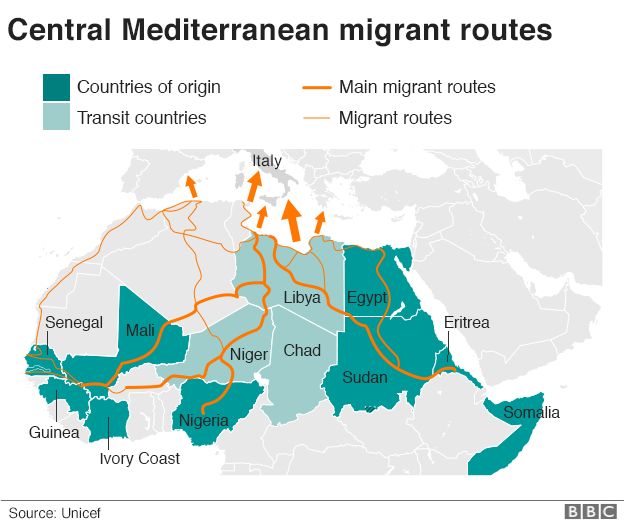
It seems that clear-cut numbers that do not fit the "women & children escaping war-torn Syria" narrative have a tendency to get down-voted...
This is what happens when you either have no empathy in your worldview or an extreme racial bias.
If great efforts are made to eradicate diseases in an area that has historically been subjected to various diseases such that the local population has adopted the reproduction strategy of having large amounts of offspring to counter premature deaths, but upon eradication/reduction of said diseases there is significant delay in the abatement of the overproduction strategy if it abates at all http://www.unz.com/isteve/the-worlds-most-important-graph/
if this population surge then expands beyond it's historical borders and causes mass societal disruption on a neighboring continent whose civilization has historically contributed great innovation and wealth to the world at large, and subsequently, said wealth and innovation contribution declines because of said societal disruption, do those who sought to eradicate the various diseases harbor some responsibility for the diminished prospects of the world at large?
Granted these are delicate questions but I believe their being asked has not just validity, but importance.
Certainly, simply ignoring pain, disease, and suffering is almost universally unpalatable.
But modifying one aspect of a complex system for what appears to be perfectly benevolent reasons, it is not at all surprising to find there could be downstream negative effects, negative enough to far outweigh whatever beneficent contribution you thought you were initially making. How do you make value judgments in such cases?
Gates himself has said it is far better to help people where they are regarding the recent unauthorized population influx events in Europe.
So I don't believe he is entirely blind to these potential downstream catastrophic effects.