I think that this is a good question, and central to a lot of the confusion that stems from a casual reading of some modern topics in physics. It's the difference between a black hole in nature, which formed in a realistic process, and the Schwarzschild metric, which has a uniform sphere of "dust" collapsing from infinity, in an empty universe, without gravity, and no angular momentum or charge.
The reason these models are used is because they can give insights and/or generate new tools to explore reality with. On the other hand, they're just maps, just approximations of systems which we couldn't hope to accurately model with fidelity.
On one hand, you get some amazing insights when your models intersect with observations, but you also need to remember... "The map is not the territory."
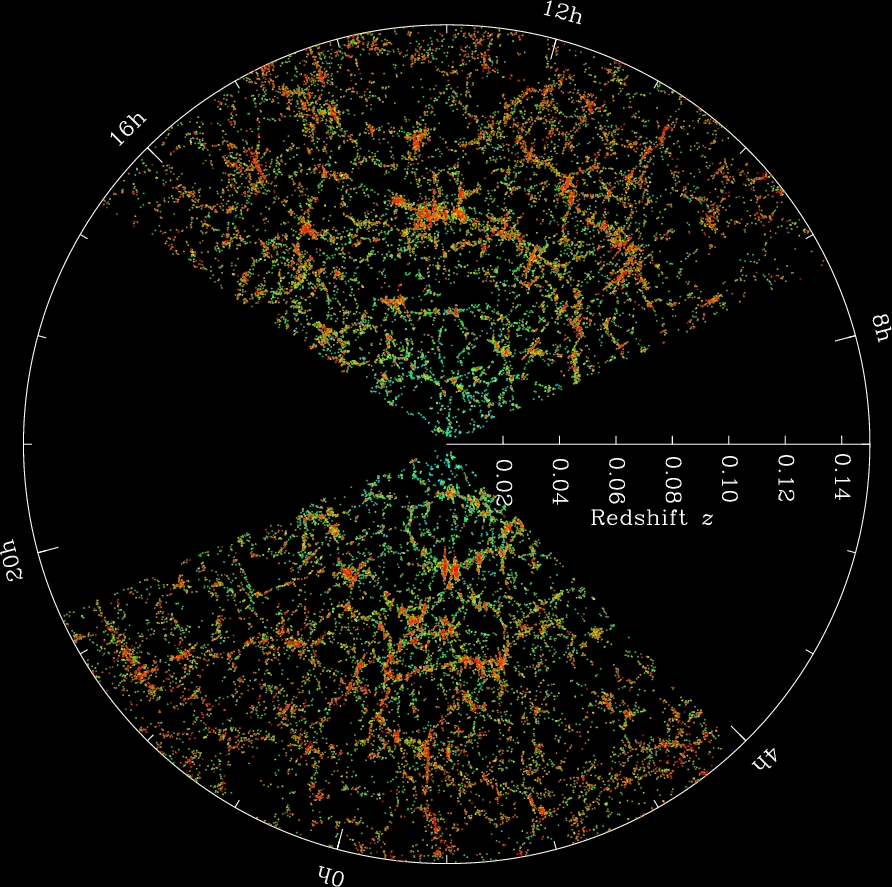
Of course, it is unlikely that there is a physical, causal link between the two. But if I have two photographs of two different things and they look similar, is it not then fair to say that the way those two different things look is similar?
[Edit: also - to be fair - it is not just models of structure formation (like the power law presented in the article) - we have pretty pictures of the large scale structure of the Universe as well http://www.sdss3.org/images/gallery/sdss_pie2.jpg]
The model is an instrument not the subject itself. A person cannot cook dinner in the kitchen of a blueprint.
The article does not demonstrate the utility of the (non-wrongness) similarities between the models. It address the "A cow is like a hammer because there is a 'b' in 'both'," possibility. Two models developed using similar techniques used in the discipline of modeling will have non-functional similarities.
The only rough similarity is the looks, and only if you dye the brain tissue in a special way.
Life is exogenous to the universe. That gives life it's meaning-to define what it is through it's impact on the universe. This is because the universe is in average empty and lifeless. The inanimate universe vastly outweighs the animate. Life could not ever overcome the average emptiness of the universe. But still it must try. It must try because if it ceases it becomes the inanimate. Life is that exogenous influence on the universe not attributable to any other physical or chemical process. If you simply cannot explain it then it may be life.
Brain evolution over time is definitely dependent upon physics/chemistry - but it's also dependent on conditions at higher levels of abstraction. We know neurons change their associations every day based on many factors at the conscious and subconscious levels (observations/thoughts).
I don't think anyone is trying to make an argument that they are the same 'thing' ("hey, maybe the observable Universe is a 'thought' inside a cosmic brain!"), just that there are striking similarities in structure - which can only easily be seen by a comparison of models.