Re:The Strange Similarity of Neuron and Galaxy Networks
by JBorrow on Saturday July 22, 2017 @12:58PM
(#14828089)
I'm somewhat confused. Are you saying that there is no relation between the structure of the large-scale Universe and the structure of Neurons? If so, then why do we get two models that come out looking very similar?
Of course, it is unlikely that there is a physical, causal link between the two. But if I have two photographs of two different things and they look similar, is it not then fair to say that the way those two different things look is similar?
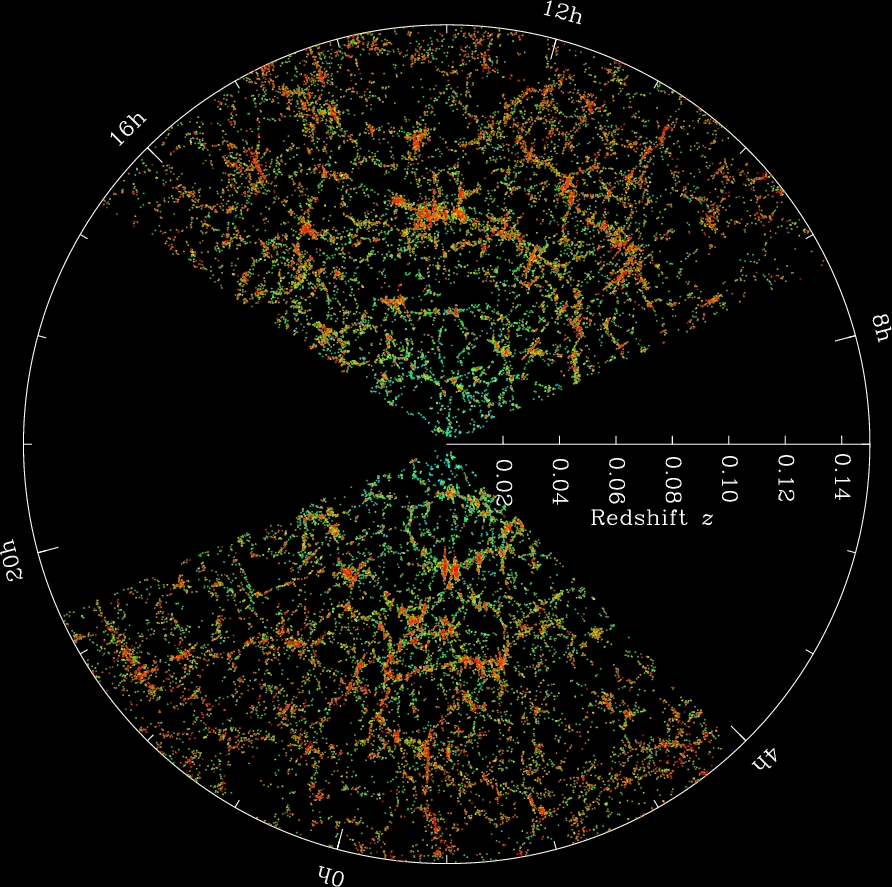
[Edit: also - to be fair - it is not just models of structure formation (like the power law presented in the article) - we have pretty pictures of the large scale structure of the Universe as well http://www.sdss3.org/images/gallery/sdss_pie2.jpg]
Re:The Strange Similarity of Neuron and Galaxy Networks
by brudgers on Saturday July 22, 2017 @01:29PM
(#14828255)
To use the photograph analogy, if a person uses a typical 35mm camera a photo of a duck will have the same proportions and color gamut as a photo of an iPhone and have a similar tonal range and if the focal length of the lens is the same, the field of view will be the same.
The model is an instrument not the subject itself. A person cannot cook dinner in the kitchen of a blueprint.
Re:The Strange Similarity of Neuron and Galaxy Networks
by JBorrow on Saturday July 22, 2017 @02:02PM
(#14828426)
But that is not how these models are constructed. They are from empirical data - they just tell you how many objects of a given size exist. The analogy is that the power spectra for the brain and the power spectra for the large scale structure are two different photographs (of actual things!) and look strikingly similar.
Re:The Strange Similarity of Neuron and Galaxy Networks
by brudgers on Sunday July 23, 2017 @10:15AM
(#14832339)
Viewed from five meters away, a photo of a duck and a photo of an iPhone may appear to be strikingly similar. The important differences depend on the level of granularity at which they are observed and the purpose for which they are observed.
I think that this is a good question, and central to a lot of the confusion that stems from a casual reading of some modern topics in physics. It's the difference between a black hole in nature, which formed in a realistic process, and the Schwarzschild metric, which has a uniform sphere of "dust" collapsing from infinity, in an empty universe, without gravity, and no angular momentum or charge.
The reason these models are used is because they can give insights and/or generate new tools to explore reality with. On the other hand, they're just maps, just approximations of systems which we couldn't hope to accurately model with fidelity.
On one hand, you get some amazing insights when your models intersect with observations, but you also need to remember... "The map is not the territory."