News for hackers. Stuff that matters.
Re:Japanese company develops a solar cell with record-breaki... by candiodari on Thursday March 23, 2017 @06:50AM (#13938690)
I'm not sure I like this. It seems that we're very clearly in the area of diminishing returns when it comes to solar panels.

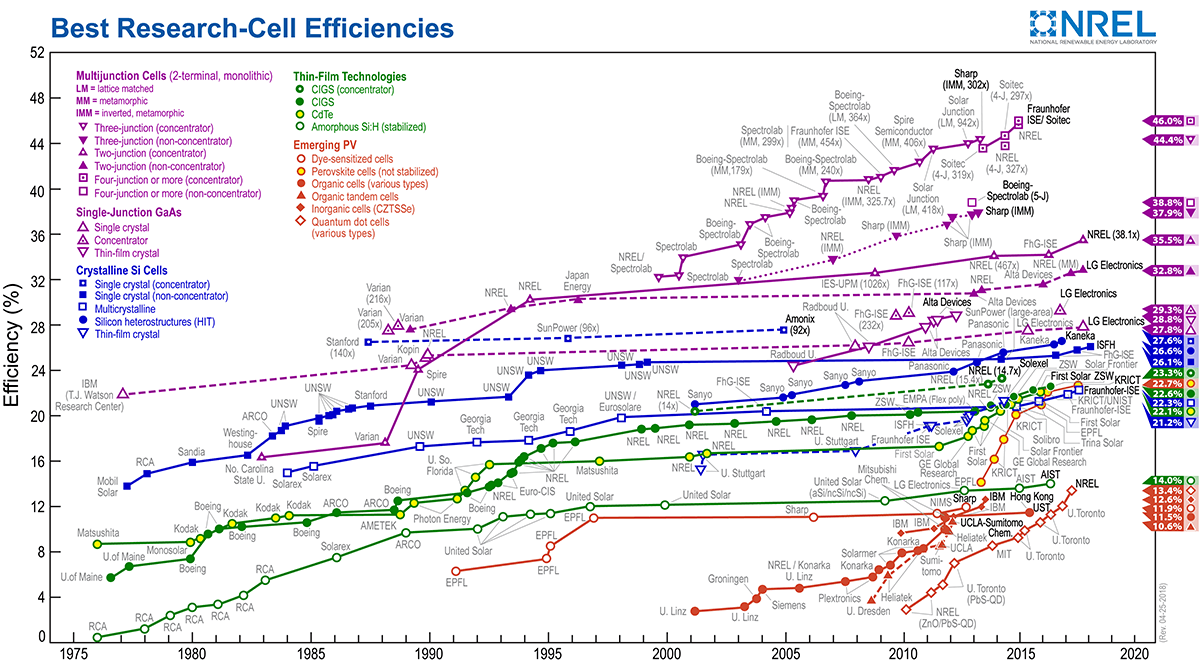
https://upload.wikimedia.org/wikipedia/commons/4/42/Efficien...

The conclusion of that chart seems to be : concentrated solar power (even on small scale) is unbeatable, and tops out (realistically) at ~40% efficiency.

So now we should probably work on very, very cheap lenses if we want to advance solar panels, and quick ways to make small, very cheap panels.

Re:Japanese company develops a solar cell with record-breaki... by Tuna-Fish on Thursday March 23, 2017 @08:06AM (#13939024)
This is the current version of that chart: https://www.nrel.gov/pv/assets/images/efficiency-chart.png

This cell is the blue dot "Kaneka".

Multijunction cells are very expensive to make. The reason the multijunction cells in that chart all have concentrators is that without them, the cost is ridiculously too much to even consider.

This particular cell is noteworthy because it is cheap enough that you can eschew the added cost and complexity of the concentrator and just use more cells and potentially still be cheaper.

Re:Japanese company develops a solar cell with record-breaki... by londons_explore on Thursday March 23, 2017 @01:45PM (#13942119)
Without them, multijunction cells are less efficient too.

Leakage current, which happens even in darkness, wastes power at a fixed rate per unit area. By concentrating sunlight, one can generate far more than this leakage rate making it insignificant.

Re:Japanese company develops a solar cell with record-breaki... by jacquesm on Thursday March 23, 2017 @08:31AM (#13939167)
> potentially

That's the operative word here. And that is far from a run race with this particular technology, it is going to be close enough that it bears watching but not so good that it is a slam dunk winner.

Re:Japanese company develops a solar cell with record-breaki... by nojvek on Thursday March 23, 2017 @10:59AM (#13940277)
To be honest it's a lot more economical to have cheap large mirrors on your roof directing sunlight towards a concentrated spot of PV cells of higher efficiency that are somewhat expensive.

You could use some of that energy to have tiny motors that track the sunlight.

This would net in more energy and less cost per square meter right?

Re:Japanese company develops a solar cell with record-breaki... by jacquesm on Thursday March 23, 2017 @11:08AM (#13940369)
I've done a lot of experimenting with that. Here are some of the (surprising!) results:

  - you only need one motor to aim a whole array of mirrors
    if you're willing to make some exotic gears

  - the lifespan of the cells will shorten measurably

  - you will need to cool the cells if you don't want them
    to die very quickly

  - there will be a serious fire risk
Re:Japanese company develops a solar cell with record-breaki... by ballenf on Thursday March 23, 2017 @12:23PM (#13941225)
Are there cells designed for higher intensity than others -- ones that can handle the extra light and maintain efficiency?
Re:Japanese company develops a solar cell with record-breaki... by jacquesm on Thursday March 23, 2017 @02:28PM (#13942636)
Yes, but they're not cheap, in fact they are so expensive that it will be cheaper to cover the mirrors with cheaper cells directly...

At this point in time there are no cheap and easy solutions in sight to make the next 2 to 5% gain in efficiency in a cost effective manner.

But given enough time and effort I'm sure that that will happen, I expect the final cut-off to be somewhere around 25% net efficiency (solar incidence to electricity out of the system) for smaller installations and maybe up to 30% for much larger installations.

Re:Japanese company develops a solar cell with record-breaki... by philipkglass on Thursday March 23, 2017 @02:28PM (#13942623)
Yes, there are different cell and cooling designs for low concentrating PV and high concentrating PV (LCPV, HCPV). But the price of non-concentrating PV systems has, so far, fallen fast enough to prevent either LCPV or HCPV from taking even 1% of the PV market. Soitec, Amonix, Suncore, and Sunfocus all failed to drum up enough CPV business to stay solvent.
Re:Japanese company develops a solar cell with record-breaki... by Tuna-Fish on Thursday March 23, 2017 @11:25AM (#13940551)
Maintenance and installation costs already eclipse the panel costs. For any assembly you evaluate, you have to answer two questions:

Will this require more complex installation than flat panels?

Will this require more lifetime maintenance than flat panels?

If the answer to either question is a yes, it doesn't matter how good your system is in any other measure, you will lose against simple flat panels in total cost per electricity produced for any small-scale installation.

Re:Japanese company develops a solar cell with record-breaki... by jacquesm on Thursday March 23, 2017 @11:53AM (#13940883)
Correct. I found this out the hard way with my two leafs of 2x4 panels tracking the sun in two axis. By the time the system was up and running I could have had more power and less headaches by installing 24 panels statically on the roof. It would have looked better too.
Re:Japanese company develops a solar cell with record-breaki... by walrus01 on Thursday March 23, 2017 @08:21PM (#13945566)
Tracking systems with moving parts are expensive and complicated. With good quality 320W panels at $0.45/watt now in pallet quantities, going with a low cost fixed mounting system (whether ground or roof) makes much more economic sense. Considering the wind loading that a two axis tracking system which can hold 6x280W panels must endure, no wonder they cost a lot.
Re:Japanese company develops a solar cell with record-breaki... by pjc50 on Thursday March 23, 2017 @11:11AM (#13940406)
That sounds like the "more economical" is wiped out as soon as you have a maintenance issue in the moving machinery. As it stands, maintenance-free panels are a huge advantage.
Re:Japanese company develops a solar cell with record-breaki... by averagewall on Thursday March 23, 2017 @09:06AM (#13939373)
Efficiency isn't quite the important thing for solar as it is for fuel burning engines since all the sunlight is used up at the same rate no matter how much power you capture from it. We could get much cheaper panels with no better efficiency and that would still be excellent.

More important than energy efficiency is price per unit energy. You could have an inefficient but cheap solar cell that's more economical than an expensive efficient one (eg. active tracker vs fixed - the less efficient option is usually more economical). Though when installation costs dominate, then you really do want smaller panels so you can spend fewer man-hours nailing them up.

Re:Japanese company develops a solar cell with record-breaki... by mangecoeur on Thursday March 23, 2017 @08:39AM (#13939204)
A fundamental limitation of concentrating systems is they only work well with direct solar irradiance - it's very hard to concentrate diffuse solar rays coming from random directions, as you have on any overcast day. This dramatically reduces the potential generated power in locations that don't have consistently clear skys (i.e. most places). So a high efficiency flat panel with a promising route to commercialization and built by a reputable company is a great step.
Re:Japanese company develops a solar cell with record-breaki... by jacquesm on Thursday March 23, 2017 @08:47AM (#13939246)
> A fundamental limitation of concentrating systems is they only work well with direct solar irradiance - it's very hard to concentrate diffuse solar rays coming from random directions, as you have on any overcast day.

It's impossible. That said, every type of solar panel works best with direct solar irradiance, what you can get from scatter off clouds and on overcast days is a pittance even in the best situations compared with direct light.

So this isn't nearly as big a step (yet) as it is made out to be, it may work out commercially but that is definitely not clear at this moment, and if it does work out commercially then it remains to be seen how much of that efficiency gain ends up reducing the per KWh installed cost of the panels. Any net gain of course is good.

Re:Japanese company develops a solar cell with record-breaki... by Brakenshire on Thursday March 23, 2017 @08:27AM (#13939148)
> I'm not sure I like this. It seems that we're very clearly in the area of diminishing returns when it comes to solar panels.

I don't follow this argument. The median panels used in actual installations have increased in efficiency from about 16% to about 18% over the last 10 years (while the prices have more than halved).

First, the chart you link to is for 'hero' cells, using expensive technology to test the limits of a particular material, it is only tenuously linked to industrial production. There's lots of leeway for improvement in industrial production, which is what matters to the economy.

Second, improvements in efficiency are only one part of cost reductions. In the time that the cost of panels has dropped perhaps 50 fold you're only talking about a 1/3 to 1/2 increase in efficiency.

Third, there's always potential for other materials or structures to come to the fore. If we could find a cheap way of producing multi-junction cells then the ~30% theoretical efficiency limit disappears.

So, there's plenty of scope for continued improvements.

Re:Japanese company develops a solar cell with record-breaki... by londons_explore on Thursday March 23, 2017 @01:50PM (#13942186)
> If we could find a cheap way of producing multi-junction cells

I really don't see why this is impossible. Hire a bunch of specialists, make robots build the cells end to end, then build a bunch of those robots.

Anything a human can make one of, it should be possible to make a robot build millions of with zero incremental human labour, as long as you invest enough upfront for the robots.

Re:Japanese company develops a solar cell with record-breaki... by danmaz74 on Thursday March 23, 2017 @07:57AM (#13938975)
I don't know if we're already at diminishing returns, but to estimate that you need to compute the economic returns, not just the conversion efficiency.

As yearly production escalates, even small increases to the "conversion efficiency"/"production cost" can yield high total returns on the investment.

Re:Japanese company develops a solar cell with record-breaki... by jacquesm on Thursday March 23, 2017 @08:02AM (#13939002)
> As yearly production escalates, even small increases to the "conversion efficiency"/"production cost" can yield high total returns on the investment.

It won't matter. Investment is hardly ever looked at in terms of total returns but only in terms of annual ROI as a percentage of the original outlay.

Re:Japanese company develops a solar cell with record-breaki... by danmaz74 on Thursday March 23, 2017 @08:10AM (#13939048)
By "total" returns I didn't mean "lifetime" returns, but returns on the whole production to which the new technology can be applied (be it yearly, monthly, or whatever). My point is that, if we're building (or upgrading) bigger and bigger production plants, even a small improvement to the process can bring in big annual ROI.
Re:Japanese company develops a solar cell with record-breaki... by Arnt on Thursday March 23, 2017 @07:18AM (#13938799)
Why?

AFAICT, there are three ways to double the output of a solar cell: Double the area, double the efficiency, and move the cell to somewhere with twice as bright sunlight and install a cable. That one option presents intractable problems doesn't seem to matter very much when either of the two others are available.

Re:Japanese company develops a solar cell with record-breaki... by contravariant on Thursday March 23, 2017 @08:23AM (#13939130)
Well, really there are only two, capturing more sunlight, or capturing sunlight more efficiently. Since we need sunlight for other things as well it's better if we don't waste it, but right now that doesn't really seem to be a limiting factor (there are still plenty of roofs without solar panels).
Re:Japanese company develops a solar cell with record-breaki... by Tharkun on Thursday March 23, 2017 @07:26AM (#13938835)
I suppose it's a matter of cost, which will likely depend on location. Cheap lenses might be more feasible in densely populated areas. A big, fat, copper cable attached to very large and very cheap panels will likely be more cost effective in sparsely populated areas.
Re:Japanese company develops a solar cell with record-breaki... by dotancohen on Thursday March 23, 2017 @08:11AM (#13939054)
Cheap lenses won't work for solar panels on a car, boat, or other vehicle.
Re:Japanese company develops a solar cell with record-breaki... by Tharkun on Sunday March 26, 2017 @09:48AM (#13960762)
Can you elaborate on that?
Re:Japanese company develops a solar cell with record-breaki... by Arnt on Saturday April 01, 2017 @12:13PM (#14012782)
I presume he means that cheap lenses will not be able to deal with a moving vehicle's quick changes of orientation.
Re:Japanese company develops a solar cell with record-breaki... by petra on Thursday March 23, 2017 @08:20AM (#13939108)
Area isn't unlimited in the residential market, place is fixed and installation is expensive.
Re:Japanese company develops a solar cell with record-breaki... by taneq on Thursday March 23, 2017 @09:04AM (#13939357)
That's why you need to install the cable.
Re:Japanese company develops a solar cell with record-breaki... by Arnt on Thursday March 23, 2017 @04:32PM (#13943981)
Those are places where people buy their vegetables instead of growing them.
Re:Japanese company develops a solar cell with record-breaki... by pjc50 on Thursday March 23, 2017 @09:51AM (#13939683)
Aren't we at the stage where "balance of system" costs are starting to dominate: wiring, mountings, inverters, installation labour and so on? Or is that only true for house-scale systems?
Re:Japanese company develops a solar cell with record-breaki... by petra on Thursday March 23, 2017 @08:17AM (#13939086)
Insolight is a startup commercializing cheap plastic lens, that both focus and track the sun(hard to do with fixed lens, requires some optics magic). Panels made from those will have 36.5% efficiency, with only a 30% increase in total installation costs - that's their goal at launch.
Re:Japanese company develops a solar cell with record-breaki... by lovemenot on Thursday March 23, 2017 @07:57AM (#13938976)
Cheap lenses can provide far less concentrated light than similarly cheap mirrors, since the latter are not constrained by having to sit atop a solar cell. As long as space is not a major constraint, controllable mirrors in array should handsomely beat lenses.
Re:Japanese company develops a solar cell with record-breaki... by _rpd on Thursday March 23, 2017 @09:37AM (#13939565)
Isn't the conversion efficiency basically irrelevant except for specialized applications like spaceflight where every gram counts? 8% thin film solar cells will be the market winner if their marketplace ROI is superior - $ per Watt and lifetime.
Re:Japanese company develops a solar cell with record-breaki... by the8472 on Thursday March 23, 2017 @10:42AM (#13940117)
If installation costs per m² dominate because moderately-efficient panels already are dirt-cheap then using a more efficient panels that are a bit more expensive can save overall costs if you can get the same power with fewer m² and thus lower overall costs.

And even if you drive down installation costs so you can roll out cheap cells en masse you'll eventually run into a space limit for some applications. There's only so much sun-facing rooftop on each building.

Re:Japanese company develops a solar cell with record-breaki... by JoeAltmaier on Thursday March 23, 2017 @06:42PM (#13945016)
Or very, very large arrays in space!