In 2016, the United airplane I was in still did not have a seatback screen and they expected all 200+ passengers to connect to the wifi to try to get in-flight entertainment. Of course no one got on. So all of us were left craning our necks trying to catch a glimpse of whatever was on the CRT in the aisle.
Meanwhile, Turkish Airlines has a touchscreen interface with beautifully done transitions and an amazing selection of movies and music. I remember seeing Radiohead's Kid A on there, along with the Blade Runner soundtrack.
Next month, I'm flying to Berlin via Turkish even though it will take 4 more hours because the price and comfort are worth it. Only problem is, this electronics ban may compromise my electronics.
(And yes, I'm aware of early adopter pitfalls and government subsidies for airlines, but United has no qualms treating non-status passengers like trash.)
Edit: spelling
This is a deliberate decision that airlines are starting to make. If most passengers are bringing a wifi-capable device (ipad, phone, etc), then why go to the extra expense (and weight) to support seat-back screens?
Now, my main experience with this has been flying within the US where none of the newest planes have screens. Internationally, there may still be screens included in newer planes, but when screens = weight, and weight = $$$, it's not surprising that they are getting removed. Moreover, screens = depth, which when removed can make room for more rows, which means more money.
If this electronics ban takes hold though, I'd expect for there to be a big rethink about this.
I'll gladly let the airline shove more seats in by thinning them out, than by reducing my leg room any further.
https://www.sanspotter.com/wp-content/uploads/2015/03/las_sa...
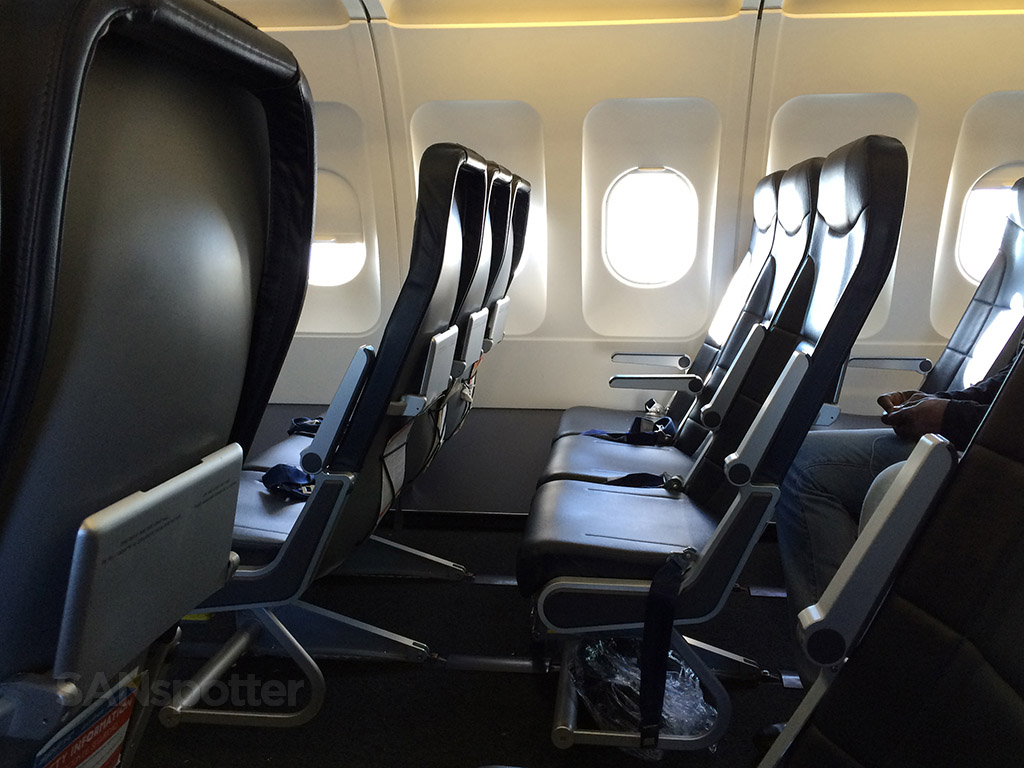
So United saved costs by not retrofitting their airplanes with seatback screens and by offering shit wifi.
Of course Louis CK would say: https://youtu.be/ZFsOUbZ0Lr0
Also their primary hub Istanbul Ataturk Airport (IST) was attacked in 2016, which left 45 people killed and more than 230 people injured.[2]
I am not sure what criteria they use to issue this award, but they do not look safe enough to me to be on the 7th best position in the world.
[1] https://en.wikipedia.org/wiki/Turkish_Airlines#Incidents_and... [2] https://en.wikipedia.org/wiki/2016_Atat%C3%BCrk_Airport_atta...
I knew of the attack at Ataturk Airport and I'm fine with a layover there. I'd even change to a stopover to hang out in Istanbul again, but don't have the time this trip. If you can get over your fears and fly the two airlines, I'm sure you'll find Turkish to be a better experience than United.
This just depends which plane you get. They all have new and old planes, you can get unlucky on any airline.
The entertainment system on the seat backs was Linux in a reboot loop.
JAL/ANA have very new planes with cool entertainment systems, but they also fly their older planes on some routes with a bunch of stuff that looks like it's powered by VCR.
To your question: they probably don't for their major international flights.
(Plus, can confirm that the ME airlines are highly competitive. They're subsidized by their governments: http://www.economist.com/blogs/gulliver/2015/03/airline-subs... (thanks hueving)).
That's not true, at least not for Emirates and Etihad, which were the main airlines accused.
Delta and other US airlines did accuse them of violating the Open Skies agreement, yes. Which is quite hypocritical since Delta (like other US airlines) has also taken direct subsidies from the US government.
But, as Emirates showed in their subsequent lawsuit, their financial records prove that they have never taken government subsidies, despite Delta's accusations. Etihad did, but long before Open Skies was signed (1999).
This behavior isn't unusual; the Big Four are just using this as an easy way to smear their biggest competitors, while ignoring other airlines that have similar financial history (China Southern, etc.). But China Southern isn't (currently) drawing passengers away from the Big Four, whereas Emirates/Etihad/Qatar are.
The Gulf aiflines are more efficient than the US airlines because they exclusively serve one city - Emirates, for example, flies only flights to or from Dubai (with a couple of tiny exceptions). That makes it a lot easier to provide excellent service and cheap flights.
American doesn't fly to any Middle Eastern cities but they partner with both Etihad and Qatar, who do.
I wonder if including Kindles is more a jibe against Bezos. Perhaps this is a stretch.
Abu Dhabi security was far more stringent than anything I have been through in Europe, (and ironically Brussels, when I was in the Brussels airport in transit when it was attacked).
This is not correct Quatar has one as well.
I'm also unsure why you would find this "bizarre" as all of the Emirates are incredibly wealthy.
And the bizarreness is that they're simultaneously trusting them enough to handle immigration, but not trusting them enough to handle passenger screening.
> It's also beyond bizarre that the US trusts Abu Dhabi's security enough to locate its only Middle Eastern Customs/Immigration preclearance facility, but not enough to let passengers who have gone through security bring tablets...
It's a good question.
However, I don't see that as a vote of confidence in them since they are still permitting flights.
I think similar could be said of the TSA in the US - the DHS trust them enough to let passengers who have gone through security bring shampoo as carry on but not enough if those shampoo bottles are greater than 3.4 ounces, despite having gone through their security.
I think its less about a vote of confidence and more about absurdist theater.
This is not about DHS trusting TSA, since the specific part of DHS that makes that regulates that is...TSA.
It's also beyond bizarre that the US trusts Abu Dhabi's security enough to locate its only Middle Eastern Customs/Immigration preclearance facility, but not enough to let passengers who have gone through security bring tablets...