That's a little disrespectful to those who actually lived in surveillance states. Is your neighbor watching you, ready to report you to the state for suspected subversive activities?
Even if you were engaged in actual subversive activities, like reading and publishing terrorist propaganda or selling drugs at scale, Tor makes it possible to do this with relatively little risk to yourself. It's still risky, but nothing like it used to be. And even if the government knows that you do these things, how much of a threat do you need to pose before they'll act against you in particular? The governments of old would routinely act against large numbers of their population for far less.
I'm not arguing for complacency, but it's important to keep perspective.
I believe the original intent was mostly about reporting unattended bags that could contain bombs, not reporting your neighbor for hosting a socialist book club or whatever. Obviously it's vague and broad enough that it could be bent to more sinister purposes though.
Perhaps a slightly different context but I have heard this almost verbatim a few days ago on buses and trains in Birmingham, UK.
If I'm not mistaken too, I believe that "If you have nothing to hide, you have nothing to fear" is also something the Govt used a few years ago.
http://www.btp.police.uk/latest_news/see_it_say_it_sorted_ne...
The content of the ad includes someone looking at someones trash, seeing some common chemicals and assuming they are making a bomb.
No it's not, and I highly resent this argument. It inevitably ends up with, but it's not at stasi levels... yet... When in truth what we have now would have made the Stasi have wet dreams! So stop it with this variation of affective fallacy already. Even if it was, somehow, disrespectful, which I don't think it is, even it was, who cares? It doesn't and shouldn't change the conversation whatsover. We are having a discussion about the current state of our mass modern surveillance engine, not about any other time in history (though they might be relevant to learn from).
Also, at this stage, if we don't talk about the potential before it gets too bad, we won't be able to stop it. Binney and Drake both refer to the current state as the "turn-key totalitarian state", and Drake for example got his start spying on east Germany during the cold war! As a matter of fact, if anything, I would find it to be highly respectful, for we are trying to prevent a similar fate those before us have failed to prevent.
"Tor makes it possible to do this with relatively little risk to yourself."
Nope, when they own enough fiber backbone nodes owning the tor network becomes much less non-trivial. Also, targeting tor-browser 0days, along with, as we can see from the NSA and CIA leaks, direct comprimise of machine, make tor not nearly as useful as a tool of anonymity as you seem to think. (Still useful, don't hate me J Appelbaum...)
"how much of a threat do you need to pose before they'll act against you in particular?"
Easy, all you need is to be effective and credible. It's been seen time and time again, since COINTELPRO and on. If you are just ranting and raving, maybe doing a protest or two, no one gives a fuck (other than to enter your name into a database somewhere). The second your protest actually starts doing something, or your dissident political campaign affects change in some way, thats when you become a target.
"The governments of old would routinely act against large numbers of their population for far less."
What's your point? First of all, with the surveillance engine storage, there is nothing to prevent the sudden repeal of ex post facto and suddenly they start walking the cat backwards 5 years, enmasse, against any potential dissidents. Remember there are over 1.1 million Americans on the "Terror Watch List", with no transparency of how they got there or any recourse to get off.
You say you aren't arguing for complacency, only for perspective, but your rhetoric does not match your claim.
Internet manifestos like yours or ones that end with "I can no longer proudly claim the West is free. We are living in a surveillance state." empirically don't do shit except help convince people on the sidelines that people who care about the formation of a surveillance state seem to be kind of paranoid.
Actually want to get people to care? Talk about very well substantiated examples that touch things most people are familiar with. It's not like Snowden failed to give us a wide selection. Even if COINTELPRO's soul sequel is in place, you're better off going with a soft sell that hits closer to home than a hard sell that fewer people will identify with.
Indeed. The first is the state of matter and has been for quite a while, the second is wishful thinking.
Totally agreed. This kind argument is almost always provided in exasperated language that invokes the No True Scotsman fallacy.
Do we really need to wait until it 'x bad' before it's ok to say we have a problem? And if so, who gets to define 'x'?
Take a step back before exploding in rage at what should be a polite discussion on the internet.
First, the west is freer than the rest because it is more able to criticize even the little things.
Second, electronic surveillance is not longer even one of the little things. It happens out of sight, and mostly out of mind, so authorities now act without the kinds of restraint usual in the west. And rich western governments are actually more capable of this sort of thing that most others.
[1]: The fate of empires and the search for survival by Sir John Glubb
This is possible and more probable than it used to be a couple decades ago. But it's more under the guise of "terrorism" than subversion nowadays.
And it's not neighbor but the middle man between you and people you interact online with that is doing the surveillance (ever heard of facebook ? google ?). It's been a little while now since we've entered the surveillance capitalism society and it is dealing with subversion through behavioral prediction and modification.
It's already in use, one example is police in California.
That's the argument surveillance states use "sure we do these things, but it's not like we are full-on like <insert worse country here>"
Also Don Ho (NPP's author) is from China. (Studied and lived most of his life in France though, so in my books he's French)
Are you sure? How long do you spend talking to your neighbor each day?
See Jacob Applebaum, Laura Poitras, Glenn Greenwald among others. Journalists, filmmakers, programmers, doesn't matter. The point is that if you don't move enough, you won't really notice the chains.
> A surveillance state is a country where the government engages in pervasive surveillance of large numbers of its citizens and visitors. https://en.wikipedia.org/wiki/Mass_surveillance#Surveillance...
Ever heard of Snowden instantly stopping the conspiracy theory accusation by releasing internal document showing it was actually happening ?
Surveillance state is not about what you are able to post on facebook. The modern surveillance state welcomes this kind of public posting, it provides data for behavior control through behavioral prediction and modification.
Thus, an H1B holder in the US may need to remove from Facebook any friends who become protestors in case they are asked to hand over their phone at a border crossing.
This represents a material loss to Americans in the Facebook context.
That is absolutely 100% false. There is no law or regulation that prohibits anyone, including work visa holders, from criticizing the government. I'm floored someone would even think that.
I'm honestly curious what led you to believe that?
Now, even if it's not illegal, I'd say it's _unwise_. Leave the protesting to US citizens, as they are afforded more protections.
No really disrespectful. It is a valid concern that what other had to suffer could be a real future potential, realized through technological mean. The human reporter is taking away from the equation. But I get where your are coming from having experienced this second hand.
Maybe not to the state, but neighbors are absolutely watching neighbors ready to report to the court of social justice for suspected undesirable opinions. This has led to people losing their families and careers for views that other people disagreed with.
Remember it's not the judge that decides if you're guilty; it's the jury.
What's worse, if your neighbour consented to watching you and is actively reporting, or if the surveillance state doesn't even need your neighbour's consent to watch you because these neighbours (and family, friends, partner, etc) are all on Facebook, voluntarily carrying GPS-tracked recording devices everywhere they go, even into your bedroom--thereby making any defensive choice you can make for yourself useless, not joining Facebook, taking care what happens to your phone, etc.
Certainly you can argue it's more disheartening and chilling if, through propaganda, your neighbour voluntarily chooses to report you to the state.
On the other hand, the part where the state doesn't even need consent, that they can watch you much more closely and accurately, all the while your neighbours believe everything is fine--that's also pretty bad.
I'm all for perspective, but can we agree that it's just different? Maybe they don't carry people off to secret prisons quite as often any more. But the level and depth of surveillance is a lot worse, they know a lot more about everybody. And the propaganda, they don't need it to convince your neighbours to spy on you to make sure you're not doing anything subversive, no they control the Facebook feeds and the media's narrative to attack the concept of "subversive" itself.
> And even if the government knows that you do these things, how much of a threat do you need to pose before they'll act against you in particular? The governments of old would routinely act against large numbers of their population for far less.
But what if today, for the governments it is easier to not just act against you in particular, they defuse the whole threat on a much wider scale, the "terrorist propaganda" with a truckload of "fake news" (already there, just a little nudge into the spotlight).
I suppose that yes, if you carefully add all the pros and cons together, these old surveillance states were in fact worse. Given that I believe torture is one of the worst possible things you can do to a person, and that happened on a much larger scale, if you're keeping score that really makes it worse. On the other hand what we have now in the West is also pretty bad. And the level and depth of surveillance and control is worse now. Just because something that was worse was called a "surveillance state", doesn't mean we are also living in one now, and that it's doing bad things to our freedoms.
(granted your last line pretty much tried to say this, I felt like I needed to add some words)
Yes. They are actively encouraged to do so by the government: https://www.youtube.com/watch?v=FENOAIrHSl8
For people who still think we aren't, ask yourself why Americans think of breakfast when you say "Bacon and Eggs." That was an advertising campaign by Edward Bernays (Freud's nephew). He also helped the tobacco industry increase the number of women who smoked cigarettes (lookup "Torches of Freedom").
You might not think that product advertising relates to propaganda, but Bernays was the father of "Public Relations." The first public relations department was for the US government, and he chose that term because Propaganda had a bad connotation to it. Public Relations is literally a weasel word/phrase to replace Propaganda.
These are important things to consider when you think about voting and "free will." Advertising has been used to make people think quality diamonds are rare (they're not), bacon and eggs are a standard breakfast and that tobacco is a symbol of womens' liberation. If you acknowledge that, you also have to realize advertising has convinced much of America there are only two political parties worth voting for, and that they're different (even thought they universally enact the same foreign policy. Bush Jr = 2 wars, Obama = 5 wars, Trump/Hillary = both will/would bring more war. I ask you, when has a war protest or congress ever stopped any of these wars from happening?)
Finally, the CIA has admitted to having operatives in US magazines for decades, and they refuse to answer if they have operatives in US television (https://youtu.be/U1Qt6a-vaNM?t=2h30m35s).
We've been in 1984 for decades prior to 1984.
He's also the guy behind "engineering of consent", the use of press releases, fear of communism during cold war, and much much more.
I'm not so sure we've been in 1984, there is a valid case[1] for us living in a brave new world or at least a mix of both 1984 and a brave new world.
[1]: https://biblioklept.files.wordpress.com/2010/12/huxley-orwel... http://ritholtz.com/wp-content/uploads/2011/11/rrxW1.png

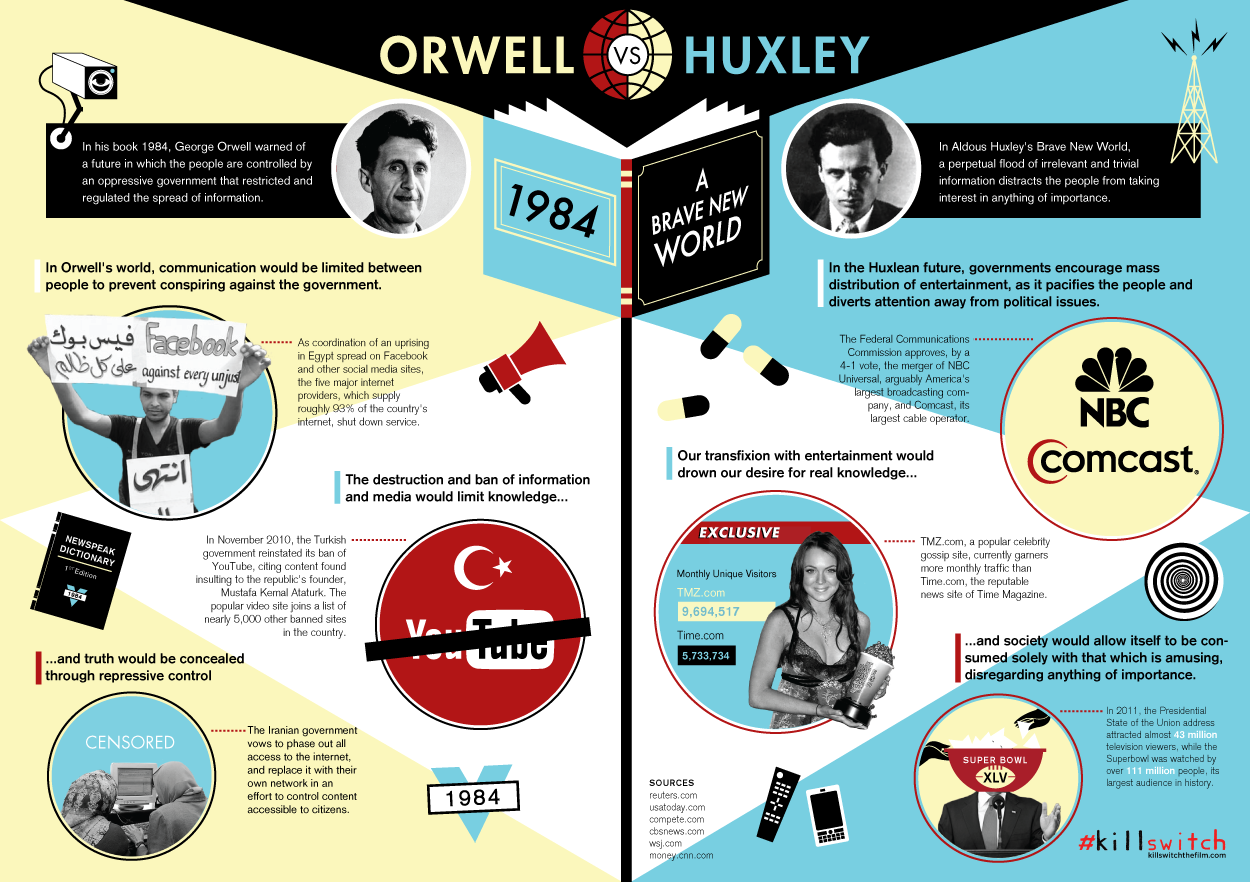
Don't fret though - the security state has been building for a long time: http://www.huppi.com/kangaroo/CIAtimeline.html
See UKUSA agreement [1] and echelon [2] for a primer on how global surveillance[3] started mid 20th century.
[1]: https://en.wikipedia.org/wiki/UKUSA_Agreement [2]: https://en.wikipedia.org/wiki/ECHELON [3]: https://en.wikipedia.org/wiki/Global_surveillance
You will know it's really over when everyone simply gives up their liberties in exchange of security, economy or national pride.
Anarchy is the only true freedom. Any social contract (i.e. government) limits freedom.
Still, saying the west is not free is disingenuous. One can still have many freedoms in a surveillance state. For example, I can criticize Trump without fear of being sent to a labor camp in a surveillance state. I can attempt to spread my religious beliefs without being randomly kidnapped.
Limits on freedom does not always translate into less free. Limits on owning nuclear bombs can be seen as an increase in freedom for those who don't own them.
I would disagree here, limits on owning nuclear weapons is sort of capping the decrease of freedom for those who don't. A strict ban of nuclear weapons is required not to impact freedom of others.
So your analogy fails as a ban on freedom always translate into less free.
Actually I fails to see how putting limits on freedom would not limit freedom. Arguing otherwise does not make much sense.
Having the freedom to do something does not imply that this freedom will be used. Pretty much anybody is free to commit suicide, but does not.
If the freedom exists, it will be used by someone, because people do commit suicide.
Less limits can lead to more freedom, but some restrictions of freedom can also increase freedom.
For instance by having conscription a lesser evil government can protect itself against bigger evil government.
Case in point, Finland against Soviet Union during World War 2. By forcing Fins to serve in the Finnish army, Finland kept their independence from a totalitarian communistic rule and evolved themselves to one of the most free countries in the world.
Try copypasting a few lines from 4chan's /pol/ in other mediums and see how far your freedom gets you.
Are jack-booted federal thugs going to kick in my door tonight and kidnap me now? Tell me more about my lack of freedom as I shoot my glock out my car window while spinning donuts on my property.
In Iran you go to prison for criticizing the president. In Malaysia (and other Muslim countries) you get kidnapped for trying to spread Christianity. In China you disappear if you start agitating for dissension on any medium. Someone merely observing you isn't taking away your freedom to say or do things.
What happens to people with the unpopular opinions? Well, Berkeley.
I can say things in America that people deeply disagree with, including the government, and I still will won't go to jail. I can join the KKK or Neo-Nazis without repercussion. I can call for genocide or revolution on facebook or twitter, and the government will ignore me. That is the freedom we have in the USA.
If you join the neo-nazis (or any similarly unpopular group) and posts that on facebook, you will lose your job, your customers will shun you, and if you are sufficiently famous the media will make sure it stays on your record forever. You will also have no platform and no way to gather like-minded people. Whatever social media you use will ban you or seek to limit your voice constantly and in imaginative ways (cf shadowban). Whatever hosting service you use to communicate with your group will shut you down unannounced when you are of sufficient size, forcing you to move, bleeding members all the while. Paypal will refuse to process your donations.
At some point somebody will dig through your past writings/interviews and misconstrue you as a pedophile.
At the end of the day you will be just another destitute crackpot that nobody pays attention to. Why bother with the jackboots?
To be fair, doxing is a problem and -- especially as a group -- people can get awfully close to that line of the law. This does need to be addressed, though I'm not sure how.
If the government outsources the jackbooting to private sector, does it stamp your face less hard? What if I design a governing structure that's distributed between a small elected 'government' branch and a large, permanent network of corporations?
Richard Spencer is still on Twitter, and still definitely has an audience—though the video of him being attacked is now very well known. Alex Jones has the President's ear. Steve Bannon is an advisor to the President with access to classified information. The President is, well, the President, despite plenty of material that could be and was used to accuse him as a pedophile. (I realize this is pedantically incorrect—I also realize the general public doesn't really care.)
Milo fared less well, but apparently appearing to advocate pederasty was a bridge too far even for many of his fans. Directing a harassment mob towards a celebrity was a bridge too far for Twitter, despite years of spewing the same not-exacty-PC views.
And espousing supposedly PC views isn't exactly safe either. Remember that time Anita Sarkeesian received multiple bomb threats for threatening to say unpopular words in public? What was THAT about, and why weren't the freedom lovers jumping to her defense in droves?
On a tangential note, this constant demand to focus on other causes whenever somebody points out something's wrong is a big part why most activism fail. Every cause gets piggybacked on by a hundred 'greater' causes that it has to expend all its resources to support. Every member has to agree with all one hundred or they can gtfo. At the end of the day nobody gets anything done, but at least you can show your friends on Facebook how virtuous you are.
It's almost as if hardly anyone cares about free speech beyond using it as a shield against meaningful opposition.
> At the end of the day nobody gets anything done, but at least you can show your friends on Facebook how virtuous you are.
For such a useless and thus non-threatening group, they sure get a lot of blowback. Let's be real—I couldn't have possibly cared less what Alex Jones had to say until people started parroting his unsubstantiated conspiracy theories en masse.
And there's something way deeper going on with fierce opposition to social justice movements than a burning desire to prevent people from continuing to be wrong on the Internet.
> In sociology, deviance describes an action or behavior that violates social norms, including a formally enacted rule (e.g., crime), as well as informal violations of social norms (e.g., rejecting folkways and mores). [...] Norms are rules and expectations by which members of society are conventionally guided. Deviance is an absence of conformity to these norms. Social norms differ from culture to culture. [...]
Note that the opposite of deviance in this context would be "normality", the Gaussian bell.
Howard S. Becker [2] is one key contributor to this topic. His outstanding book "Outsiders" (1963) is one of the best food for thought I've ever read.
Deviance being such a key concept in pretty much every human group/society/civilization and even fictional stories, it's generally agreed upon that it's a characteristic of our species' social interactions (whether biological or psychological or both), more innate than acquired (since we all evolved towards these behaviors, probably back in immemorial times when it had a survival purpose).
Moving on to political science, specifically law-making and state 'architecture' (i.e. Constitutional Law, that which creates Institutions and ultimately defines a Regime such as Democracy or Dictatorship), most schools of thought in 'free'/'democratic' countries are very conscious of the intricacies of protecting minorities and their opinions/rights. It is an integral part of the praxis of making law and you will find such fail-safe mechanisms even in authoritarian regimes (notoriously in China where, believe it or not, citizens have much local power on paper). Obviously in the real world, politics and corruption shift all of this, from the netherland of 'toxic deviance' to the promised land of 'hot-buzz-bait cause'.
Where I personally think political science is mistaken is precisely in labelling regimes into 3-4-5 neat categories; imho every country has some of each kind and should be rated on a scale for each kind of regime. It's the idea that democracy is never an absolute but a freaking wide spectrum, and that you can live in a 'weak state of democracy' combined with a 'normally high state of surveillance or authoritarianism'. And maybe a 'touch of dictatorship' emanating from the top exec office (usually PM, President) or top spiritual order (e.g. theocracy). Currently in the West, given the oligarchic configuration of the elite and the relatively high degree of corruption and low level of public debate, I wouldn't rate our countries very high on the democratic scale (the People has little power if any); freedom still is at an all-time high in the grander movement of history; however the development of surveillance technologies opens a wide door towards authoritarianism (also unlocked by an oligarchic rule).
I have one faith in the fact that big data is also possibly the solution to aggregating public opinion in ways that previous generations could only dream of (if we care to make the machine intelligence necessary for that), and that we also now (well, soon) have the capability to tailor a regime to each and every individual if need be (there's something to be said about a huge victory for freedom if we ever get to that, basically "make your own --pizza-- regime").
There is still the matter of circle-jerking once we're all free to group with like-minded individuals; but that one may prove to be a hard problem for humans.
[1] https://en.wikipedia.org/wiki/Deviance_(sociology)
[2] https://en.wikipedia.org/wiki/Howard_S._Becker#Sociology_of_...
Different countries have different freedoms. If you think political speech is the most important freedom, then good for you, but some people think being free to have whatever they want without paying is even better.
You can't call for genocide in the US if you're too specific. That's part of what's not counted as free speech. Nor can you publish information like what Snowden and Manning did, nor information protected by an NDA, nor threaten to kill someone. There's a long list of what you're not allowed to say in America. Sure it's largely a subset of what you're not allowed to say in China or Iran, but it's not exactly a subset.
In short, you're defining free speech to be the specific and narrow meaning that has evolved over hundreds of years of US politics and law. That's only one arbitrary way to define it.
Even worse. In America in the '60's and 70's, civilians were forced to fight in the Vietnam war! You would be imprisoned if you didn't go to war. That's the extreme opposite of freedom. Today, there's a huge amount of unjustified imprisonment of innocent people. Again, that's the opposite of freedom.
I'm not sure what you are trying to argue. In parts of Africa you are "free" to loot villages and rape women. Convincing me that America is just as free as China or Iran (just in different ways) is a hard sell because I value different freedoms with different weights. The freedom to steal people's IP and profit from it is not a freedom that is very beneficial for humanity.
> Today, there's a huge amount of unjustified imprisonment of innocent people
Do you have any evidence that the imprisoned people are innocent? Or are you referring to drug arrests? In those cases the people are definitely guilty of the crime (possession, using drugs). Sure, you may disagree with current drug laws/punishment, but law enforcement doesn't arrest literally innocent people and throw them in jail except on extremely rare and unusual occasions.
Flint tap water being more drinkable than ammonia does not make it potable.
As a Malaysian, there's plenty to criticize about my country, but this is the first time I've heard of this. Got a source?
If the US didn't have one of the worst prison record of the world, been known for kidnapping, assassinating and disappearing people all over the world you may have a point. Right now you're just looking like a fool boasting about not being black, muslim and having the privileges of not having been the target of what the US government has been known for doing for decades.
Regarding freedom of speech, the United States does have the concept more strongly encoded in law than the other 3. China's Constitution has Article 35, but apparently there is little enforcement of these rights (http://www.rfa.org/english/news/china/constitution-day-prote...), so such is toothless. I am not aware of a freedom of speech law in Iran, nor I was able to Google one.
Malaysia does have freedom of speech protections with Article 10. Having said that, the legalese is not as strong as the US's Amendment 1 -- the Sedition Act overrules Article 10, for instance. So criticizing the leader in Malaysia could bring you into legal trouble, unlike in the United States.
The First Amendment is not completely unbounded either, but unless you can demonstrate a US equivalent to Malaysia's Sedition Act (Malaysia being the country with the strongest freedom of speech protections of the three being compared), well, I think the OP has a point.
He fucking nailed it. This is what all of us are feeling. It's almost like, we are collectively being punished by trying to make shit more secure. It makes me dysphoric with hopelessness.
I can no longer proudly claim the West is free. We are living in a surveillance state. It's going to be hard to point fingers at other authoritative regimes around the world using the same tools.
I sometimes feel as if the West is a giant hypocrisy because of the double standards it upholds but relatively better than it's counterparts. Lesser evils.