- NYC Third Water Tunnel, under construction since 1970. 24 deaths, the vast majority of which were decades ago as safety improved. In fact, the first tunnels were blasted and drilled; the newer ones are made with a boring machine.
- St. Gotthard Road Tunnel, 1969-1980, just one lane in each direction and 2 deaths per mile. A comparable transportation tunnel today in the area is the Gotthard Base Tunnel, 0.2 deaths per mile.
- Older tunnels apparently caused thousands of workers to die due to silica exposure.
It also seems that tunnels are more dangerous than roads per mile by many orders of magnitude. For example, the aforementioned Gotthard Road Tunnel had over 875 accidents and 30 deaths in a span of just 24 years.
Pollution from congestion probably has at least a similar impact in terms of premature death and debilitating disease.
Edit. Down votes for stating that pollution from congestion causes premature death and serious health effects - yikes! Is that even a disputed fact? Google is full of academic papers on the very subject. The first result I see talks about congestion pricing having a massive impact in London. I would argue that congestion relief from the construction of tunnels would have a similar impact.
http://oem.bmj.com/content/65/9/620.short - "Predicted benefits... were 183 years of life per 100 000 population... In London overall, 1888 years of life were gained."
These three provide a useful survey level of understanding of the elements of building tunnels, the challenges to be met, and to some extent what is possible today.
Seattle is particularly instructive with regard to the impact on existing buildings vs depth and the challenges of fixing a tunneler mid-bore as it were. The Chunnel provides some great experience on depth and the ability to withstand pressure, and the Gotthard tunnel went through everything from sand to bedrock and speaks well to the ways of mitigating different materials. Taking the time to read the material on those three projects can certainly make you feel like you understand some of the issues.
Musk is correct in that there are a lot of things that are "well known" now by various engineering firms. For example producing pre-stressed wall sections so that a boring machine can leave behind tunnel instead of an unfinished hole. The process of supplying material and removing it, the build as you go narrow gauge rail lines for moving the tunneler and the material, and mitigation factors for different kinds of material (from rock to sand). There are practical considerations that aren't technological. For example you need ventilation. And that means a vent shaft to the surface periodically, and that means negotiating with people above the tunnel for access for that. Getting in and out of the tunnel is also its own challenge. If you want to let people drive their own cars in a tunnel you need a way to get in and get out, if you put a bus or a train in the tunnel you need stations where people can board. Those kinds of things, which involve negotiation with people who might not share, and might even resent, your vision seems to be the "hard" problem to the idea.
I have worked on tunnels ranging from the smallest to the largest, rock to soil, and all forms of construction.
I have stopped commenting on any tunnel related Elon topic due to people refusing to believe my experience and expertise when it does not align with what Elon Musk and his team of "experts" have said or published in their desk studies.
If you really want a machine then you would just call the contractor and ask them their price. You would likely have to pay for delivery.
The process to establish whether or not one could use that machine locally is just whether or not you have a job that needs a 58.5 ft diameter TBM set up the way theirs is. In other words, the process to establish whether or not one could use the machine again locally is basically to go through the design process for the tunnel (preliminary design, geotechnical exploration, laboratory testing, final design, etc.).
   > I doubt Bertha will be purchasable given the
   > litigation on the SR 99 job.
   > I don't know what you would be able or want to
   > use it for - it's 58.5 ft in diameter.
Based on my evaluation of the Viaduct plan this plan would use it in substantially the same way.
I'd suggest looking at the Sound Transit "ST2" tunnel boring project, it's been massively simpler in execution.
That page reads like a man page, and the associated pdf's are worse! :-o
I have close ties to both jobs.
Do you know of any good resources on these projects for the transit / infrastructure geek who's willing to read technical information? Executive summaries and dog-and-pony documents only go so far. :)
Anything past that probably hasn't come out yet since the jobs are aren't in a position where much has been published about them. If you want more information in general you can read conference proceedings (RETC, WTC, NATC).
Much of the deeper analysis and such isn't really accessible to the layman because it's really buried in the litigation.
SR 99 is likely your best bet between the two jobs because WSDOT has had an open book policy on the job. I think they've been too much of an open book, but that's neither here nor there.
No, I can't.
Regarding the rest of your post, you would need to carry out a geotechnical investigation to see if the soils are amenable to a machine like Bertha. I would guess not, based on my experience in both areas, due to the differences in the geology.
EDIT:
"New machines normally cost at least $15 million, but a decade of frantic subway construction in China has created a glut, and lightly used models can be had for 90 percent off sticker."
I could Kickstart a tunnel boring machine purchase. What a time to be alive.
Hopefully Elon's advances aren't the same as the cure for AIDS: http://southpark.cc.com/clips/164373/they-found-a-cure-for-a...
   > I have stopped commenting on any tunnel related
   > Elon topic due to people refusing to believe my
   > experience and expertise when it does not align
   > with what Elon Musk and his team of "experts"
   > have said or published in their desk studies.
Had you phrased it like this
"The challenges are less technical and more in the political side of infrastructure, property and easement acquisition, dealing with spurious suits from third parties, and the ever present complex series of environmental and safety regulations. While I admire Elon's ambition and desire to get things done, these political issues have stymied projects literally for decades, and I can't see even his star power being able to defeat rampant NIMBYism."
It would be easier to hear your expertise in your writing.
Your profile says you work in machine learning - imagine if every thread you posted in about machine learning you were told that you were an idiot because someone had read I, Robot and the AI in that doesn't match your idea of ML so of course you're wrong.
So I just try not to post in most tunneling related topics, especially those related to Musk, any more unless I see something interesting (like your original comment for this whole thread noting that nobody here knows anything about tunneling). When I do find something interesting I try to respond honestly and directly, as you can see with my other responses in this thread; however, the GP comment here offers nothing to the debate other than basically saying "Elon is a superhero".
I would not be surprised if others in their respective fields take a similar approach in other cult of personality topics (Uber, Elon, Apple, etc.).
I no longer read the comments for things relating to medical testing, my professional field, and I try my best to avoid medicine generally.
It to me feels like many commenters are somewhat clueless on the topic, and many others have strongly held opinions that lack foundation. It's a frustrating environment to comment within: it takes a lot of energy to write a thoughtful comment that can fill in missing domain knowledge for an earnest reader, and subsequently demoralizing to have a popular frequent poster on this website to dismiss my comment with snark because they consider themselves to be informed in this area. My comments became gray. I deleted the password to my account when that happened and rarely post since, the frustration is not worthwhile.
> This literally only happens in Musk related threads.
   > Your profile says you work in machine learning - imagine if every
   > thread you posted in about machine learning you were told that
   > you were an idiot because someone had read I, Robot and the AI
   > in that doesn't match your idea of ML so of course you're wrong.
And that brings us to this:
   > I would not be surprised if others in their respective fields take
   > a similar approach in other cult of personality topics (Uber,
   > Elon, Apple, etc.).
In your comment you call these "cult of personality topics" and that hits two interesting points. The first is that cults are, by and large, considered to be organizations which control their hapless members. The second is that personality is not a quantitative statement. "Fanboys", "Groupees", "Sycophants" are all negatively connotative words to describe someone who irrationally favors some topic or group.
The challenge though is that these people don't see themselves coming from that perspective, and they come by their admiration of founders or companies honestly. And it is important to recognize and acknowledge that someone can both admire Elon Musk's accomplishments and companies, without being "duped." And how you disagree can be just as important as what you disagree on.
So to wrap up, if you're comfortable with it, I recommend a bit of background/bio information in your profile to help people understand your expertise. When people comment with information you know to be incorrect, ask how they came to that understanding so that you can understand how to help them learn something new. And when people are dismissive of your expertise or your comments, help them learn by pointing them to the same sources and material you used to get to your understanding. Thanks to you I've got a copy of Dunn's "Fundamentals of Geotechnical Analysis" coming via inter-library loan. Until your comment I didn't have a name for the activity that analyzes the feasibility of tunneling projects, now I do. With that I can learn more.
Recognize that everyone here comes from a different background and have different levels of expertise. When someone disagrees with you or dismisses your comment take that as an opportunity to learn something new, not about about your area of expertise but about how to communicate it clearly to a non-expert.
Rocks are the biggest. The ratio of rock to finer sediment increases with depth until bedrock is reached. This might be anywhere from 1 to 1000 meters depth but in most cities it's probably <30 meters average (less in hilly parts of town, more in river valleys etc).
Bedrock can be bored through and is quite strong, but it's slow and may be more expensive (although it could cut down on regulatory and post-boring structural reinforcement costs quite a bit).
Mixed soft sediment and large boulders are often trickier to deal with--the boring rate can vary wildly, and it's difficult ta maintain the proper rate balance between cutting and sediment removal. Remove too slow and things clog, remove too fast and the pressure becomes too low and voids can develop, which are then filled in by overlying sediment as the ground above collapses a bit.
Shallow seismic techniques could certainly be used for imaging/boulder detection some number of meters in front of the borer if it was built in right. But I don't know how useful it would be. Can they steer or reroute? Probably not much...
Water is a lesser concern but is still important. The water table is pretty shallow (<10 m almost everywhere) and tunnels need to be sealed. This is pretty straightforward, but I really wonder about LA during an earthquake with a deep transit tunnel (especially in winter when the water table is higher). What if a long tunnel's walls are seriously breached? Could it flood and drown passengers who may be blocked by debris etc?
Certainly out here in a much more karst [1] part of the country (I'm in Kentucky specifically) there's just about no way, from what I read, to bore under our cities without threatening the geologic stability of just about everything above it, because our cities are already essentially built "on top" of caves, caverns, and limestone hollows. Sinkholes are a real problem with sometimes deadly effects.
Tunnels in general here can be very expensive to cover survey costs and insurance. I am not a civil engineer, but I would assume there are probably maintenance tasks and costs that differ for this sort of geology.
The deeper tunnels of the London Underground are "bored", that is a full circular profile is cut for the tunnel path. This is contrasted with the "cut and cover" method, which just digs a pit, builds a support structure, and covers it back up [1]. Cut an cover is not feasible for deeper tunnels, too much structure is required to hold up the weight of earth above you. Some of the older lines on the underground were dug this way; fun fact: You'll notice in NYC or Boston for example, that the subway stations are all square in their tunnel shape profile, and you can visibly see the support structures, that's because they are mostly not very deep, and used the cut and cover method. I'd be interested to know if any US cities have deeper tunnels? (Despite not being very deep, cut and cover is a very good way to quickly build mass transport for growing cities.)
The BBC has been doing programmes on the Underground for years, so there has been a steady steam of documentaries on this topic! I apologise if you can't get to any of these links:
- A 1969 BBC documentary on the Victoria line (hopefully answers your question 1)^: http://www.bbc.co.uk/programmes/p00sc29t
- A 2014 documentary on Crossrail, London's latest new underground line^^: http://www.bbc.co.uk/programmes/b04bwkj1
^currently streaming in the UK
^^ looks like this one is no longer available, except on Amazon. The Crossrail project website has some info on the show [2], and in general the Crossrail site tires to put educational info on there for the curious [3]
[1] https://en.wikipedia.org/wiki/Tunnel#Cut-and-cover [2] http://www.crossrail.co.uk/news/crossrail-documentary-the-fi... [3] http://www.crossrail.co.uk/construction/tunnelling/meet-our-...
Some NYC subway stations and lines were built with boring as opposed to cut and cover. 90% of the new 2nd Avenue line, for example, is planned to be bored[1]. Here[2] is an article with more details about the tunnel boring machine used -- the comments also have a lot of good discussion. Also, Los Angeles has done some boring for its new subway lines[3].
1: https://en.wikipedia.org/wiki/Second_Avenue_Subway#Construct...
2: http://secondavenuesagas.com/2010/05/14/down-the-rabbit-hole...
3: https://www.metro.net/projects/tunnel-boring-machine-tbm/
You will find that most stations were actually cut-and-cover, with only the Red Line having bored segments: one starting from after Farragut North [2] and running until shortly after the Medical Center [3], and another starting as soon as it leaves the CSX Metropolitan Sub northwest of Silver Spring and continues until the terminus at Glenmont, although that station itself was built from the surface [4].
Also highly recommend the book 'The Great Society Subway: A History of the Washington Metro' [5]
[1] https://www.washingtonpost.com/graphics/local/wmata-metro-de... [2] http://www.johnreilly.us/washington-metro-transit-design-and... [3] http://www.roadstothefuture.com/Metro_Glenmont_Route.html [4] http://www.nycsubway.org/wiki/Washington,_D.C. [5] https://books.google.com/books?id=beDoAwAAQBAJ
The Forest Glen station on the Washington, DC Metro is deeper than the Hampsted tube station (196 ft versus 180 ft, respectively).
The world's first tunnel under a river was completed by Brunel in 1843 and is still in use today by Transport for London for as part of the London Overground network (ignore the confusing naming - the Overground is like the Underground, but the service operates at longer intervals).
The Wikipedia page has a lot of detail about how it was constructed:
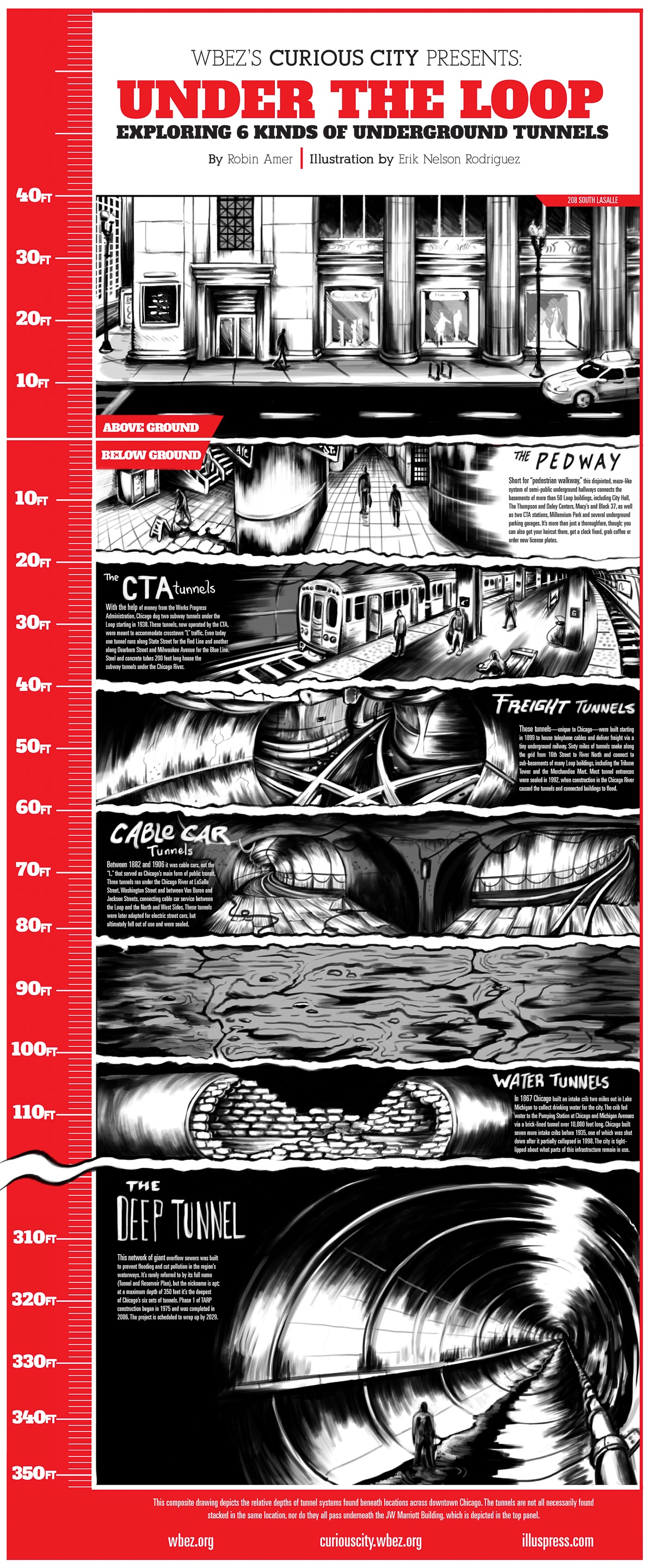
The downtown portions of Chicago's Blue Line[1] and Red Line[2] were primarily dug using tunnel boring machines in the 1940s. Here's a better view of the tunnels being not square[3].
Edit: infographic of various tunnels under Chicago, many of which are even deeper than these bored ones[4]
1: http://www.chicago-l.org/operations/lines/dearborn_subway.ht...
2: http://www.chicago-l.org/operations/lines/state_subway.html
3: http://www.railworks.com/track-project/cta-red-line-tunnel
4: https://uploads.disquscdn.com/images/32697b82560fbd40ec95ec1...
[1] http://www.lexpose.ch/2013/02/gotthard-base-tunnel-inside-sw...
[2] https://www.herrenknecht.com/en/products/core-products/tunne...
Musk didn't know much about rockets, electric cars and batteries but still managed to found and run the first private rocketry company, the first mass-market electric car and is responsible for the creation of the world's biggest battery factory. Not to mention Hyperloop, but there's no real product yet.
What Musk touches that eventually becomes gold, I believe - especially because his name and fame attracts talent that is willing to work extremely intense for his goals.
New Austrian tunnelling method, although that's on the very edge of 50 years ago. Since then, I imagine there's been incremental improvements that aren't easily understood by people who don't work on TBMs (just like steam locomotives didn't really have any revolutionary technologies after Stephenson's Rocket, even though they clearly improved in the next 100 years).
> What are the maintenance costs of tunnels like as compared to surface roads?
More expensive, I imagine. You have more infrastructure to maintain. In addition to the road surface, you have to inspect and maintain the tunnel lining, ventilation, and drainage systems. Given that two of those are active systems, I doubt there's any real savings over the lesser deterioration from weather.
> What are the big costs in the industry? The article hinted that Musk picked up a boring machine for 90% off $15MM, or $1.5MM, which seems extremely cheap given that even small size tunnels in urban areas can cost more than one -billion- US dollars per mile.
TBMs are usually purpose-built. I suspect Musk's "cheap" boring machine is him picking one up after it's completed its project and no one has any use for it.
> - Is there enough boreable space under our cities that this is doable? I know Musk says he wants to go deep, but even at very deep depths you run into problems of sand, boulders, geography, etc, etc.
Most of the buried stuff in our cities are relatively shallow. After around 10-20 feet of depth, you can basically assume nonexistence of municipal utilities, which means the only obstacles are others trying to avoid such things. The real problem in geometry is trying to maintain egress and ingress capabilities, as well as maintaining maximum grades internally. Don't forget that you'll need emergency access tunnels and ventilation shafts for long tunnels (and, usually, if it's not long, it's not deep).
It's a joke that came to life, and it's a pretty funny one, and I'm fairly confident Musk can make improvements, but I'd still like to know something about the whole process.
I assume someone here knows something about this, or at least can find out, so here's my wishlist:
- Has there been any improvement in boring in the last 50 years? The frequently-repeated statement that it hasn't improved would be quite shocking to me since at the very least I'd expect safety to improve.
- What are the maintenance costs of tunnels like as compared to surface roads?
- What are the big costs in the industry? The article hinted that Musk picked up a boring machine for 90% off $15MM, or $1.5MM, which seems extremely cheap given that even small size tunnels in urban areas can cost more than one -billion- US dollars per mile.
- Is there enough boreable space under our cities that this is doable? I know Musk says he wants to go deep, but even at very deep depths you run into problems of sand, boulders, geography, etc, etc.