* How long will it take for "Deleware" to melt?
* Is ocean ice this large called an iceberg?
* Does is get an official name, like IIS Wilmington (international ice station, capital of Deleware)?
* Have large ice sheets in the past forced/caused changes in human behavior, such as altering shipping lanes, in the same way planes fly around a storm?
Potentially a very long time, although it will likely break into smaller pieces first. A lot of icebergs get caught in the Antarctic Coastal Current, and just drift around the edge of Antarctica, not melting very much at all. Over time, most of them break free and drift north into warmer waters and melt, but others stick around. Iceberg B-9, which calved in 1987, still has a few chunks sitting around.
> * Is ocean ice this large called an iceberg?
Yes. You'll sometimes see the bigger bergs described as "ice islands", but that's just a subcategory of iceberg.
> * Does is get an official name, like IIS Wilmington (international ice station, capital of Deleware)?
It'll get a numeric designation, A-nn, where A indicates which quadrant of Antarctica it originated from (in this case 0-90W) and nn is a sequential number, probably in the high sixties depending on whether any other large bergs calve first. Then, as it breaks up, the resulting bergs will get letters added to the name, A-nnA, A-nnB, etc.
> * Have large ice sheets in the past forced/caused changes in human behavior, such as altering shipping lanes, in the same way planes fly around a storm?
In 2005, B-15A blocked the entrance to McMurdo Sound, where the main US and New Zealand Antarctic bases are located, and they were unable to get cargo ships in for a few weeks. And of course, ships are redirected around icebergs in the open ocean all the time.
Thanks for posting, and curious about this. When icebergs subdivide, how is tracking accomplished?
I assume late 80s was recent enough for decent resolution space imagery?
Landsat (https://en.wikipedia.org/wiki/Landsat_program) was likely the best available imagery back then. In the 80's it looks like they had 60m resolution - I assume that would be big enough to see an iceberg?
That bit about McMurdo is interesting. I doesn't surprise me, but I didn't know, that they send and receive thinhs via ships. I always hear about McMurdo as being inaccessible by plane during some chunk of time during the cold season, usually tied to some real world emergency or movie plotline with a sense of urgency.
Potentially a very long time, ...
(pedantic Blue Hen here.)
Regarding spelling, I plead not guilty by reason of autocorrect+gorilla-fingers-on-little-screen.
Not human in this example, but they can be devastating to penguin populations:
https://www.theguardian.com/world/2016/feb/13/150000-penguin...
I was going to add a few ideas on how to glue it back, but then I deleted them as it would sound more stupid than it already does.
Then, once you had it back into position, you'd need to apply your "glue" to the whole crack surface, which is around 40 square kilometers, a little smaller than Manhattan Island. Also, the majority of that crack surface is hundreds of meters deep in sub-zero waters in one of the most inaccessible places on the planet.
Then, once you've done that, the same forces which caused this bit to calve off would cause a new bit to calve a year or two later.
Also are there implications for the glacier(s) that feed this ice shelf after this part of the shelf breaks off?
Also, remember, you're only seeing the top 10% or so of the berg. There can be interesting shapes below the waterline, caused by preferential melting.
As for the glaciers feeding the shelf, that's an interesting question. Floating ice on its own provides very little resistance to their flow, but the mouth of the ice shelf is narrower than the back, so the converging flow has a resistive effect, like squeezing toothpaste out of a tube. If a gap is made in the ice blocking the mouth, then there should be some speedup of the glaciers. It all depends on exactly where the rift goes next, and on the exact balance of stresses in the shelf, which there's some uncertainty about.
A more probable (but still fairly unlikely) scenario is that this could destabilise the ice shelf over a longer timescale (maybe decades). Removing ice from the front would let the ice behind accelerate, stretch and thin, which makes it more vulnerable to calving again, and so forth.
The most likely outcome though is that there's no significant change to the ice shelf, except maybe the flow of the ice speeds up a bit, which is interesting glaciologically, but probably not something the rest of the world will get excited about.
Obviously, any and all of this could change as the climate continues to warm. If we start to see significant levels of surface melt ponding across the shelf, then we can worry.
I'm not an ecologist though, so I'm hazy on the details.
Just guessing:
There might be tardigrades. They can withstand extremes of hot and cold. First saw them mentioned here on HN some time ago. Amazing creatures. From the Wikipedia article:
Tardigrades are notable for being the most resilient animal: they can survive extreme conditions that would be rapidly fatal to nearly all other known life forms. They can withstand temperature ranges from 1 K (−458 °F; −272 °C) (close to absolute zero) to about 420 K (300 °F; 150 °C),[8] pressures about six times greater than those found in the deepest ocean trenches, ionizing radiation at doses hundreds of times higher than the lethal dose for a human, and the vacuum of outer space.[9] They can go without food or water for more than 30 years, drying out to the point where they are 3% or less water, only to rehydrate, forage, and reproduce.[3][10][11][12]
This is all much further south than cruise ships normally go though.
Of course, that shelf is also having some crack problems: https://www.theguardian.com/world/2016/dec/07/british-antarc...
What is your theory ? What should society as a whole do now in order to stop these processes ?
If you mean more broadly how can we help prevent the loss of ice from Antarctica, then I'm not a climate policy expert, but https://350.org/ is a good place to start.
Antarctic sea ice extent has been increasing, largely because of a change in wind patterns. Winds blow ice away from the coast, leading to more open water, which leads to more sea ice formation. Even though Antarctica is getting warmer, it's still much too cold to melt sea ice in most places, so climate warming isn't having a huge direct effect on sea ice.
However, the land ice in the Antarctic is almost certainly decreasing (exact measurements are quite hard), and the trend is definitely towards more ice loss. Ice shelves, although floating, are the outer extremes of this land ice.
This is a good review paper on the subject of the mass balance of land ice: http://www.vliz.be/imisdocs/publications/248038.pdf
If the entire Antarctic ice shelf melted, global sea levels would rise about 60 meters (200 feet).
http://science.howstuffworks.com/environmental/earth/geophys...
Though it would take a huge temperature rise for that to happen -- enough that the other climatic effects would probably be as bad or worse than the sea level rise.
Greenland is not nearly so cold, so it's more likely that its ice shelf would melt, which would add about 7 meters (20 feet) to sea level.
Reference: http://www.livescience.com/40125-climate-change-affecting-ar...
Also, surface melt is only half the story. The base of the ice is in contact with the ocean, which is also warming. Water in contact with ice is (more or less by definition) at the freezing/melting point - if it warms, the ice melts a bit, if it cools, the water freezes. So a change in ocean temperatures can have a big effect on melt rates.
Finally, it's not enough that the shelf be in equilibrium, melt-wise. The ice is constantly thinning, as it stretches and flows under its own weight. There needs to be enough extra mass added (mostly as snow) to compensate for that, if the shelf is to remain a constant thickness.
They're mostly old volcanoes some are still active but so pointy there wouldn't be much for a berg to catch on until it was right on top of them.
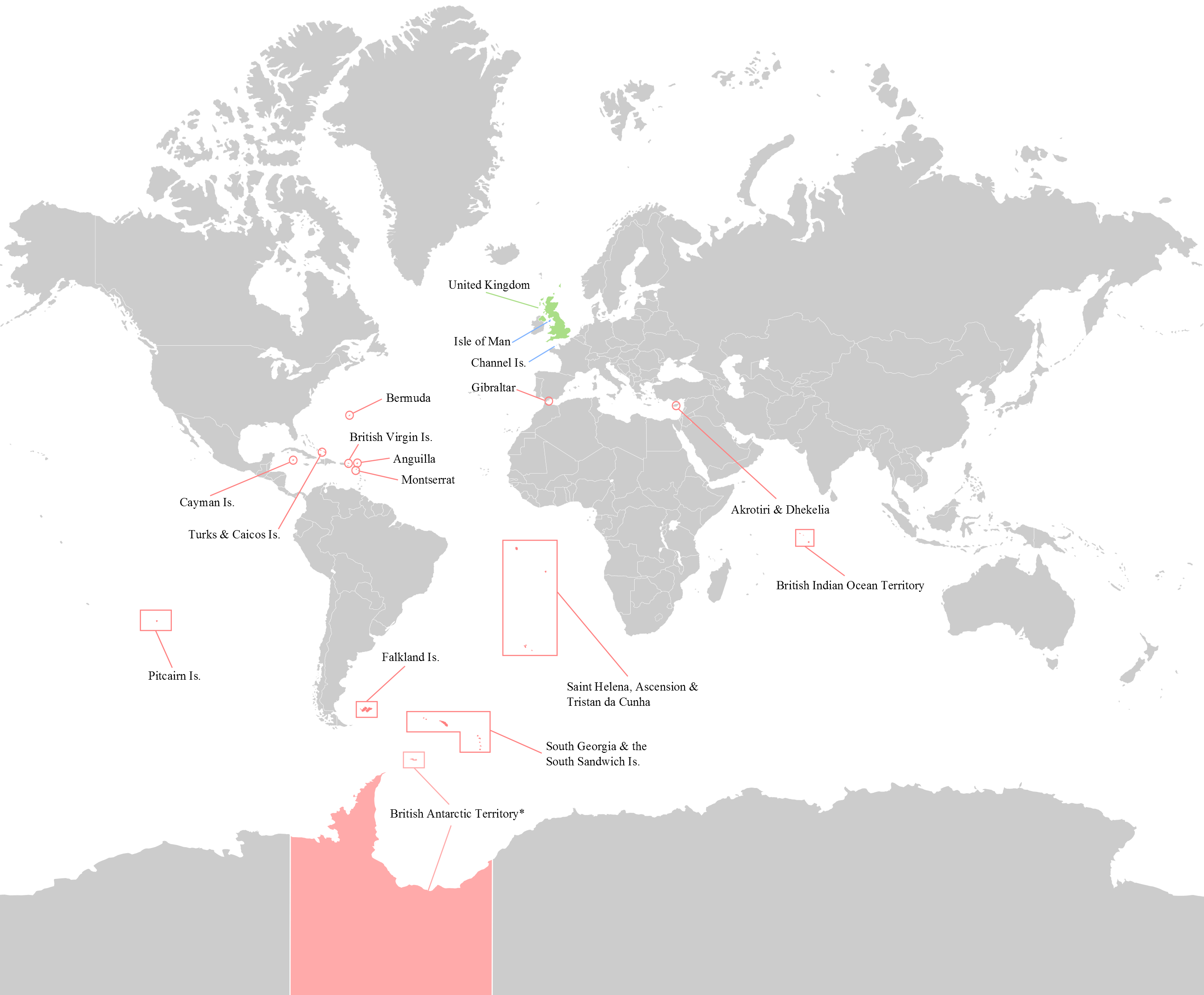
https://upload.wikimedia.org/wikipedia/commons/8/8e/British_...
I'm one of the scientists on Project MIDAS (the team that made the announcement). Happy to answer questions about this. I've also been keeping a spreadsheet of things roughly the size of the iceberg, for journalistic comparisons: https://twitter.com/mewo2/status/818826891545210881