"In bank-based financial systems such as Germany and Japan, banks play a leading role in mobilizing savings, allocating capital, overseeing the investment decisions of corporate managers, and in providing risk management vehicles. In market-based financial systems such as England and the United States, securities markets share center stage with banks in terms of getting society’s savings to firms, exerting corporate control, and easing risk management." [1]
France is a bank-based economy. Britain is market based. London's financial dominance pre-dates the EU for good reasons.
[1] http://documents.worldbank.org/curated/en/259341468739463577... Introduction, Table 11, Table 12
Postscript:
"• In higher income countries, stock markets become more active and efficient relative to banks. There is some tendency for national financial systems to become more market oriented, as they become richer.
• Countries with a Common Law tradition, strong protection of shareholder rights, good accounting regulations, low levels of corruption, and no explicit deposit insurance tend to be more market-based.
• Countries with a French Civil Law tradition, poor protection of shareholder and creditor rights, poor contract enforcement, high levels of corruption, poor accounting standards, restrictive banking regulations, and high inflation tend to have underdeveloped financial systems." page 5
Lets first have a look where Common Law exists [1]. OK, that's pretty easy: It is FVEY plus some islands.
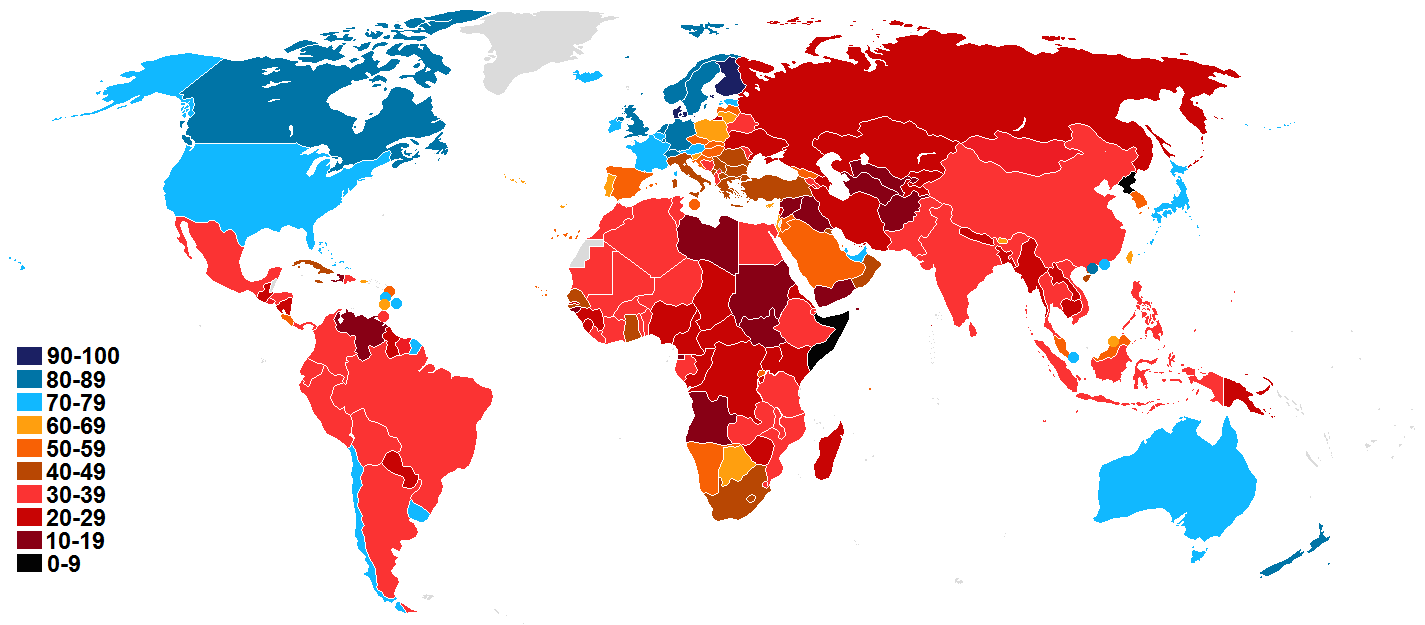
Now lets have a look at the Corruption Perception Index [2] (alternatively, just check the picture at [3]). The UK and US are at place 12 and 17 respectively. The top 10 is comprised of: Denmark, Finland, Sweden, New Zealand, Netherlands, Norway, Switzerland, Singapore, Canada, Germany. I count 2 common law (New Zealand, Canada), and at least 7 Civil Law (I'm not including Singapore because I don't know what kind of law system they have; the list is including that pesky Germany who according to your source have high corruption). I fail to see your pattern.
[1] https://upload.wikimedia.org/wikipedia/commons/9/92/Map_of_t...
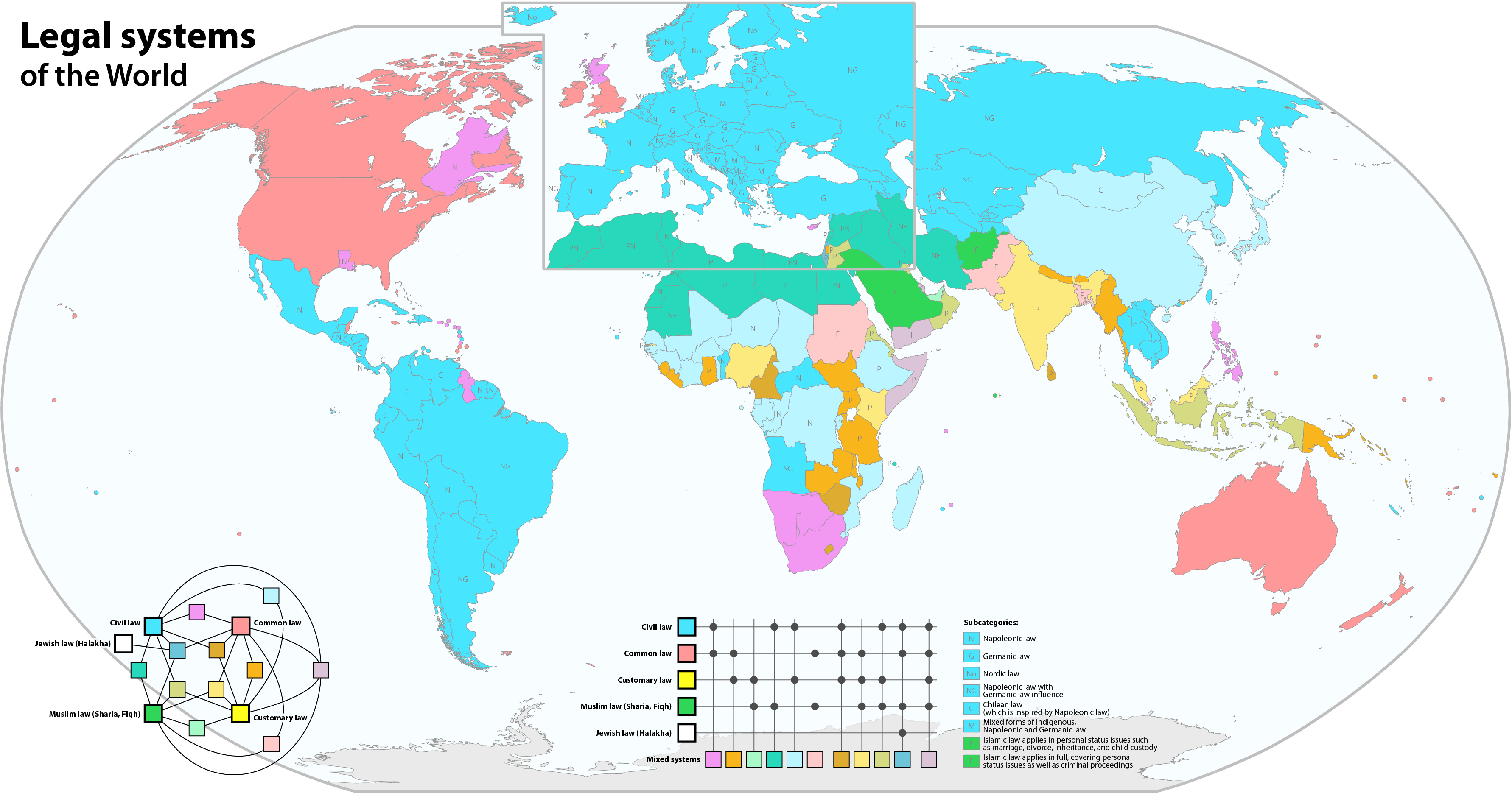
[2] https://en.wikipedia.org/wiki/Corruption_Perceptions_Index
[3] https://upload.wikimedia.org/wikipedia/commons/b/b4/Transpar...
London bankers' skills are unlikely to efficiently translate to Paris. Moreover, Paris can support less financial activity for having a bank-based economy--banks can't process at the throughputs markets can.
> I fail to see your pattern
The paper considers more than ten European countries. I included the postscript because I found it interesting, not because it's particularly germane to the article topic.
I replied because I saw your quote contained a possible inaccuracy. When I investigated that specific part, I found contradicting proof of a causal relationship between French Civil Law tradition and corruption. Which is what your quote was implying. I didn't attempt to verify anything else, but I'm highly skeptical.
Either that, or I read wrong and what is being implied with:
> Countries with a French Civil Law tradition, poor protection of shareholder and creditor rights, poor contract enforcement, high levels of corruption, poor accounting standards, restrictive banking regulations, and high inflation tend to have underdeveloped financial systems.
(Emphasis mine.)
is that these are all requirements due to and.
Which further is suggested by the quote hereunder that countries with high income such as France, Germany, and Benelux (all of which are original members of the EEC/EC) are not meant to be included in the list you mentioned.
> In higher income countries, stock markets become more active and efficient relative to banks. There is some tendency for national financial systems to become more market oriented, as they become richer.
But hey, if you want to prove your point feel free to prove -with sources- France, Germany, and Benelux each have:
* Poor protection of shareholder and creditor rights
* Poor contract enforcement
* Poor accounting standards
* Restrictive banking regulations
* High inflation
The paper divides economies into three buckets: market-based, bank-based and underdeveloped. It does this by looking at economic factors. It then looks at what other factors, Y, are similar between countries in each bucket. This doesn't work going backwards.
By analogy, suppose I have circles, squares and triangles in blue, green and orange. It is meaningful to group by shape. It may also be meaningful to observe that 90% of the triangles are blue. It does not follow that a random blue shape is a triangle.
I know it doesn't because the paper is linking certain properties it observes without proving the causation, and then tries mention them as if they're relevant while in reality there's no relevance shown.
(For example, an alternative plausible explanation could be a relation between corruption and wealth.)
> By analogy, suppose I have circles, squares and triangles in blue, green and orange. It is meaningful to group by shape. It may also be meaningful to observe that 90% of the triangles are blue. It does not follow that a random blue shape is a triangle.
Imagine shapes and colours can change, and there's no proof the change is related to the shapes or colours. Imagine the conclusion for the 'blue' is 'beautiful'. Does it then matter to mention that the blue ones happen to be 'beautiful' and 'mostly triangles'? Is it a relevant conclusion that the 'non-beautiful' are 'mostly not triangles' or 'that they are not beautiful because they're mostly not triangles'? The latter is what your quote implied, and its merely suggestive. You have no proof.
Because correlation is not causation. So why does the paper mention it? If you're not willing to prove the missing point, why do you quote it?
I'm not saying Paris isn't a financial centre. It's just in a different league compared to London, NYC, Singapore, Hong Kong or Tokyo.
> The physical location of the trading desks relative to the markets matters little
Making markets requires plugging into financial and political power structures. Due to home-country effects, buyers and sellers of a security tend to congregate around the issuer.
A Singapore desk will hand off to New York to execute an order by a Singaporean buyer and American seller. Note: we're not talking about hedge funds. We're talking about investment bankers, sales-traders and market makers--relationship-driven businesses.
That's true. But the point here is that a lot of London's banking depends on unfettered access to the EU markets, and so the question is not "which city", but "which city in the EU" will take over once the UK exits the EU.
> Making markets requires plugging into financial and political power structures. Due to home-country effects, buyers and sellers of a security tend to congregate around the issuer.
That matters for some roles, but certainly not all. But this same arguments also is part of the exact reason why the UK faces an onslaught post-Brexit.
But how come (French) Civil Law is to be 'a bug'? To me Civil Law seems superior, because it tends to make law more codified and less informal. In return it seems to be more affordable for the masses. If you're considering where to locate your startup for example, the differential in litigation costs between UK and Germany is said to be 3 to 1. But really, I'd like to know what you think.
The paper divides economies into three buckets: market-based, bank-based and underdeveloped. French Civil Law is found in a disproportionate number of underdeveloped economies. I suspect this has to do with France's colonial traditions more than the merits of civil versus common law. (Based on what I've read, both legal systems have produced advanced, albeit structurally different, economies.)
[1] https://en.wikipedia.org/wiki/Common_law#/media/File:Map_of_...

[2] https://de.wikipedia.org/wiki/Common_Law#/media/File:Common_...

Not to mention, France is increasingly an outlier in Europe with a punishing corporate income tax rate (33%). Most of their European competitors have been slashing that rate the past decade plus: Netherlands 25%, Spain 25%, Austria 25%, Sweden 22%, Denmark 22%, Portugal 21%, Finland 20%, UK 20%, Iceland 20%, Czech 19%, Poland 19%, Switzerland 17.9%, Ireland 12.5%. The average across Europe is about 20%. Why would an international bank want to be there, except for local French business purposes?
Only Frankfurt and London are at a similar level as Paris in the EU for banking today, and if London ceases to be a viable alternative (due to passporting etc. post brexit), then Paris will end up taking a lot of that business for the simple reason labour laws and taxes are not the only things the banks need to care about, but also where their employees are willing to live and work.
My ex works in HR at executive level at a major investment bank. French labour laws etc. never comes up when they consider where to staff up/down (and they do continuously). As for corporate taxes, no investment bank has a problem finding schemes to shift profits around.
> They do have a lot of bad labor laws and quite high taxes, both of which have contributed to France having a very stagnant economy (both in terms of innovation and growth) for decades.
Their GDP per capita is largely moving in lockstep with the UK and Germany, despite far fewer hours worked per year for the average French worker. As it turns out there's very little evidence that these "bad labour laws and quit high taxes" have much impact on growth.
> Not to mention, France is increasingly an outlier in Europe with a punishing corporate income tax rate (33%).
In line with Germany.
> The average across Europe is about 20%. Why would an international bank want to be there, except for local French business purposes?
They are already there for purposes other than "local French business purposes". Many international banks have similar numbers of staff in Paris as in London.
> In line with Germany.
The problem in France is not corporate income tax, as some huge companies do not pay that tax with creative but perfectly legal accounting. The problems are with the "taxe professionelle" which is not based on revenues and the taxes on labour. If some employee receives 2000 euros, usually the company has to provision 3000 to 4000 euros. Most of those labor taxes go to the social security organism which has a budget as large as the state budget. (Edited for grammar and clarity)
This is similar in the UK with employers national insurance contributions.
Total tax wedge in France is higher than the UK and higher than the OECD average, but still in line with Germany according to the OECD [1], just as I stated. Note that the OECD tax wedge data covers total cost paid by both employees and employers.
The "Taxe professionnelle" was abandoned in 2010/2011.
https://fr.wikipedia.org/wiki/Contribution_%C3%A9conomique_t...
Wrong. With the exception of the French banks Natixis, BNP Parbias and Societe Generale...Investment banks have far greater staff in London vs Paris.
Hilarious. Did you know that London is the 7th largest French city? Those people are not here for the weather. And Frexit is not off the cards either.
The French consulate publishes inflated estimates without evidence for obvious self-serving reasons, but verifiable data from the ONS is singnificantly lower than that.
Le Monde's estimate, also given in the article and based on a comparable INSEE data would make it 23rd.
Repeating ad nauseam the unsubstantiated claim that it's the 7th largest French city when all evidence suggests it doesn't even make the top 20 is not a worthwhile contribution to this discussion.
The bank my ex works at has as many traders in Paris as in London, for example, and that's fairly common.
I don't doubt there are many French traders in London - these banks shifts staff and roles around as if they're commodities. But that doesn't change the fact that Paris has a large proportion of the EU financial industry. Not as large as London, but substantial enough for Paris to be a major financial centre.
If London finance is 5 times Paris. It's enough to make it a major financial center yet it's laughable at the same time.
It's not a question if banks will move some portion of staff out of London, but how many and where they go.
London does have more than Paris, but Paris and Frankfurt are the only two other EU cities that consistently get listed amongst the top global financial centres.
What exactly that means in hard cash depends on what you want to count and how, and so the rankings vary greatly depending on who you ask.
Still no sign of movement.
[1] http://www.ccomptes.fr/Publications/Publications/Les-preleve... (in French)
Can you elaborate on the bad labor laws?
But I only have a small experience of the consequence of our current labor laws (which are very hard to change, the current gov tried last year and got massive protests for their trouble).
Edit: Also the employment taxes (the one paid by employers) are very high in France (half of the salary +/-).
Maybe there's a "management class" distinction?
I wouldn't think that would be a big draw for finance types, especially when there are other markets in the EU that seem like they would be more tax friendly (Ireland, Luxembourg, Switzerland, Frankfurt), while still being close enough to other centers of power.