News for hackers. Stuff that matters.
Re:Google Trends Electionland by NelsonMinar on Tuesday November 08, 2016 @11:32AM (#12901576)
It's pretty but what is this really telling us? There's a 126% increase in searchers for "Voter intimidation" in Hoback, Wyoming. OK, so does that mean that someone's being intimidated? Planning to intimidate? Curious about the news? Does a "126% increase" mean there were 7 searches today instead of just 4?
Re:Google Trends Electionland by nostromo on Tuesday November 08, 2016 @12:07PM (#12901937)
It's meaningless.

Near Seattle there are trends reported for "voter intimidation" and "long wait times" and "voting machine problems."

Those trends make no sense for a region that votes by mail.

Re:Google Trends Electionland by Pigo on Tuesday November 08, 2016 @01:36PM (#12902741)
I'm going to search for intimidation and see if it pops up on the map, sorry everyone
Re:Google Trends Electionland by perfectfire on Tuesday November 08, 2016 @01:40PM (#12902781)
I'm assuming you don't want to tell us where you live, so please update us on whether it showed up on the map or not.
Re:Google Trends Electionland by folksinger on Tuesday November 08, 2016 @12:31PM (#12902171)
The reports of "voter intimidation" on the electionlandstrends map matches the boundary of this racial demographic map.

http://www.censusscope.org/us/map_nhwhite.gif
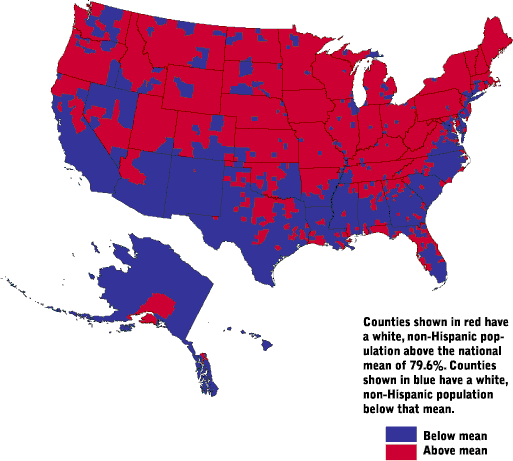
Here's those two maps combined:

http://i.imgur.com/eKT5s0h.png

Re:Google Trends Electionland by nostromo on Tuesday November 08, 2016 @12:32PM (#12902182)
Re:Google Trends Electionland by folksinger on Tuesday November 08, 2016 @12:35PM (#12902208)
Yeah but the maps I'm showing don't follow general population density so the point being made by this comic doesn't apply in this instance.
Re:Google Trends Electionland by arcticfox on Tuesday November 08, 2016 @12:51PM (#12902360)
Unless I'm reading something on your graph incorrectly it's almost perfectly correlated with Martha Stewart Living subscribers. Looks like it applies almost exactly to me.
Re:Google Trends Electionland by folksinger on Tuesday November 08, 2016 @01:07PM (#12902501)
Well I already did the work I'm willing to do on my end. Further research would obviously have to take in to consideration deviations from general population density, but just looking at the map, there's a lot of voter intimidation being reported in the south that clearly has nothing to do with population density.

Also, there's no correlation with voter intimidation and population density for cities in the midwest.

So I guess it's just my word and my graph against your word and, well, nothing else. So you better get to work!

Re:Google Trends Electionland by idanoeman on Tuesday November 08, 2016 @01:23PM (#12902626)
I'm not sure why you're pretending that it should be someone else's job to prove the point you're trying to make. You threw up a graph which looks identical to a population-density graph and are pretending you gave us evidence of your assertion.
Re:Google Trends Electionland by folksinger on Tuesday November 08, 2016 @02:29PM (#12903204)
No, I'm saying that he has to provide a better refutation of my point.

I do not agree that the graphs look identical.

What point am I trying to make, BTW?

Re:Google Trends Electionland by arcticfox on Tuesday November 08, 2016 @01:24PM (#12902635)
Except your graph doesn't seem to support your point...IMO it's your word vs. your graph.
Re:Google Trends Electionland by folksinger on Tuesday November 08, 2016 @02:36PM (#12903265)
Prove it.
Re:Google Trends Electionland by alexbeloi on Tuesday November 08, 2016 @02:29PM (#12903203)
The boundary is where racial demographics are closest to the national average, are you arguing that voter intimidation is more likely in places demographically similar to average national demographics and less likely in places statistically further from the average (either higher % white people or higher % non-white people than national average)?
Re:Google Trends Electionland by farright on Tuesday November 08, 2016 @04:53PM (#12904277)
I'm honestly not seeing an relation there.

The problem is that both follow a very non-uniform pattern and so it's hard to even define what a "correlation" would look like.

Re:Google Trends Electionland by thesimpsons1022 on Tuesday November 08, 2016 @12:16PM (#12902022)
i'm searching this stuff in california. not because it's happening to me but i want to hear about the horrific things happening in north carolina and elsewhere.
Re:Google Trends Electionland by mtgx on Tuesday November 08, 2016 @12:12PM (#12901980)
How come? I would think the opposite. Voting from home absolutely applies to "voter intimidation" situations. Someone could literally be in your home with a gun to your head, making you vote the way they want you to vote.

The same problem as well as vote buying applies to online voting, too. But those are not even the biggest problems with online voting, so most people tend not to focus on them.

Re:Google Trends Electionland by bowmessage on Tuesday November 08, 2016 @12:24PM (#12902100)
Voting machine problems though?! There are no voting machines here.
Re:Google Trends Electionland by Sacho on Tuesday November 08, 2016 @12:45PM (#12902308)
If you dont have voting machines, it would make sense for you to google about them to understand what other voters are talking about, no?
Re:Google Trends Electionland by ethanbond on Tuesday November 08, 2016 @12:59PM (#12902431)
Maybe, but that's kind of the point. A search string + location + change in occurrence tells you literally nothing.
Re:Google Trends Electionland by jpalomaki on Tuesday November 08, 2016 @05:49PM (#12904652)
They are tracking what search terms people are using to search from Google. These search terms have been grouped under few headings, like "voter intimidation". Looks like they are not telling what search terms are actually used. Maybe this is to prevent people from gaming the system.

"[...] To ensure the map includes the most relevant trends, we compiled a list of ways English and Spanish-speaking voters might indicate voting issues through their search queries on Election Day, by looking at historical data from 2012 Election, Super Tuesday 2016, and early voting 2016. We combined hundreds of the most relevant search terms around the following voting issues [...]"

https://medium.com/google-news-lab/how-google-trends-data-wi...

Re:Google Trends Electionland by alistairSH on Tuesday November 08, 2016 @11:40AM (#12901658)
And increase since when? What's the baseline?

I would expect most of these searches to increase in frequency on election day, even relative to SuperTuesday or 2012.

Re:Google Trends Electionland by listentojohan on Tuesday November 08, 2016 @11:42AM (#12901674)
Good points, I thought the same, but they actually address that if you click the logo (though it's just a possible explanation of how that data point might be explained): "FEARS OF VOTER INTIMIDATION KEEPING PEOPLE FROM THE POLLS

We’ve had a lot of reports of people worried about going to the polls because of threats of voter intimidation. While the fears are real — and we certainly expect to see one-off issues of attempts at intimidating voters (like the Trump supporters will bull horns in West Palm Beach) — there is no evidence to suggest that an organized campaign to intimidate voters is underway. "

[1] https://projects.propublica.org/electionland/

Re:Google Trends Electionland by nostromo on Tuesday November 08, 2016 @12:02PM (#12901883)
Like everything in politics, there's an ulterior motive to many of those reports.

"They don't want YOU to be able to vote!" is a great way to get your people to vote.

Re:Google Trends Electionland by fny on Tuesday November 08, 2016 @12:13PM (#12901994)
The most value I see here is the map presents you way to observe state-by-state disparities about the searches that MAY reflect some state-level, systemic disenfranchisement due to voting laws, disorganization, negligence and like. For example, it's notable that NC has a high concentration of searches for "Inactive Voter Status" compared to a much more populated state like Texas.

Of course, this could just mean people in NC are more curious about "Inactive Voter Status" than the rest of the country... but I would reserve that possibility for search terms like "Voter Fraud" that are a more politicized.