I don't believe this is completely true. How does an economic disparity happen? Through material factors or cultural, ideological, or philosophical factors.
Mexico for various reasons has had an incredibly difficult time having a stable political system. Santa Anna came back from exile and screwed his people over how many times? How many times did power violently sway back and forth between the liberals and conservatives in the early part of the 20th century? Why is Mexico now effectively a narco state ruled by the cartels and crony politicians?
I'll give you a hint: it's not because of resources or good land or good people: all of which it has in plenty. Mexico should be booming due to NAFTA. So much of this development we now see in East Asia could have very easily gone right across the border if it had a working political system.
No, there's clearly bigger issues. Building a new city on the border isn't going to fix that. We already have Juarez.
Colonialism, originally, then maintained due to the geopolitical interests of the wealthier power.
I mean, sure "material factors or cultural, ideological, or philosophical factors" play a part in there somewhere. But the main cultural factor is that New Spain was set up as a colony of extraction for the Spanish empire, with the majority of the population as "conquered" indigenous people. The U.S. was a colony of settlement, populated by mostly Englishmen who were by far the first to obtain any sort of citizenship rights in the U.S. This gave rise to dramatically different political and legal institutions, that after independence gave quite a leg up to the U.S. vis a vis Mexico. The U.S. leveraged that leg up to: annex one third of the Mexican territory (including some of its currently richer areas, like California), intervene in Mexican politics (see. Monroe Doctrine, and Cold-War Era support for single party rule).
Sure, the crony politicians and cartels are Mexican, but the U.S. also had clientelism and Mafia just about a hundred years ago, and is not like the cartels' weapons and the government logistic support doesn't come from up north (not to mention the market for drugs...). What the U.S. didn't have to go through, in the same period: Conquest (unless you are Native American), Encomienda/Exploitation (unless you are African American), Dictatorship, Two foreign interventions, 70 years of single party rule...
The wave of revolutions in Latin America were mostly led by them because they stood to benefit most in the new order and that continues today. From my travels, I've found that Latin America is just a little bit more colonial in nature with private citizens/corporations having more power than here in the US. For instance, the idea of a private, unregulated paramilitary/militia group being allowed to operate is an anathema. It's also slightly more misogynistic.
I'm painting with a very broad brush. For instance, I find countries like Bolivia to be very progressive with regards to their drug policy and courageous for standing up to the US, asserting their rights and traditions vis a vis Coca leaf production. American drug policy is so schizophrenic as it is willing to take drastic measures to ensure compliance while also being far and away the world largest consumer of narcotics.
Yes, I just finished bringing on Narcos
terms of t
This is a bold claim which you don't really back up. If they can't put together a functioning state where the economy can prosper then they most certainly have their fair share of bad people too, many of them in powerful positions in the state, offsetting all of the good ones.
Just look at the disappearances of people and kids in the country which the state was complicit with. This and other lawlessness destroyed tourism in Acapulco which used to be a primary tourist destination there: https://en.wikipedia.org/wiki/2014_Iguala_mass_kidnapping
Or the foreigner-owned hotels taken over by armed thugs and corrupt judges: http://www.nytimes.com/2016/08/17/world/americas/mexico-tulu...
Or entire towns being taken over by vigilantes because of police corruption: http://www.naturalnews.com/039808_vigilantes_Mexico_armed_ci...
Their all-out war with the cartels hasn't done much to reduce the flow of drugs either, it mostly created a series of power vacuums for the next round of poor kids to take over. The failures in enforcement makes the police/army v cartels comes off as two parties with a very thin line of morality separating them. That's not helping the situation and the opposite of leading by example.
These are just some recent examples. In this environment it's no wonder they haven't developed a thriving (legal) economy. Maybe they should focus on letting the good people run things and take a good hard look at the people they are letting hold power...
There seems to be a culture of turning a blind eye to people in power not following the laws and this is only something they can solve internally by holding up their representatives to a higher standard.
------------------
Yet he soon learned that a family from the distant northern state of Nuevo León claimed to have a title to part of the ejido land, a conflict that had percolated for years.
Mr. Jacquet did not let it deter him. “I looked at everyone else, and we weren’t worried because nobody had lost their land,” he said.
By the late 2000s, though, Tulum had taken off as a vacation destination. Room rates soared, making beachfront properties more attractive as takeover targets.
One of the first significant warning signs for business owners came on Nov. 30, 2009.
That morning, two dozen police officers and a judge descended on Ocho Tulum, a hotel belonging to Mr. Wolf, the American entrepreneur. It sat on beachfront land that he had rented since 2005 under a 30-year lease. In 2006, before he started building, he had learned there was a competing claim to part of the land, but decided to move ahead with the project.
“I heard that it would probably not amount to anything,” he said. “I never thought that I was at risk of losing it.”
He challenged his loss in court, but was defeated after years of litigation.
It's not about the goodness or evilness of people, I believe. It's more about the economic disparities that force people to act more desperately. Hence, corruption, escalating violence, etc.
> In this environment it's no wonder they haven't developed a thriving (legal) economy.
Our democracy was really born 16 years ago. And our economy really got stable about 20 years ago. Sure, the dollar is right now at an all-time high ($1 USD = $19 MXN). However, this has been a gradual decline with a few spikes. It's not ideal, but it's nothing compared to the crises of the past.
For instance, during the 2008-2009 financial crisis, we barely got a hit. If this had happened a couple of decades before, the country would've collapsed. So yeah, while we're still far from having the economy that we could have, I believe that overall it's improving and more stable than it has ever been.
> Maybe they should focus on letting the good people run things and take a good hard look at the people they are letting hold power...
It's not as simple as that.
> There seems to be a culture of turning a blind eye to people in power not following the laws and this is only something they can solve internally by holding up their representatives to a higher standard.
We need systematic changes that include: starting by diminishing the power that political parties hold, enforcing laws, improving education, among many other things.
A "good system" doesn't just mean rewarding the top contributors with more but also implies the existence a strong and fair legal system where human, business, and property rights are respected and criminal law is enforced. That is almost always a necessary prerequisite for capitalism to function (even Adam Smith wrote about this quite a bit in the 1700s) but capitalism usually gets faulted regardless - even when market economies are pigeonholed on top of a) purposefully neglectful authoritarian states or b) places with under-developed legal systems.
There have been plenty of cases in Mexico where rightful owners of land were 'dispossessed' and this didn't happen as a result of a functioning free-market system (which is what I believe you were taking a swipe at).
Whether the land rights were fairly distributed or respected post-colonization is also not a cause/effect result of a market economy but a result of the functions of the state/legal system. It certainly won't help either when responsibility is post-defacto shifted onto markets where the powerless poor will have even less authority than in courts or government.
Stealing a bunch of stuff then shifting previously centralized authority/responsibility over to markets is a sadly common tactic in underdeveloped regions, not surprising there was such hostility towards capitalism in South/Central America in the past 60 yrs where it was rushed in without addressing underlying systemic issues (see also: Russia and parts of eastern europe in 80/90s).
Sure it did. It's just that you haven't yet figured out that "free-market system" is a label that ranks up there with "creation science" in terms of deceptiveness about what it actually labels.
Land-wise, Mexico's got real issues. Its core territory is limited, encircled by mountains, the country has massive desert and jungle areas that make imposing central leadership difficult, and it offers very little in the way of internal or external defenses. Mexico City is shockingly easy to invade via Veracruz, and the US Navy is about the only entity preventing anyone from blockading their primary port.
Mexico's geography isn't awesome.
A lot of their economic limitations are self-imposed, e.g., the 1917 constitutional nationalization of the country's mineral resources killed foreign capital investments of exploration and production.
Oil revenues fund government programs instead of funding Pemex's growth. The state needs its oil revenue to function, which is a major limiting factor.
> Mexico should be booming due to NAFTA.
Despite all the above, it is: http://assets.bwbx.io/images/users/iqjWHBFdfxIU/iDpyf7X2wzkM...
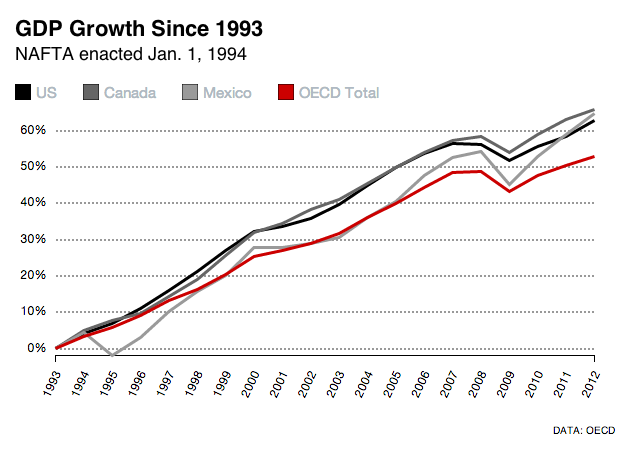
And that's just the on-books economy, which excludes a significant amount of cashflow coming both from remittances, and the narcotics industry which funnels a massive amount of cash into the Mexican economy. The most conservative estimates are staggeringly big: it's a significant percentage of their cash economy.
It's the world's 11th-largest economy. It was 13th just a few years ago.
Their exports are skyrocketing: https://www.stratfor.com/sites/default/files/styles/stratfor...

Foreign direct investment, while obviously highly driven by fluctuations in the US economy, is on balance far higher than they've ever been: https://www.stratfor.com/sites/default/files/styles/stratfor...

> So much of this development we now see in East Asia could have very easily gone right across the border if it had a working political system.
East Asia saw such an influx of investment precisely because their wages were relatively low, thanks largely to their poverty.
You can't have it both ways: either the economy gets to be stable and robust with a functioning government that can control crime, or it gets to have low labor costs, which is what drove the investment in East Asia: relatively lower labor costs.
The narco trade is the one thing probably suppressing wages in Mexico the most, and is, in a very unusual way, driving the shift of manufacturing from East Asia to Mexico. (As is automation.)
But I agree that building a city on the border won't change much (if anything).
The solution we've pursued thus far does indeed make Mexico richer, but it also makes parts of the US poorer. That's a big problem as we've found out this election, and one which both political parties discounted, the Republicans moreso since apparently the nationalist faction of their coalition is larger than the labor faction of the Democrats' coalition.
You can justify current policy with utilitarianism (net welfare of the planet is maximized by globalizing as fast as possible) and realpolitik (we're going to globalize as fast as we possibly can without losing elections).
However whenever change occurs too quickly over the will of the people, there is a reaction and we came very close to upsetting the apple cart this election. I think the opinion makers should set about trying to ameliorate the dislocations caused by globalization rather than trying to accelerate it. The latter course smacks of indifference and hubris.
Trump is grabbing votes from the labor faction more than any past Republican candidate -- his stance clearly taps into the American psyche, that American exceptionalism is real and that every American company should put American workers first. Jobs, jobs, jobs! is a great platform to run on.
Increasing net welfare of the planet by globalizing as fast as possible would undeniably end in failure as the resources would not at all be redistributed evenly, as can currently be seen as plain as day. Globalization is a threat to everybody as it increases instability across the board except for the very wealthy.
There is value in retreating to isolationism.
Foreigners seem to butcher this point with the American exceptionalism BS. There's a simpler and more honest explanation: Americans think American government policies should favor creating American jobs over foreign ones. We lost hundreds of thousands to millions... who knows what current count is... of jobs to outsourcing by greedy businesses. Buying power and stability keep going down which sends ripple effects throughout the economy.
The Trump supports likely want the job security more than the belief that their uniquely perfect or something. I want it to even though I'm a Trump opponent. Incentives for this country should reward people in this country rather than destroy their future.
The world may be ready for more supranational unions akin to the EU but it must occur under a framework where the consent of the governed is respected above all else, and I don't see that happening under a Clinton presidency and neither does Trump.
It's impossible to know for certain how each strategy would actually play out over time, since there are far to many variables, but those outcomes are how I see the different sides approaching it. Globalization isn't for the benefit of the poor of other countries, that's just a positive externality politicians talk up because it's an added incentive.
The democratic deficit springs more from impatience and haughtiness among government officials, than with an actual need to reduce democracy to achieve long-term good policies, I believe.
Globalization benefits the wealthy and global poor, the latter the most. The losers are the middle and working classes of developed countries.
https://www.weforum.org/agenda/2016/07/people-are-angry-abou... See Figure 4.
How is it the responsibility of the American people?
This is a prime example of a tragedy of commons -- we are depleting the resources of America at the expense of Americans. The return on investment just isn't there.
I'm not going to deny that lifting hundreds of millions of foreigners out of poverty is noble but why does the entirety of America's middle class have to be hollowed out? Those foreigners being lifted out of poverty aren't paying taxes to the US, they don't deserve the help they're getting, and the very wealthy aren't at all paying their fair share of taxes.
To say that wealth will simply be created by a burgeoning middle class through replicating the Chinese model is delusional, it implies wealth will simply trickle down and we all know how silly Reaganomics is. China achieved their current status by rabidly enforcing the consumption of Chinese products and services and now they are reaping the benefits, and we have to do the same thing.
China prevented their wealth from escaping through isolationist policies, it is clear that this model is the best way to secure our future. Simply lifting people out of poverty without enforcing domestic consumption is suicide by a thousand cuts.
Because it is better in the long run.
> How is it the responsibility of the American people?
I can't answer that one for you, but I can answer for my own situation (NL): This country got rich over the backs of many people in other countries, if it wasn't for centuries of abuses, war, colonies, mass murder, slavery and exploitation we wouldn't be nearly as wealthy as we are today. This continued right up to 1975 with some nice examples of war crimes right up to and including modern times.
Compared to that wealth the little bit that we end up sharing with the rest of the world is an absolute pittance.
What matters more is good governance _at this time_. Singapore, Taiwan, Equatorial Guinea (despite the "dictator"[1]), Iceland, etc. Poorly governed places with huge natural resources reserves like Brazil, Indonesia, Mexico are doing relatively poorly despite their advantage and potential. They simply need better governance.
[1] Dictators can be economically beneficial (if they execute well) despite the repercussions to open government. Same for S Korea (up until the 90s)
I look forward to the day when society is more enlightened than the current phase we are going through. Luckily, we won't hold the entire current-generation guilty, and their descendants guilty-by-proxy, for the things we are doing under some vague notion of "righting past wrongs", by punishing the innocent.
China prevented their wealth from escaping through isolationist policies, it is clear that this model is the best way to secure our future. Simply lifting people out of poverty without enforcing domestic consumption...
China has the third lowest rate of domestic consumption (as a percentage of income) in the world. The only countries with a higher savings rate (and therefore a lower consumption rate) are Kuwait and Bermuda.
http://www.cnbc.com/2015/10/25/china-savings-rate-versus-the...
Oops.
Water.
"Should we stop exporting corn..."
Mostly.
*"...and industrial machinery too?"
No.
Tell that to, oh, every ex-peasant Chinese urban worker ever. The problem with globalization right now is that workers in rich countries don't own shares in companies doing the outsourcing. Maybe that's what populists should focus on instead of preventing globalisation altogether.
I would wholeheartedly support this if and only if each and every Chinese citizen paid their fair share of taxes to the US, but obviously that will never happen.
The US is being hosed.
The US as a whole isn't being hosed. The USA as a whole benefits from trade with China, but a significant subset of its population is getting hosed because of inequalities in ownership of companies that benefit from the trade. Now if we made sure that every American worker owned shares in those companies, everyone, including workers, would be better off than if there were no trade.
Say I own a factory and it makes 100 million dollars gross per year and I have to pay my American workers 40 million dollars and the other running costs are 40 million. Now I've made 20 million in profit. Now I move operations to Mexico and I pay my cheaper workers 10 million dollars. Maybe I lower my product prices a little but I can still make it away with massively larger profits, which is why I moved operations there in the first place!
Where is the money going into Mexico in any of this? Sure, the government taxes you but odds are that tax is less than in the US, since you wouldn't otherwise set up there (take a look at Ireland for a good example of this). You probably did some greasing up of politicians to get a good deal and much of that tax money is not reaching the people of Mexico in the form of decent services, as is the case in most government expenditure (US military budget anyone?)
Now you say, well I'm hiring Mexican employees who are being paid and can now put that money back into the Mexican economy. This all sounds good in theory but you are paying them the bear minimum that you can (the whole reason you moved over there in the first place, remember) which ionly has to be marginally better, if at all, than the money they were making before you showed up.
It's been shown that NAFTA killed local industry in a lot of Mexico because American companies could sell their products more cheaply to the Mexican market, thereby killing the local competition. This forced people to abandon their businesses and work for American companies for pitiful wages.
Nothing about this neoliberal form of globalisation is helping to alleviate economic disparity in the world. We have seen inequality increase and real wages stagnate in the time since this whole project started.
But haven't you increased the aggregate demand for labor in Mexico, since people who came to work in your factory are no longer doing other jobs? So either total employment could increase as other people start to do those jobs, or wages could rise more than marginally.
(If Google comes to town somewhere and hires away the whole IT department from a local hospital -- even for a 1% pay rise -- presumably the hospital will now be looking to hire some new IT staff.)
Be very careful to note that generally, yes, there are some losers from trade, but that there are more winners: it's a positive sum game. At a theoretical level this means you could take something from the winners, redistribute it to the losers and still come out ahead compared to not having trade in the first place.
There's nothing whatsoever wrong with a shared economic area and huge economic disparity. Consider Bombay, Bangalore or Pune - all lovely places which bring high skill/high income folks together with low skill/low income folks looking to move up in the world. The result is beautiful modern neighborhoods like Koramangala, Bandra or Koregaon park, up and coming areas (described by westerners as "slums") like Dharavi or Baiganwadi, and free trade that benefits everyone. You have rich Parsis/Gujus moving in and working at banks, smart Tamils working in software, poor Biharis driving their Ubers, and everyone benefits.
Do you think Bombay should close her borders to Bihar, or even inland Maharashtra?
The only big issues are political externalities - i.e., Mexicans might vote for politicians that make the US more like Mexico. That's an issue even in the US (California refugees voting for CA-like policies in their new states), and is best solved with disenfranchisement/reduced democracy rather than trade barriers.
GWB got over 40% of the Hispanic vote in 2004. Mexicans tend to be very conservative. That's the truth in California as much as it is in the South. These conservative roots match the Republicans more so than the Democrats, but it's the immigration stance that has tilted Hispanics towards the Democrats, but only recently, and even that is probably a temporary thing.
The notion that the Democrats have Hispanic (and especially Mexican) voters locked up isn't a reality.
> The only big issues are political externalities - i.e., Mexicans might vote for politicians that make the US more like Mexico. That's an issue even in the US (California refugees voting for CA-like policies in their new states), and is best solved with disenfranchisement/reduced democracy rather than trade barriers.
To be clear, regardless of your political stance or your views on immigration, not giving illegal immigrants the right to vote is not the same as disenfranchisement or reduced democracy. For legal migrants, am not aware of anything showing actual attempts at disenfranchisement.
http://latinovotematters.org/stats/
    1980 Jimmy Carter, 56% Ronald Reagan, 35% +21
    1984 Walter Mondale, 61% Ronald Reagan, 37% +24
    1988 Michael Dukakis, 69% George H.W. Bush, 30% +39
    1992 Bill Clinton, 61% George H.W. Bush, 25% +36
    1996 Bill Clinton, 72% Bob Dole, 21% +51
    2000 Al Gore, 62% George W. Bush, 35% +27
    2004 John Kerry, 58% George W. Bush, 40% +18
    2008 Barack Obama, 67% John McCain, 31% +36
    2012 Barack Obama, 71% Mitt Romney, 27% +44
I'd love to see that broken down by race and or nationality.
Their base is a shrinking circle whose circumference is defined by an ourobouros
If the Hispanic vote share would have been what it was in 2000, let alone 1992. Romney would have won. Romney however would not have won with the vote share Bush got among Hispanics with the current composition of the electorate.
http://tino.us/2012/11/why-hispanics-are-natural-democrats-a...
Voting habits have little to do with either philosophy or policy. Black Americans are socially conservative too. It's mostly just tribalism; Democrats are on the same team as Mexicans/Blacks, Trump is on the team of American Vaisya's (see http://unqualified-reservations.blogspot.com/2007/05/castes-... to understand the terminology), etc.
To be clear, regardless of your political stance or your views on immigration, not giving illegal immigrants the right to vote is not the same as disenfranchisement or reduced democracy.
If we legalized them (which I favor), and allowed them to move to the US permanently, it would be disenfranchisement to prevent them and their children from voting.
Note: This article explains nicely why I don't consider disenfranchisement to be a dirty word: http://bleedingheartlibertarians.com/2016/09/expressive-mean...
The word "conservative" doesn't help us much here either. Are black families more likely to attend church than urban white families? Yes. Are older black voters more likely to have strong traditionalist views on marriage and marriage equality? Yes. Are black voters likely to respond to appeals to defer to the authority of the police? Very much no.
Tribalism isn't about policy and it's concrete effects at all. Here's a great Howard Stern interview about it. The gist is that Obama asked a bunch of NY folks whether they support Obama because he wants to stay the course in Iraq or because he's pro life? His supporters agree with him on both policies and are glad he chose Sarah Palin as his VP. (The one McCain supporter in NY was no better.)
https://www.youtube.com/watch?v=GqAiarOhC2U
Similar sketch from 2012: https://www.youtube.com/watch?v=SeJbOU4nmHQ
Tribalism isn't about policy. It's about identity and it seems to be the primary driver of voting. Trump is incoherent, and insofar as he had any concrete policy goals he's backed away from them (e.g. the giant wall of ice). But he shows respect to Vaisya Americans [1] so they support him. I imagine that if I spoke to typical white Trump supporters they would probably be as incoherent as Obama voters in Stern's interview.
This is also why Modi had to go so heavy on Hindutva to get support. "Toilets First, Temples Later" will help far more people, but he needs to ensure strong support among tribalist voters too.
Or even to go with your example, ask why people who incorporate "black" or "non-racist righteous white person" into their identity care so much about blacks being killed by police, and so little about blacks being killed by black civilians? That's directly comparable to the level of attention rural/suburban whites give to terrorism vs murders by rural white civilians. The former is an attack on our tribe by outsiders, the latter isn't.
[1] I'm taking the term from this article. In the US we deny these concepts so strongly that we don't even have words to describe them; as a result Moldbug had to borrow Indian words when discussing it. http://unqualified-reservations.blogspot.com/2007/05/castes-...
I only referred to Moldbug for a description of one particular tribe (Trump's) - ignore that tribe if Moldbug causes you too much angst. I included other examples. Do you have any argument beyond highbrow dismissal and appeals to uncited authority?
That depends on which CA refugees you're talking about--the ones who fled when it was undergoing a red -> blue transition, or the ones that were priced out? The former are political refugees and tend to vote for very anti-(current)-CA policies, whereas the latter aren't exactly analogous to Mexican immigrants in the US--they love everything about CA except the price and are trying to create low-cost CAs in exile, whereas Mexicans are escaping more structural problems and are in no hurry to recreate the conditions that made them left.
For a moment, I thought this was a new slang word I hadn't run across yet.
In Europe this is known as Eurodistricts https://en.wikipedia.org/wiki/Eurodistrict, there are also similar things in Asia but again slightly rarer.
US perceptions of Mexico are - as you mentioned - inaccurately skewed towards a disenfranchised class of Mexicans, notably absent of the privileged class that is completely content with Mexico.
There are already places where the US and Mexico effectively share a cross border municipality/urab environment.
Adding another one won't change anything it can either create a false state if only the richest of Mexicans move in or will result in the same state as many other border urban areas right now where the Mexican side provides cheap day labor and a "safer" platform for criminal activity due to the financial disparity.