It's not something that's nearly as sharply defined in NYC, but there's definitely some racial separation by neighborhood if you look at statistical maps on the subject.
http://www.huffingtonpost.com/2013/08/27/map-segregation-ame...
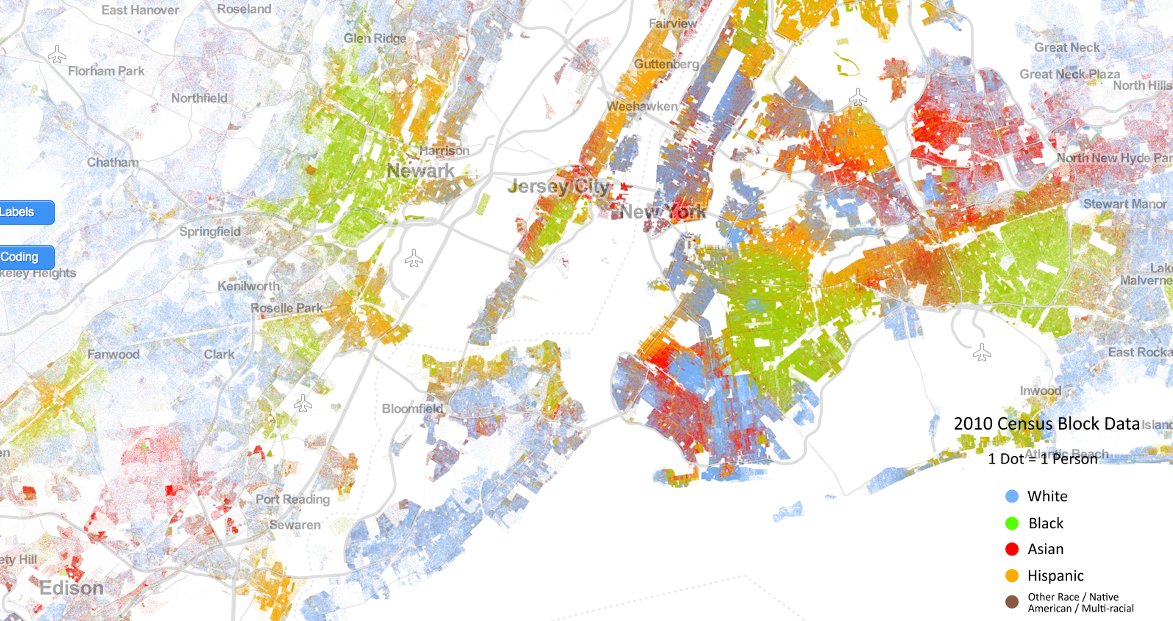
This is a very, very untrue statement. I grew up in New York and both the city and Long Island are pretty heavily segregated by race. Yes, there are areas where there is more integration but by and large blacks live in one area and whites live in another. Housing costs in the city have made it so that integration happens for a while in some neighborhoods but really only when that neighborhood is gentrifying. Post gentrification it ends up being pretty much just white or, if you're lucky, a mix of upper middle class people of varying ethnicity but still majority white.
Ethnic neighborhood is cheap -> Young professionals start to move in -> Integration begins -> Businesses that cater to young professionals establish themselves in the neighborhood -> Landlords slowly but steadily increase rent -> New immigrants and children of existing ethnic tenants move to a different, less expensive neighborhood
Some mixed areas like the South End (50% white), but also the North End (90% white) and Roxbury (8% white). Roxbury and the North End are only 4 miles away from each other.
Not to mention the fact that the fact that Roxbury is only 8% white is primarily due to a huge wave of white flight to the metro Boston suburbs. This happened within our parents' lifetimes. In Boston one of the largest periods of white flight happened to coincide with forced school segregation (bussing).
The east coast may be liberal politically, but it's still also racist. You can see similar themes reoccurring with the rate of gentrification and the rise of charter schools in the city.
The Irish were ultimately pushed out by a mix of Jewish and Italian immigrants (the Jews ultimately shifted to Roxbury and the Italians took hold and established the North End as 'Little Italy').
I don't think gentrification is any more over than it was 100 years ago. It simply cycles.
I disagree. NYC is the same, just at lower resolution. The segregation happens along small blocks and avenues rather than towns. I live along the "tracks" on 4th Ave in Brooklyn. The difference is stark-- both in terms of demographics and steep drop-offs in property prices and rents.
Segregation is not good, but having it at low resolution at least allows some interaction across lines, which is positive. Such interaction is more unlikely when the segregation is at the town or village resolution.
A larger assortment of maps is here:
https://www.flickr.com/photos/walkingsf/sets/721576248126749...
They generally show more mixing than the cities featured in the OP. (Cold comfort if you happen to live in Kansas City, Baltimore, St. Louis, or Chicago.)
I have lived in Kansas City and in St. Louis, and I agree that they are both more segregated than their peer cities in the, say, top 50 US cities. Certainly in Kansas City, the racial covenants highlighted in the article were very much in force when large land developers expanded the city into its suburbs.
It's worth remembering that the racial covenants in force at the time were very popular. Proposition 14 in California, which was specifically written to allow redlining to continue, passed with 65% of the vote in 1964 (https://en.wikipedia.org/wiki/California_Proposition_14_(196...).
NYC is 14 million people -- bigger than lots of whole countries. There are tens of states smaller than it.
Think instead of this trend in NYC as divided into boroughs and neighbourhoods. How many blacks with 5th avenue apartments overlooking the park?
isnt harlem, the bronx, spanish harlem parts of NYC?
i agree nyc is extremely fast in gentrification - but that doesnt make it mixed on the long run
I'd hope that this article would have done a better job in explaining that this isn't the rule but that these are a few exceptions to such.