He infiltrates every level of our life, so much so that when the wife of one of the PM candidates accidentally leaked an email she wrote to his team Murdoch was named specifically.
He isn't even that rich compared to the absolute richest but he owns a huge chunk of the media market here (Newspapers and Sky TV/Sky News) which allows him to set the agenda almost completely.
Between him and Dacre (editor of the Daily Mail - a truly terrible newspaper) they have effective control of the news media and it's agenda in this country and it's terrifying.
His company hacked the voice mail of a dead girl and he walked away from it essentially scott free.
https://en.wikipedia.org/wiki/Economic_inequality#Effects
http://rooseveltinstitute.org/stiglitz-why-inequality-matter...
http://www.economist.com/news/briefing/21640316-children-ric...
Also read "Twilight of the Elites" to learn about how inequality leads to greater "vertical social distance" and how the government now largely reflects the interests of those at the top (http://www.newyorker.com/news/john-cassidy/is-america-an-oli...)
However, I'm not sure I see any actual evidence to support the power theory. The economist article paints a link between education, IQ and income, but not political power. Stiglitz breifly asserts it's truth in point six in his article, but doesn't actually provide any documentation. And similarly, despite clicking through to a dozen promising sources in the wiki, I wasn't able to find any evidence of any sort of trend or change in political power associated to income inequality.
From the Princeton study (http://www.huffingtonpost.com/2014/04/15/government-wealthy-...):
U.S. government policies reflect the desires of the wealthy and interest groups more than the average citizen, according to researchers at Princeton University and Northwestern University.
“[W]e believe that if policymaking is dominated by powerful business organizations and a small number of affluent Americans, then America’s claims to being a democratic society are seriously threatened,” write Martin Gilens and Benjamin I. Page in an April 9 article posted on the Princeton website and scheduled for fall publication in the journal Perspectives on Politics.
“Not only do ordinary citizens not have uniquely substantial power over policy decisions; they have little or no independent influence on policy at all,” the researchers write in the article titled, “Testing Theories of American Politics: Elites, Interest Groups, and Average Citizens.”
Affluent Americans, however, “have a quite substantial, highly significant, independent impact on policy,” Gilens and Page write. Organized interest groups also “have a large, positive, highly significant impact upon public policy.”
I am a little unclear on what you specifically mean by "the power theory".
Do you mean to question the proposed relationship between greater monetary resources and greater (political and social) power? This is something that seems pretty obvious but there are some interesting graphs presented in:
"Economic Inequality and Political Power (Part 1 of 3)", Martin Gilens, 2012. http://themonkeycage.org/2012/08/economic-inequality-and-pol...
"When preferences across income groups do diverge, however, I found that the association with policy outcomes persisted for the affluent but disappeared for the middle class and the poor, as the second chart shows...If federal policy more equally reflected the preferences of all Americans, we would see a more progressive tax structure, higher unemployment benefits, stronger regulation of business and industry, a more protectionist trade regime, more prayer in public life, and less access to abortion."[1]
Another source is:
"Democracy and the Policy Preferences of Wealthy Americans", Benjamin I. Page, Larry M. Bartels, and Jason Seawright, ?. http://faculty.wcas.northwestern.edu/~jnd260/cab/CAB2012%20-...
"There is good reason to believe that the wealthiest Americans exert more political influence than their less fortunate fellow citizens do. Historically oriented scholars like Thomas Ferguson, William Domhoff, Fred Block, and others have long argued that “major investors” or business elites dominate the making of public policy and the agendas of both the Republican and the Democratic parties.1 Jeffrey Winters maintains that the top one-tenth of 1 percent of US wealth-holders constitute an “oligarchy” with decisive power over certain key policy areas related to what he calls “income defense.”2 Jacob Hacker and Paul Pierson describe how Washington has “made the rich richer.”3
"Even without being able to gauge the actual political power of wealthy citizens, we can confidently reject the view that extensive political power by the wealthy would be of little practical importance anyway because their policy preferences are much the same as everyone else’s. On many important issues the preferences of the wealthy appear to differ markedly from those of the general public. Thus, if policy makers do weigh citizens’ policy preferences differentially based on their income or wealth, the result will not only significantly violate democratic ideals of political equality, but will also affect the substantive contours of American public policy."
Which I found from, "Wealth Inequality and Political Inequality" by Bruce Bartlett. http://economix.blogs.nytimes.com/2013/04/30/wealth-inequali...
Or, do you mean to question the proposed relationship between monetary inequality[2] and (political and social) power specifically? There are several links on the Wikipedia page concerning specifically inequality and social cohesion, crime, and social, cultural, and civic participation; all of these are more or less linked to perceived social and political power. However, more specifically:
"Economic Inequality and Democratic Political Engagement", Frederick Solt, 2005. http://citeseerx.ist.psu.edu/viewdoc/download?doi=10.1.1.602...
"It finds that income inequality has a large negative effect on political interest, frequency of political discussion, and participation in elections among those with median and lower incomes."
Another source is:
"Income Inequality and Participation: A Comparison of 24 European Countries", Bram Lancee and Herman van de w erfhorst, 2011. http://www.uva-aias.net/uploaded_files/publications/DP6-Lanc...
"To conclude, although resources are important to explain participation, there seems to be support for the theory that resources are not fully able to explain inequality effects on participation. In addition to the material or neo-material theory that explains inequality effects in terms of resources, we found support for the idea that inequality affects people of different income levels differently through non-material, inter-individual processes. "
Also, Martin Gilens' subsequent blog posts provide further discussion of the effects of inequality specifically.
[1] A blog post, yes, but I believe the data is taken from his book, Affluence & Influence: Economic Inequality and Political Power in America.
[2] Yeah, I'm assuming income inequality is strongly related to wealth inequality, at the very least.
Donald Trump's campaign is populist, not whatever-the-political-opposite-of-elite-is. He is tied for #121 on the Forbes 400, after all.[1]
I don't actually know enough about Brexit to tell what the hell is going on there (like a lot of people, apparently). I do know that some people[2a] are very unhappy that David Cameron called a referendum instead of going through parliament.[2b] See also populism. My feeling, however, is that the anti-immigration thingy has more to do with the UK's own inequality situation.
Individual income taxes have been hovering between 6% and 10% of GDP since WWII; overall taxes have been between 15% and 20% of GDP since WWII.[3]
Now, as far as power being the problem, to the extent of my knowledge there are no facts in politics. All I've got is that, historically, concentrating power into the hands of a small minority seems to be a poor idea; and that most of the modern "rich countries" are de facto pseudo-democracies, apparently in an effort to avoid having ultimate authority concentrated in a small minority. YMMV. Some shrinkage may occur. Not for internal use. Do not taunt Happy Fun Ball.
[0] Unless someone's done gone and created a secret world government without copying me on the memo (Again, dammit!), rich countries' governmental structures should probably be treated in isolation. Particularly the US, which has remarkably little in common with "most rich countries".
[1] http://www.forbes.com/forbes-400/list/2/#version:static
[2a] https://next.ft.com/content/7877a0a6-3e11-11e6-9f2c-36b487eb...
[2b] http://www.economist.com/blogs/graphicdetail/2016/02/graphic...
[3] http://www.taxpolicycenter.org/statistics/source-revenue-sha...
[4] http://www.justfacts.com/images/taxes/federal_state_local_re...
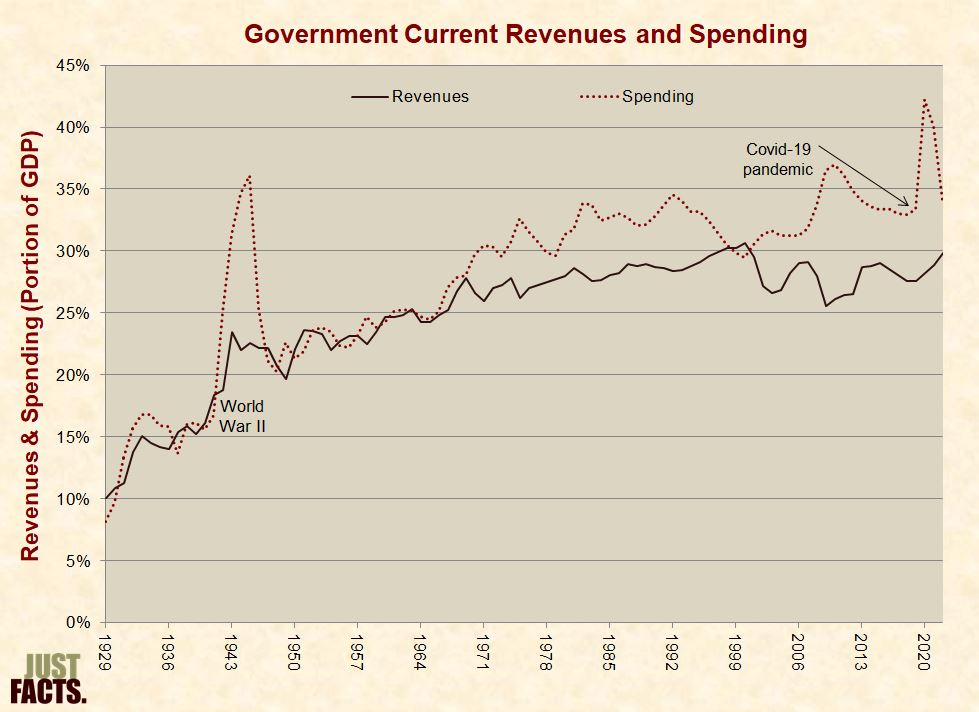
I keep forgetting state and local taxes. I'm from Texas, which doesn't have a state income tax; I'm living in Alabama, which has an income tax rate of something like 4%. Both localities rely heavily on sales taxes to a typical tune of about 9% (and sales taxes are regressive, I'll remind you) and property taxes.
Anyway, check this:
http://taxfoundation.org/article/short-history-government-ta...
Chart 1 duplicates your graph's "Current Revenues" and "Current Spending" lines, while Table 1 shows total gov't receipts as a percent of GDP by (roughly) decade since 1930. In 1950, 22%; 1980, 28%; 2000, 31%; 2012, 26%.
So yes, taxes have gone up. But not spectacularly, certainly not as much as deficit spending, and probably not to the excessive detriment of the "moneyed elite".
You know, if the rich were actually suffering under confiscatory taxes, their percentage of total national income and wealth would be in the decline, but actually it has been steadily going up. Were you really not aware of that?
No problems with offering your opinion. Everybody should be free to metaphorically weak noses. Here is my opinion.
This is only a paradox if you think the median household income is a lot of money. It isn't.
With respect to their power and positions, geeks in our society earn a lot less value than they generate, from scientists to programmers.
The truth is that the USA and Europe contain corporate cartels which control programmer wages. We've already seen this at [Eric Smith]/Apple/Microsoft but it's even worse in Europe where the government endorses wage suppression for STEM employees as part of some insane plan they thought was a good idea at the time. That's why Britain and Germany have shit tech and science sectors in comparison to the States still, despite its factional political disputes threatening to drag it down, which still maintains a certain level of meritocracy.
You'll be unlikely to hear much of this from the established media although the SV wage collusion did come out.
A General Strike of computer programmers would cripple the world economy overnight. I'm an extremely capitalist person, not a communist, but this much is clear. The powers that be are painfully aware of the fact in inverse relation to most engineer's obliviousness to the fact. That they're pissed at that guy in the E-Embassy is not a coincidence because among many things, they're perturbed by his attempts to get a geek rebellion underway.
So we get paid better than most, but nowhere close to a real market wage, which would be in the millions easily. Is there any rational reason other than a power play that makes a programmer earn a similar wage to the white collar professions? This is entirely arbitrary!
If a dentist or lawyer could affect millions of teeth or cases at a moment's notice, you better believe they would be looking to be compensated for that reach.
50% of the households in the United States would think it is more than they are making. Any further conclusions are up to you.
We know men make more money than women. The typical programmer is male.
We know technical professions like engineering make more money than say, working in retail. Most workers are not engineers.
Right there your benchmark is going to be at least twice median household income and we haven't even added the fact computing has been the most influential industry since the railroads and steamships got invented.
So yes, I am quite confident 100k is not a high salary for the kind of work being done.
It would be better to compare many programmers to venture capitalists or inventors than other traditional white collar professions. I repeat my point from the above post. It is all about the scaling factor. I expect a programmer's work to attract white collar wages without the Internet existing. But with it, that's a different story. The fact there's more programmers to compete with is meaningless in comparison to the ability to affect the majority of people on the planet.
Absolute poverty is a solved problem. People rarely starve to death in the US. It's an El Niño year; out here in not-SF we're having a bit of a drought, but no one is seriously afraid of a famine. Sure, there are things like health care that could be better, but those are second-order effects and fairly minor on the poverty scale.
The actual problem is power. (That may not be a popular statement[1] in this forum, where single young adults are commonly making 2-3x the median household income and yet are fond of complaining about disenfranchisement.) Money is power, the power to do things and the power to tell others what do do.
Now, I admit that the technology industry seems spectacularly bad about translating it's assets into political power, so it may not be apparent to people reading this, but I don't expect that to last forever. (C.f. Thiel and Gawker.)
On the other hand, a lot of money in a small number of hands is not in the hands of the tech industry. Consider the Kochs, or Citigroup/JP Morgan/Goldman Sachs. That money buys politicians, to an extent, but it also buys agendas, access, and, rather amazingly, consensus. (Why do Americans seem to have a weird habit of voting for ideology instead of their presumably enlightened material interests?)
This power held by a few people means that the actions of a country may not necessarily be in accord with the wishes of its citizens. Take a look at the third graph in the article. The peak of the England-Wales line is roughly 1825-1875, roughly the high point of the British Empire and, strangely, including things like the Irish famine.
But, fortunately, for the likes of you and me, there isn't a problem. Yay. (As long as no one sets up guillotines.)
[1] Dare I say it?: not a politically correct statement.