Who do you think was pushing for proposition I (an 18 month development moratorium in the mission) to pass? It wasn't homeowners, that's for sure. It was renters living in the Mission who were (not incorrectly) terrified that new development means they will get evicted and displaced.
Why did 60% of SF voters (keeping in mind only 30% are homeowners) vote for Proposition B, requiring a city wide up-or-down vote on all new waterfront development over 40-80 feet? A measure that was also endorsed by multiple major newspapers? Because people are afraid of everything changing too quickly and the nice beautiful waterfront turning into midtown Manhattan.
It's complicated. This isn't homeowners giving the middle finger to everybody else. The situation is more akin to existing residents fighting against future residents. Though whatever the situation is, pointing fingers at individual constituencies instead of trying to understand the problem holistically is not helping anything.
New development as the cause of displacement is just outright misinformation. There has been very little development in the Mission:
https://rationalconspiracy.com/2015/05/25/new-york-times-mak...
There is an extremely strong negative correlation between development and housing prices across cities:
http://www.spur.org/sites/default/files/wysiwyg/asking.price...
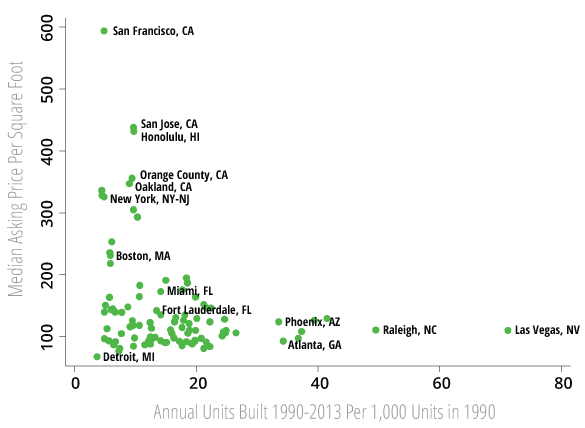
This is an excellent writeup by Jason Furman, chief economic adviser to President Obama, which explains in detail how land use restrictions make cities expensive (and cause other problems besides):
https://www.whitehouse.gov/sites/default/files/page/files/20...
This is such a bizarre idea.
How exactly do renters get displaced by adding more housing?
"Because the actual building they live in gets demolished to build another building"
This happens very rarely, people will literally revolt before a rent controlled unit gets demolished in the mission
So someone opposing more building in the mission falls into the first two categories and they are extremely selfish
http://sfist.com/2016/03/29/report_evictions_continue_to_inc...
This is such a stupid myth. On par with "vaccinations cause autism" or Bigfoot.
Science has studied how price depends on supply and demand very thoroughly. Increased supply always leads to lower prices.
Not in real estate economics. Housing isn't a commodity market. There are firm price tiers, different methods of construction, different fixed costs for those methods, and drastically different markets for individual neighborhoods. Real estate isn't fungible and it's isn't particularly liquid. Basically none of the requirements of Econ-101-style supply and demand are met in the world of real estate. Building skyscrapers is nothing like creating an assembly line for widgets.
So yes, "construction" has some small aggregate effect on the price of a rental in the city, but that effect is meaningless to you if your affordable building was knocked down to make room for a luxury skyscraper.
Moreover, if you do happen to overbuild housing in a market, the price sags. Developers then almost immediately stop building, because the costs of new construction don't decline with scale. Thus, price controls enabled by construction happen on the order of decades, not years. Neighborhoods gentrify much more quickly.
In practice, a low-density neighborhood gentrifies, land values go up, and developers start to replace cheaper, low-density construction with expensive, high-density construction that can only be justified because of the higher land values. Existing residents are displaced. Ideally, those residents then move to a cheaper neighborhood. If no such neighborhood exists (because, say, you're in a small land-locked city with more millionaires per capita than anywhere on earth, and no remaining "undesirable" land), then those residents are, indeed, completely displaced. The fact that luxury apartments are theoretically $30 a month cheaper in some other neighborhood is thin gruel.
Increased supply leading to higher prices would be something that Economist would crawl over each other to study, if true.
So where are these studies?
Who are the professional economists who support this view?
https://www.washingtonpost.com/news/wonk/wp/2016/02/12/the-p...
"None of this dismisses the fact that displacement from specific homes happens when low-income housing is literally knocked down to build high-end towers. A good amount of new supply in cities, though, can rise on under-utilized land (former industrial plots, surface parking lots, abandoned properties, etc.). And the cumulative effect of all that new supply can hold down rents across neighborhoods and cities, including for the poor."
Nobody thinks that new housing is bad - in the long term. Where economists start to disagree is how to prioritize low-income housing and market-rate construction in the near-term:
https://www.washingtonpost.com/news/wonk/wp/2016/02/19/how-t...
"To be sure, more supply is needed, but unless it is targeted to those who need it most, it will only help wealthier residents."
"'Filtering,' where older housing units trickle down to lower-income families as they age, can happen in the broader metropolitan context. But it can take decades for filtering do deliver truly affordable units to lower-income households. As apartments age, the rent of a typical unit – not in a hot area - declines an average of 0.31 percent per year so even after 30 years, the rent will have fallen by only 9 percent."
"In gentrifying neighborhoods, filtering does not work at all, because land values and rents rise as the neighborhoods become more desirable and developers bid up land values. So lower-income households must look in other neighborhoods where services and schools are likely to be much weaker. Hence the gentrification process can reconstruct economic segregation."
The second article lets various people give their reaction to the first one. The non professionals say what they usually say. But the Berkeley professor of economics answers my question very clearly:
Economic research on this topic is unanimous. There is no question that on net, adding more units tends to lower rents. All existing peer-reviewed academic studies — including work done at Harvard University, the Wharton School at the University of Pennsylvania and by me at UC Berkeley — find that more housing supply results in lower rents and house prices, everything else being constant.
Filtering does work, but as you point out, it takes time: https://oregoneconomicanalysis.com/2016/05/25/housing-does-f...
But just because the best time to build more was 30 years ago doesn't mean now isn't a good time to start.
Also: if you are adding expensive housing it takes some pressure off of the cheaper housing that would otherwise be the 2nd choice of those going into the expensive housing.
Supply has gone up, but demand has gone up even more.
- A building owner doubles his rents from $3000/month to $6000/month. What happens? Everyone moves out. The high price eliminated Demand for that building.
ANALYSIS: When the owner tried to jack up his rents too high, it created an excess supply of $6000/month units and not enough demand. What will happen to that owner? ANSWER: go out of business or increase Demand by lowering his asking rent. CRUX: owners only have 'pricing power' matching the strength of demand, they cannot just start 'greedily' raising rents.
Now assume Zynga opens up shop in the neighborhood. Does demand increase for apartments? YES. There are hundreds of new renters.
Building owners see they get 20 applications now for a vacancy instead of 5. They raise their asking rents to $3100 and people pay it due to lack of Supply of units.
The owners cannot raise the rent unless Demand increases. But in San Francisco, which has become much more of a Tech hub over the past 20 years, Demand for apartments has increased. Supply hasn't kept up.
INCREASE IN DEMAND = more applications for a vacant unit = HIGHER RENT because lack of supply means renters have few choices.
Okay, now assume Zynga goes out of business.
Does demand DEcrease for apartments in the neighborhood? YES. There are hundreds of fewer renters.
Building owners see they get 5 applications now for a vacancy instead of 20. If they keep the rents at $3100 there is now an excess supply of expensive units. They must lower their asking rents or wait longer to fill a vacancy and lose money on an unrented unit.
I own/operate rental properties. Supply and Demand is alive and well in the apartments realm on the Peninsula.
During the worst parts of the recsssion we had 20% vacancy (normally it's between 3% to 5%).
Demand for apartments dropped precipitously. Did we lower our rents? We had to. We entered a 'race to the bottom' competition with other rental property owners.
THERE WAS AN EXCESS SUPPLY OF APARTMENTS in the 2008-09 recession. Rents dropped.
Right now there is a lack of supply of units because Demand rose as the job market got healthy.
Rents are higher.
When Demand drops in the next few years in the next recession (due to layoffs, tech firms folding, etc.), will my firm have to lower our asking rents?
OH BABY. Yes indeed. It hurts too.
The argument 'Supply and Demand don't apply to housing' is patently false.
During a recession, there's lower Demand for units (fewer people working; living in parent's basement or leave the area). RENTS DROP.
During a healthy job market, there's higher demand for apartments (more people working -- move out of parent's basement; and new people get hired locally and move to the area). RENTS INCREASE.
The argument that 'everyone must have an apartment in San Francisco, regardless, if they want one' is BOGUS. If you cannot afford to live there, that's YOUR FAULT. Not the city's fault. Not Zynga's fault. YOUR FAULT.
We don't in practice have "1 person, 1 vote". Because of the influence of money in politics, the effective reality is somewhere in between "1 person, 1 vote" and "1 dollar, 1 vote". There are far more dollars on the property owning side.
Yes, but many renters are covered by rent control, and thus immune to increasing market rents.
To repeal segregation laws that are supported by the public, you're going to need a desegregation movement. Here's one: https://www.facebook.com/DesegregateATX/
I can't say I blame them, either. It's nice having some quiet - four families in the lot next door means 4x more noise, cars, dogs, parties, etc.
Difference here is that you can live insanely cheap in the suburbs, so most end up doing that, but with no reasonable public transport and no current ridesharing, it's a mess that will continue to grow.
Our affordability crisis is a charade. It was manufactured by selfish people looking out for their own interests without caring about the consequences. They have segregated our cities by income, and pushed people away from jobs and communities that would've improved their lives. Our cities must be desegregated. This injustice must end.
Maybe instead of paying linear tax based on purchase price, we could implement a reverse logarithmic scale for property tax % based on state / national / something average sales prices / sqft that would be re-assessed yearly. And then either apply that to all new home purchases, and when enacted, allow existing home owners to opt-in ( recent buyers ), or opt-out.
Increasing as-of-right development opportunities can potentially actually increase land values. Definitely bad for condo owners though.
Why? I would assume, as the area gets denser, more popular, more shops, more restaurants, that also condos go up in price?