This meant that individual account holders were much more tolerant of chip-and-pin technology, and demanded additional security features like portable card readers, which mean that the credit card never leaves the account holder's possession.
Edit: it's also not true in France now: http://www.french-property.com/guides/france/finance-taxatio...
http://www.paymentscardsandmobile.com/wp-content/uploads/201...
I am unable to find good data on fraud rates in Europe going back before chip-and-pin, but the system reduced fraud in the UK by ~60-70%, at least for face-to-face transactions:
http://blog.unibulmerchantservices.com/wp-content/uploads/20...
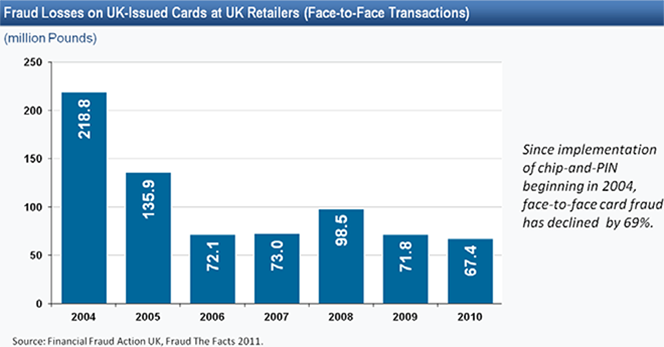
So the UK almost certainly had significantly higher fraud than the US before rolling out chip-and-pin. If seliopou is right, then this was also true for France.
Let me know if you can find better Europe-wide data.
A processor does not charge lower fees for chip cards in a vacuum, they do it because they expect to eat less fraud from chip cards.
http://www.paymentscardsandmobile.com/wp-content/uploads/201...
Losses due to fraud are much easier to eat in the US because of the 10x larger fee.