Blue water is groundwater (1/4) and you may be able to say the same thing about it. Some blue water comes from underground acquifiers, so pumping may be bad thing if you're pumping faster than it replenishes; others is pulled up by the root system so is completely natural.
8% is grey water, water required to flush fertilizer and other pollutants. That sounds bad, but it too is often part of the natural water cycle.
Most of the problematic water usage is caused by irrigation. Sugar cane & beet can and is produced without irrigation, but doing so requires more land usage and possibly extra fertilizer. In other words, it's a matter of trade-offs.
90% of the land area used for growing corn is not irrigated (100% green water) and in this case it's no trade off. It's not irrigated because there is adequate rainfall.
In Indiana most corn fields have some movable watering things (like http://thumbs.dreamstime.com/x/field-irrigation-system-34543...). They don't get used much, but in a few week dry spell they might get used for a day to keep the corn alive.
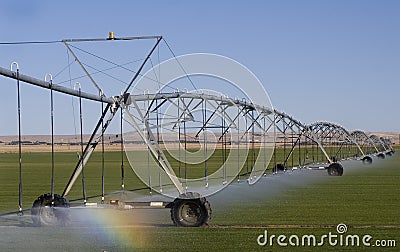
Really, the only thing wasteful would be the energy needed to pump up and distribute the water. But we get some of the most efficient farmland in return, without harming anyone (unlike e.g. the US that caused the dustbowl thanks to overly aggressive farming)
edit: also that's only when irrigation is actually needed, we get our fair share of rain.
In plenty of areas where water is needed, the time it would take for the big circular arrow "water cycle" to replenish it is so long, it should be considered a finite resource.
Ars Technica had a great article about this a few years back, likening "peak water" to "peak oil": http://arstechnica.com/science/2010/05/not-just-oil-us-hit-p...
The Dutch are not master farmers, you are just in a fairly moist climate and the culture has been relatively uninterrupted due to political strength that you obtained through the plunder of the developing world. I don't think your water security is anything to be proud of. How is water security in the former Dutch colonies these days?
"In the Netherlands water pollution originating from agriculture is an important environmental concern. While recent trends indicate that the pressure from farming on water quality is diminishing, absolute levels of pollution remain amongst the highest across the OECD (Figures 2-5). Agriculture is the major source of nutrients, pesticides and the only known source of heavy metals in water. Pollution from endocrine disrupters and veterinary medicines in terms of potential impacts on human and wildlife reproductive systems is also a concern. The total external costs of agricultural water pollution are unknown, but in the late 1990s the annual external costs of eutrophication associated with nitrate emissions was estimated at €600 million (US$540 million), and for treating drinking water polluted with nitrates at an annual cost of €23 million (US$21 million)."
http://www.tandfonline.com/doi/full/10.1080/07900627.2010.53...
That water is "lost" by any practical definition. For humans to use it again, it would have to be desalinated, which is expensive.
Not in the US. Its corn syrup or an artificial sweeter. Curious to know if corn's water footprint is more or less than sugar beet.
I guess there's a larger issue here on how water like this isn't truly lost or in competition for human drinking water. Its part of a natural cycle of rainwater, runoff, and back into the aquifers or evaporated. A better metric is the real cost of irrigation for those farms. There are a lot of practical areas to grow corn or sugar beet. Those areas are rich in water, so its not a big deal if you use that much water for argiculture. Water heavy farming in the midwest is different than water heavy farming in California.
I amused myself trying to find the source. The article is based from a quote from the book which is based on a study:
The green, blue and grey water footprint of crops and derived crop products, Twente Water Centre
http://waterfootprint.org/media/downloads/Mekonnen-Hoekstra-...
I think he is for example counting the rain and irrigation water that falls on the sugar cane that it used to make the Coke.
Quote from the book:
In 2011, in- vestigators from the University of Twente Water Centre in the Netherlands conducted a careful assessment of the total direct and indirect water footprint of a specific soda: a half-liter bottle of a hypothetical carbonated beverage sweetened with beet sugar. They based their assessment on a systematic method developed specifically for this purpose.
The result: 170 to 310 liters per half-liter soft drink. But we don’t care about half liters. We care about full liters. For that, we need to double these figures, giving us astonishing water-use ratios of 340 to 620 liters per liter of soda. The range varied with the type of sweetener and the country growing the sugar. The 620 water-use ratio applied to a soda made with cane sugar grown in Cuba, whereas the 340 ratio applied to a soda sweetened with beet sugar produced in the water-efficient Netherlands. Sodas sweetened with high-fructose corn syrup grown in the United States required 360 liters per liter. These amounts, enormous as they seem in comparison to the prize- winning 1.4, are on the low side of water use for food production; figures for meat and dairy production, for example, are higher.