"Ok, that's not real world". Today, the cable guy is here fixing my home internet, so I'm tethering my iPhone 5s. Loading the .js for my site took 40kB in 143ms = 300kB/s, so 150kB would have been enough.
"Still not real world". Fine. Here's the waterfall graph of a visitor from Canada to rasterize.io today: (https://s3.amazonaws.com/static.rasterize.com/canada-waterfa...). Loading the .js took took 40kB in 60ms = 666kB/s, so 300kB.
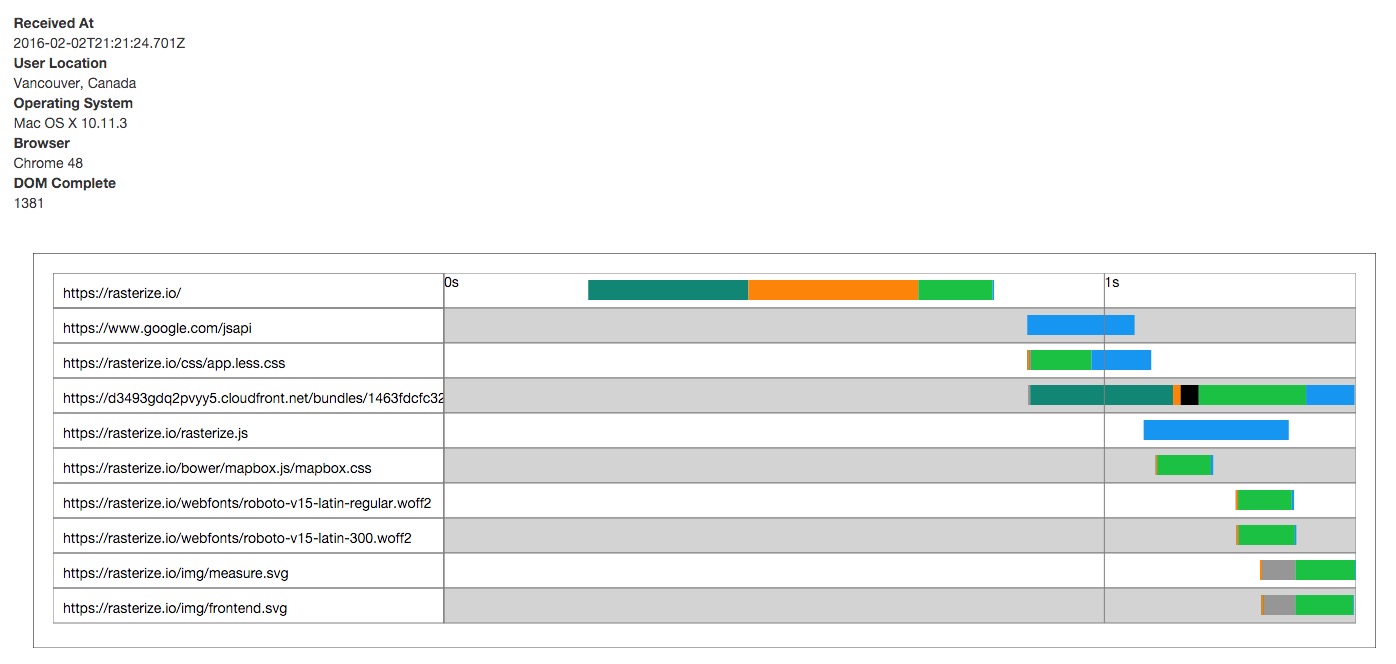
So certainly less than half a meg of JS, which is very common to see in SPAs.
Certainly, there are tons of other things that can slow down a site. But the JS is one of the "easiest" to solve, because devs are responsible for it, and it has well known solutions, that people don't apply consistently. (reduce dependencies, only serve one file, Use webpack/closure, use CDN)
Was that a controlled test?
If just a correlation, then other variables might confound i.e. users from overseas, users with a slow connection, users with a slow computer.
Agree with you though!
I'm not in the position to intentionally slow down my customers, so I haven't run a controlled test. Google's test was controlled though.
Amazon found every 100ms slower the site loaded, they lost 1% in revenue: http://www.gduchamp.com/media/StanfordDataMining.2006-11-28....
Walmart.com found a very large change in conversion rate based on page load times: ( http://www.slideshare.net/devonauerswald/walmart-pagespeedsl... slide 37)
My own customers have seen 4x different conversion rate, when grouped by page load time. (i.e. same slide as walmart page 37 above, where the peak is 4x higher than the lowest performing group).
Your business probably won't fail because it's slow, but it will certainly make less money because it's slow.