https://www.youtube.com/watch?v=tndXr-oQxxA
I am optimistic the video has some relevance to this discussion.
> It is very disheartening when you take the time to write something thoughtful and you get no response at all.
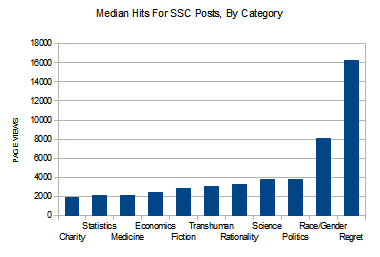
Scott Alexander explored this topic in [0]. He also laments the fact that the posts he considers most valuable are read the least, while his most controversial ones are also the most popular. He even has a nice graph of it[1].
[0] - http://slatestarcodex.com/2014/12/17/the-toxoplasma-of-rage/
I mean that literally. These people have mental health issues and they want you to bend over backwards to accommodate them out of a sense of guilt or something. You shouldn't do it. You're just enabling the sickness. It's like those guys who keep running out for more Twinkies even after their partner has grown so large that they can't fit through the door of the bedroom and are trapped.
If someone is claiming that your use of regular English adverbs is triggering their PTSD then they are the ones with the problem, not you.
Those that ban people out of forums believe they are following same principle.
Edit: in case you missed it, this was sarcastic.
This sort of matches the way I personally thing about information and my own opinions. Back in my head I always have this feeling of "degree of confidence", of how sure I am about what I'm saying, and it's often hard to express it in the speech itself. It fits perfectly as meta-data / qualification. Saying once, "this is a thought I'm playing with, I'm not sure either way" beats having to qualify every sentence with "maybe".
Also, I have most fun reading arguments that sound totally convincing to me but are tagged by author as something he doesn't have high confidence in. I end up having to figure out how this smart guy just convinced me of something he himself isn't sure about.
It seems that many people who I would call "intellectually honest" end up developing speech patterns to avoid (1) speaking in absolutes; and (2) making statements of opinion articulated as statements of fact. An example of (1) is to use the words "many" or "most" instead of "all". An example of (2) is to start opinions with "I think".
Those speech patterns, though, can lead to writing which is bland and less than forceful, full of justifications with no interesting assertions to be found. One huge plus of this belief metadata, as you note, is that it frees the author to make bold and daring statements (and hopefully back them up) without committing to the truth of those statements. I think it can make for great writing – the style of strong and passionate assertion mixed with (via the disclaimer) the sensibilities of a reasoned opinion.
It's Obama vs. Trump.
Write down the answers in a few words, then slap them in brackets at the beginning, and there, you've created your first belief tag :).
The real problem is that if you put your ideas out there, and someone says something like that, and you don't respond, they've gotten the last word, and your silence is a patent acceptance of their point (as it would be in a face-to-face debate). So we try to guard our opinions with "This is just my opinion" (duh, whose else opinion would it be?), or try to beat others to the counterpoints, and when you are constantly setting up defenses to your ideas, your idea loses a lot of potency and clarity.
That could resolve a lot of issues that occur in text communication. /p7
"The defensive writing style also encourages another sort of ugliness, which is that “avoiding saying something wrong” becomes a primary focus of the writing, rather than communicating or exploring ideas which the author might himself be unsure of."
One thing that's great about Gwern Branwen's writing is that Gwern's essays are accompanied by a "belief tag". That tag gives the ability to say "This essay is exploratory; I don't have a high degree of confidence that it's canonically true." Details here: http://www.gwern.net/About#belief-tags
Having the option to dissociate ideas from one's person can give a lot of freedom to put contrarian ideas out there and spark debate in search of the Truth without fearing personal attack. Indeed, one of the things that I consider to make a healthy company culture is that ideas can be criticized without the people behind the ideas feeling criticized themselves.