Which option would you prefer? (1) You have a 70s real wage, but can only purchase goods and services that were available in the 70s, or (2) You have a 2016 real wage and you can purchase all goods and services available today. Keep in mind that real wages have stayed roughly constant since 1970.
Most people I know will pick option (2), which suggests that purchasing power has in fact increased rather than decreased. Technology is improving and everything is becoming cheaper, bringing up our standard of living.
Here are some facts about Americans living in poverty, according to the Census Bureau [1]: 80% of households below the poverty level have cell phones. 96% have a television and 83% have a DVR. 97% have refrigerators, 96% have stoves, 93% microwaves, and more than 83% have air conditioning. 58% have computers. If you had to choose, would you prefer to live in poverty today in 2016, or would you prefer to live in poverty in 1970? How about 1900 or 1800? How does the standard of living in poverty compare to any other time in history? An American living in poverty today probably has a better standard of living than a typical king did in centuries past.
[1] http://www.census.gov/hhes/well-being/publications/extended-...
If you'd like to argue that "purchasing power should have increased more if it wasn't for XYZ..." then that's fine, but it's separate from the point that I was debunking:
> but the purchasing power of that nominal wage has gone down faster than the increase
If one prefers 2016 products at 2016 wages, then purchasing power has increased. Since real wages have stayed constant, we're basically just talking about 1970 products vs. 2016 (and 2016 products are much better, cheaper, etc)
http://www.npr.org/sections/thesalt/2015/03/02/389578089/you... https://www.eia.gov/todayinenergy/detail.cfm?id=10891
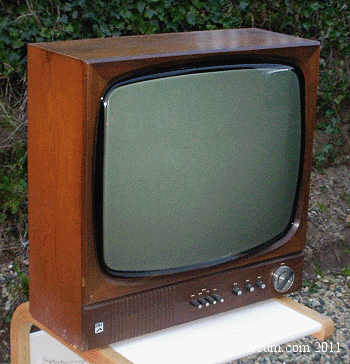
On that TV you can watch 1970s programming only. A 25" TV in 1970 cost $850 dollars ('77 Sylvania), which is equivalent to $5200 dollars today. I can hardly even find a TV that costs $5k today! For $4000 I can buy an 80-inch absolutely amazing Visio M80: http://www.amazon.com/dp/B00VQO5HSE - and they don't even sell TVs as small as 25" any more.
Your stove and refrigerator look like this, and work about as well as they look: http://airconvintage.com/antique/images/101_8149.JPG You also have access only to 1970s automobiles, which are nowhere near as comfortable, quiet, and maintenance-free as today.

If you're making this (hypothetical) tradeoff, then you're also limited to 1970s medicine and dentistry as well. Would you really choose 1970s medicine over today, too?
There are some people who would make this tradeoff, and I can respect that choice if you are one, but most people would not. Most people would prefer to live in 2016 with the products and services available today.
Childcare, healthcare, education, shelter, world travel, free time, organic food.
Keep your trinkets and baubles.
>PG is wrong that he is a creator of economic inequality. Technology development usually brings prices down. This is deflationary; the 'big picture' way that deflation happens: that prices are discovered more efficiently, or resources are used more efficiently, or that idle labor capacity is recruited to fulfill a want or need that was not known before (esp: think uber/lyft).
>Deflationary processes are inherently anti-inequality. Think of it this way. If we never changed the minimum wage, then people's incomes, especially at the bottom segment of society would make their net economic potential greater over time.
>It is not the investment in technology that makes "tech drive inequality". It is the political structure around it. We have a structure where monetary policy shoves free or cheap money into the faces of banks and the investment classes in efforts to 'stimulate' the economy, where the secular (over decades, not over years) inflation drives low- and middle- class citizens into risky investment activity just to be able to sustain themselves in their later years (effectively a subsidy for the rich).
"families often consist of two breadwinners (& no children) with a hearty amount of debt, nothing owned, and few savings. The family unit itself may even be weaker because of less shared ownership. Wages haven’t tracked productivity for decades, so wages haven’t risen since the previous story was normal."
Is this because of rapacious capitalists taking wages? The nominal wage has increased since the early 70s, but the purchasing power of that nominal wage has gone down faster than the increase. This is policy, not capitalism.
http://www.nytimes.com/2012/04/06/opinion/krugman-not-enough...
Policy wonks like to argue that the fed should "pay more attention to employment". The irony is that if you think that people are consigned to being wage slaves, a national policy of total employment is keeping people there. There is a cost to getting people employed, and that is that those who are employed are going to be paid less, and the way you trick people into that is by making what people earn be less, even for the same or greater nominal amount ("sticky wages argument").
What happened in the early 70s? Prior to the nixon shock we had wage increases leading inflation and a trending toward decreasing of the wage gap that had momentum enough to continue till about the 2000s (if you think about it that momentum makes sense because entrants into the workforce in the 70s started retiring in the 200s) - during the bush/obama era we see income inequality turning the corner.
While we are certainly trending towards getting worse things actually are not that bad:
http://im.ft-static.com/content/images/d823a614-9e82-11e5-b4...
Everyone is worried about the far right side of the graph (which is partially a histogram artifact) but look at the left hand side of the graph and see how the lowest income fraction of society is far less populated than 40 years ago. (yes, between 2008 and 2015 it is getting worse, which is cause to worry)