News for hackers. Stuff that matters.
Re:First New U.S. Nuclear Reactor in Two Decades to Begin Fu... by ju-st on Monday October 26, 2015 @07:33AM (#10450694)
back of napkin calculation:

1180 MWh; 4.5 billion dollar capex; 2.4ct/kWh opex[1]; 50$/MWh income

yearly power production = 1180MWh * 24 * 365 = 10'336'800 MWh

yearly revenue = power production * 50$/MWh = 516'840'000 USD

yearly costs = power production * 1000 * 0,024$ = 248'083'200 USD

capex / (revenue - costs) = 18 years

Doesn't look like a very interesting investment choice!?

1: http://www.world-nuclear.org/info/economic-aspects/economics...

Re:First New U.S. Nuclear Reactor in Two Decades to Begin Fu... by hga on Monday October 26, 2015 @07:45AM (#10450741)
Any reactor build during the TMI singularity is going to have an outrageous capex, and a better calculation would be to ignore the sunk costs and look at the figures going forward. You also need to allow for refueling downtime, these aren't constantly refuelable designs like the outlawed in the US old generation CANDU and Soviet RBMK (outlawed due to their positive void coefficients, something the latest CANDU design addresses). From vague memory, assume no more than 90% yearly uptime.

ADDED: And you get an upvote if for no other reason than that you're doing the math. I wish a lot more people would do that.

Re:First New U.S. Nuclear Reactor in Two Decades to Begin Fu... by jerven on Monday October 26, 2015 @09:28AM (#10451229)
90% is a best of fleet number. But for economic analysis you should really assume a lower number, unless you can guarantee that you are the cheapest producer at all times. As demand during the day can be near double of that in an area during the night, once your type of plant is over 50% of local supply your capacity factor is not a limit but demand side is.

4.5 billion capex is a really good number for nuclear in a competent regulatory environment. Still its double the estimated project cost when started.

Funnily enough nuclear and renewables really compete hard because of this. Extra power production is nearly nothing for both compared to opex and capex, so if you can produce you shall until returns hit 0. Both love energy storage for that reason. Nuclear is more dependable i.e. less peakers on because of supply issues. But capex for wind and solar are trending too be lower, as is time to market. Leading to less risks, which affects project planning a lot.

CSPs with inbuilt storage tend to go to lower generator capacity factors so that they can take a share of the peak shaving market, due to their relative good dispatch ability (send power to the market when wanted, instead of when you can).

Wind and solar projects tend to be online and producing quickly in time measured from first concrete poured to power send to market, certainly relative to nuclear in practice. Projects also tend to be smaller scale and in independent phases. Nuclear is added a GW at a time to the market, solar and wind in smaller 50-100mw projects. i.e. wind&solar are project wise much more agile.

Re:First New U.S. Nuclear Reactor in Two Decades to Begin Fu... by trothamel on Monday October 26, 2015 @11:56AM (#10452228)
According to http://www.platts.com/latest-news/electric-power/washington/... , 90% seems to be an average number, not a best of fleet number.
Re:First New U.S. Nuclear Reactor in Two Decades to Begin Fu... by jerven on Monday October 26, 2015 @12:02PM (#10452265)
That is only in the last decade, and for the US. Other countries and decades have differing numbers. Still it only holds when Nuclear is a less than 50% of production. France tends to have around 77%.
Re:First New U.S. Nuclear Reactor in Two Decades to Begin Fu... by DennisP on Monday October 26, 2015 @12:27PM (#10452432)
Why would the percentage of production being nuclear have any effect on nuclear capacity factor?
Re:First New U.S. Nuclear Reactor in Two Decades to Begin Fu... by jerven on Monday October 26, 2015 @12:39PM (#10452526)
If you produce it but no one buys it what was the point? In fact in reality if you do that you wil pay a lot to the grid maintainer for this.

Capacity factor is % utility of your max generating power output.% utility is lower if you can't produce or no one is willing to buy so you don't produce max.

If you produce min deman load with nuclear at 90% capacity. The it's all good.Once you are above that demand slack means production capacity is wastes. Currently nuclear is the last to stop producing as it's variable costs are so low. If nuclear is a larger part of your grid it will tend to have a capacity factor that is equal to the average demand.

Re:First New U.S. Nuclear Reactor in Two Decades to Begin Fu... by DennisP on Monday October 26, 2015 @01:27PM (#10452849)
Ah good point. That's why I think solar + nuclear is a good idea, the nuclear plants running all the time and solar adding more during the day. It won't perfectly match demand, but it'd still be better than either tech on its own.
Re:First New U.S. Nuclear Reactor in Two Decades to Begin Fu... by hga on Monday October 26, 2015 @09:32AM (#10451250)
4.5 billion capex is a really good number for nuclear in a competent regulatory environment.

Is France one, and does anyone know what their's is?

Re:First New U.S. Nuclear Reactor in Two Decades to Begin Fu... by jerven on Monday October 26, 2015 @11:07AM (#10451915)
Flamanville, at 10.5 billion euro for 1.6 GW is not nearly as good as watts bar 2. This has had serious delays due to quality issues detected by its regulator. As had the finish and Chinese units build to the same design.

Sure these are supposed by GenIII, but are currently not competitive in any way with other power sources in economic terms. 10.5 billion buys you about the same in offshore wind e.g. 3 london array installations ( 2 billion per 600 MW * 50% capacity, compared to 10.5 billion per 1600mw * 90% capacity) = 10/(1.6*.9). Big difference is london arrays take 1 year to build instead of 10 for nuclear. That alone gives a mayor difference in real project costs.

Re:First New U.S. Nuclear Reactor in Two Decades to Begin Fu... by hga on Monday October 26, 2015 @11:12AM (#10451951)
There's not much surprise if the first version of a new design runs over budget; I'm interested in the costs of routine, serial production once those unknowns have been worked through. What about the 59 reactors already in operation, including Flamanville 1 and 2?
Re:First New U.S. Nuclear Reactor in Two Decades to Begin Fu... by jerven on Monday October 26, 2015 @11:57AM (#10452240)
That is really hard to determine, mostly because project costs are part of the greater EdF numbers and not broken down in details for those years. So someone with better French and access should be able to answer you there. This is true not just for nuclear but all power generation before the late 90's in europe. i.e. same difficulty to getting numbers in the UK and Germany. Once these national power companies went to the stock exchanges they started to report in more detail how much projects cost. Anyway there are also number of existing reactors that are no longer running even if in the same generation as some other ones.

The, unfortunate, reality is nuclear reactors are not build in serial production. Therefore learning costs do not decrease as much as you might expect. Main reasons are distance between sites, meaning many construction workers do not work on all sites. You see at most 10 units for one design. Time between forgings for mayor means parts are not made in large series so relatively little is learned. All 4 EPR sites seem to have suffered from the same issues with concrete pouring so even there learning might not have happened.

Economically nuclear is in a real bind: for regulatory reasons you want big plants (1gw+), but for economic reasons you want many small ones (about 100mw). The current 1.6GW units are in many ways to big and smaller reactors would be much better project/knowledge wise. Yet the regulatory overhead for each new unit means that the firms went towards designing larger units.

Bechtel marine nuclear powerplants could actually be produced in series as they are small enough to be build off site and could be made economically viable. Yet I don't expect that Bechtel ever will.

But lest assume Arreva learns how to build EPRs for 5 billion and in 5 years. Which gives you

EPR done right 5 billion / (1.6 GW * .7 historic capacity factor) = 4.4 to 5 billion / (1.6 GW * .9 best capacity factor) = 3.2 London array 2 billion / (.63 GW * .50 historic capacity factor) = 6/2

Even in this very optimistic scenario, offshore wind is between 100% and 60% more expensive on construction costs. Offshore wind however, still has lower opex and a much better learning curve. i.e. if ordering a london array today costs will be less than 2 billion. (big difference in reporting is that wind projects include interconnect costs which current nuclear projects do not due to sitting next to existing plants).

Wind farms, also have positive decommissioning costs (those steel towers have real economic value at end of life).

Both types of projects have issues with nimbys.

Re:First New U.S. Nuclear Reactor in Two Decades to Begin Fu... by illumen on Monday October 26, 2015 @08:28AM (#10450899)
I think it's an even worse investment than that.

I don't believe them that the cost of decommissioning is built in. Especially since the financiers who pay during construction aim to sell their equity. Also in the UK, recently had to pay 4 billion worth of tax payer funds to decommission. That puts the whole thing at a loss.

Also, wind, solar and other renewable are able to be produced with a much smaller capital cost, and are only getting cheaper. Many of the tech issues are being fixed. For example, critical steam is now possible with CSP and mass production is making the systems cheaper.

The production risks for nuclear are really high, because of the high capital costs. As demonstrated by this project stalling for over a decade.

Also, uranium costs are not fixed. Over the last 18 years have changed a number of times. The price difference has been 3x (not even adjusting for inflation).

Finally, many nuclear power plants have been closed down early to fix up (14% have been closed for more than a year). Including of course Fukushima, but also other ones around the world and in the USA. There was a report of 14 plants in the USA which will likely close early. That is around 14% of plants (so far) closing earlier than planned. (There are 99 plants in the USA).

If there is a problem because the high capital costs, it seems many of the plants get closed. 100 orders for plants in the USA were cancelled, bankrupting companies.

Re:First New U.S. Nuclear Reactor in Two Decades to Begin Fu... by AnthonyMouse on Monday October 26, 2015 @08:52AM (#10451035)
> I don't believe them that the cost of decommissioning is built in. Especially since the financiers who pay during construction aim to sell their equity. Also in the UK, recently had to pay 4 billion worth of tax payer funds to decommission. That puts the whole thing at a loss.

Only if you're counting the decommissioning costs for nuclear but not for anything else. By the time a mine is exhausted it's generally a Superfund site, whether they're mining coal or neodymium. And what do you do with fifty million decommissioned solar panels?

> Also, uranium costs are not fixed.

The amount uranium price fluctuations contribute to operating costs is negligible.

Re:First New U.S. Nuclear Reactor in Two Decades to Begin Fu... by illumen on Monday October 26, 2015 @09:22AM (#10451184)
Yes, PV solar is not so good with waste either. Yes, the costs of removing broken solar panels should go into the costs for a project too. But that has nothing to do with judging weather Nuclear plants are a terrible investment.

Last I read none of the closed plants in the USA had been completely decommissioned. Which is why I think the estimates for decommissioning are wrong. But perhaps there are cheaper ways to do it in the future... I don't know.

Yes, fuel cost isn't that much... apparently 0.52 ¢/kWh. But that could still impact the bottom line if costs were 3x as much. But with 70 years of uranium left, I'm not sure prices will stay at similar prices over the life time of a new reactor.

Re:First New U.S. Nuclear Reactor in Two Decades to Begin Fu... by Tuna-Fish on Monday October 26, 2015 @01:45PM (#10452970)
> Yes, fuel cost isn't that much... apparently 0.52 ¢/kWh

That's more than 95% processing, not raw material cost.

> But with 70 years of uranium left, I'm not sure prices will stay at similar prices over the life time of a new reactor.

That's not true at all. The total accessible uranium resources are near inexhaustible. The 70 years you hear bandied about is proven reserves/consumption, which is completely braindead, because proven reserves do not mean what you think they mean.

If the market price of uranium rose by two orders of magnitude, it still wouldn't materially impact the economics of nuclear fuel plants, and it would make thousands of years worth of uranium reserves economically extractable.

Re:First New U.S. Nuclear Reactor in Two Decades to Begin Fu... by merpnderp on Monday October 26, 2015 @11:11AM (#10451949)
Seems like I remember the "peak uranium" studies suffered from the same faults as "peak oil". That there is estimated to be quite a bit of easily recoverable uranium left undiscovered. And a near infinite amount recoverable from seawater.
Re:First New U.S. Nuclear Reactor in Two Decades to Begin Fu... by PhantomGremlin on Tuesday October 27, 2015 @08:02AM (#10457453)
Last I read none of the closed plants in the USA had been completely decommissioned.

The Trojan Nuclear Power Plant[1] in Oregon comes "close" to being decommissioned. E.g. the reactor vessel itself was barged up the Columbia River and dumped into a big pit in the ground.

Of course, the spent nuclear fuel remains on site. But that's a political issue, not a technical one.

[1] https://en.wikipedia.org/wiki/Trojan_Nuclear_Power_Plant

Re:First New U.S. Nuclear Reactor in Two Decades to Begin Fu... by hga on Monday October 26, 2015 @09:34AM (#10451265)
Last I read none of the closed plants in the USA had been completely decommissioned.

Much, if not a lot of this has to do with the simple fact that after you mothball the plany, it's easiest and cheapest to wait a while for various radioactive isotopes to decay to less hazardous stuff. As long as you mothball it properly, and maintain that, there's no hurry.

Re:First New U.S. Nuclear Reactor in Two Decades to Begin Fu... by Retric on Monday October 26, 2015 @10:18AM (#10451584)
If the money is set aside ahead of time and invested well then sure. If your dependent on the company that operated the plant to still be around then there just going to keep putting it off until the company fails. At which point the taxpayer is stuck with the costs.
Re:First New U.S. Nuclear Reactor in Two Decades to Begin Fu... by kabdib on Monday October 26, 2015 @09:55AM (#10451410)
Non-commercial plants have been fully decommissioned, I don't know about commercial ones. (The NASA Plum Brook research reactor is completely gone now).
Re:First New U.S. Nuclear Reactor in Two Decades to Begin Fu... by hga on Monday October 26, 2015 @08:50AM (#10451028)
Also, wind, solar and other renewable are able to be produced with a much smaller capital cost, and are only getting cheaper.

Are you including the energy storage systems they require to provide either baseline or peaking power? Outside of perhaps some very special locations (i.e. cover deserts with solar cells if you can get that past the BANANAs, and that still doesn't cover nighttime to, e.g., recharge electric cars) they don't, you know, actually produce the two types of electrical production the system actually needs....

Re:First New U.S. Nuclear Reactor in Two Decades to Begin Fu... by illumen on Monday October 26, 2015 @09:21AM (#10451179)
You can build small renewable systems with all sorts of different capital costs, and all sorts of power generation abilities. Price ranges from $100 to $9billion. Nuclear projects do not happen for less than $Xbillions (and about half bankrupt before completion).

Got data? Seems that most of the renewable energy is being used ok. Smarter energy management, and using salt/aluminium/steel aluminium molten lakes allows for storage/adjustment. In many places aluminium factories use up a LOT of power. They can be used as batteries of sorts. CSP solar can hold power for over 8 hours. Wind farms over provision to allow for baseload generation. Then there is storing energy in car batteries. Biomass solutions offer different power generation abilities too. All this is being done today, and systems are continually being enhanced.

The point I was making though, is that you can have power generation (including batteries) at a much smaller cost for it to be useful. For example, even installing solar on a factory roof and installing batteries can be done for way under $100,000.

Working nuclear plants have to close 38 days every 17 months for refuelling and maintenance. How good are they at generating baseload then?

Re:First New U.S. Nuclear Reactor in Two Decades to Begin Fu... by fnordfnordfnord on Monday October 26, 2015 @11:37AM (#10452105)
They aren't good at generating baseload during refuelling, obviously. Most plants have more than one reactor. Refuelling usually occurs during the spring or fall, when demand is lower, and only in one reactor unit at a time. It's not exactly a feature, but it also isn't much of a bug.

http://www.eia.gov/todayinenergy/images/2013.08.27/supplyreq...
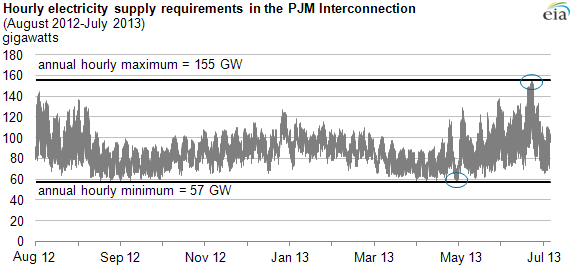
http://www.eia.gov/todayinenergy/detail.cfm?id=12711

Re:First New U.S. Nuclear Reactor in Two Decades to Begin Fu... by rwcarlsen on Monday October 26, 2015 @02:20PM (#10453269)
Decommissioning costs are generally around a few hundred million $ - not more than 10% of the capital costs generally [1]. And there are very strict regulations around it - many firms are required to have a trust or other type of fund built up during operation of the facility in advance of final shutdown and decommissioning. And as others have stated, uranium price is very small part of total nuclear energy cost.

[1] http://www.nrc.gov/reading-rm/doc-collections/fact-sheets/de...

Re:First New U.S. Nuclear Reactor in Two Decades to Begin Fu... by skrause on Monday October 26, 2015 @02:29PM (#10453362)
The German utilities just had to set aside around 35 billion dollars to decommission just about 10 nuclear power plants: http://www.bloomberg.com/news/articles/2015-09-16/why-german...

With that in mind I honestly don't believe the "few hundred million $".

Re:First New U.S. Nuclear Reactor in Two Decades to Begin Fu... by PhantomGremlin on Tuesday October 27, 2015 @08:13AM (#10457484)
I wonder where all the money will go? See my previous comment about a decommissioned plant, elsewhere in this topic. https://news.ycombinator.com/item?id=10457453

The reactor vessel is long gone. What remains on site is spent fuel, but there's nowhere to move that to. Cost was perhaps $0.23 billion but that's an approximate figure. Still, nowhere near the $3.5 billion per plant that German utilities have set aside.

Re:First New U.S. Nuclear Reactor in Two Decades to Begin Fu... by gh02t on Monday October 26, 2015 @09:36AM (#10451275)
Don't forget though that these plants are designed for a 50 year operating life, with some talk that they might be extended upwards to as much as 100 years, and with operating costs that are pretty low. Maintenance isn't that bad, fuel is hardly even a rounding error; waste disposal is the only significant cost long term.

Definitely a long term investment, which is why only large utilities are really interested in them. I think the direction for power generation in the US is solar/wind/hydro, but supported by nuclear in areas where solar and wind are much less attractive (like the Southeast). That's discounting the possibility of clean fusion energy (or other novel tech), which is likely inevitable but still a long way off.

Re:First New U.S. Nuclear Reactor in Two Decades to Begin Fu... by ScotterC on Monday October 26, 2015 @10:54AM (#10451847)
I've worked analysis related to extending reactor lifetimes. With correct maintenance, 100 years is going to be easy. Most of the analysis to getting them to 80 years required almost no changes.
Re:First New U.S. Nuclear Reactor in Two Decades to Begin Fu... by mseebach on Monday October 26, 2015 @07:45AM (#10450743)
Compared to hitting the jackpot on a SV Unicorn, it sucks. But in the grander scheme of things, it's not bad.

You have to remember that it's a very long-term investment -- considering that well run nuclear reactors have expected life spans of 50+ years, and the price of carbon-free electricity probably isn't going to go down anytime soon, it's starting to look pretty good. After the capex is paid off, you have a 250mm/year cash cow.

Re:First New U.S. Nuclear Reactor in Two Decades to Begin Fu... by Graham67 on Monday October 26, 2015 @08:07AM (#10450812)
It's not carbon free.
Re:First New U.S. Nuclear Reactor in Two Decades to Begin Fu... by DennisP on Monday October 26, 2015 @08:49AM (#10451016)
Neither are solar or wind farms, if you count everything that went into their construction. None of the three technologies have enough CO2 emissions to worry about, though.
Re:First New U.S. Nuclear Reactor in Two Decades to Begin Fu... by illumen on Monday October 26, 2015 @08:34AM (#10450935)
You are correct. It is not carbon free. Nuclear power plants make about 90 - 140 g CO2 per kWh electricity.

Uranium extraction, waste management, construction, and decommissioning being the biggest offenders in the whole process.

Re:First New U.S. Nuclear Reactor in Two Decades to Begin Fu... by snowwindwaves on Monday October 26, 2015 @09:27AM (#10451220)
90-140g/kWh sounds like a lot when 'carbon free' is also being bandied about. Nei states c02 emissions are 4-50g for the entire lifecycle,including construction mining fuel and decommssioning. Only hydro electric is lower.

http://www.nei.org/Issues-Policy/Protecting-the-Environment/...

Re:First New U.S. Nuclear Reactor in Two Decades to Begin Fu... by illumen on Monday October 26, 2015 @09:46AM (#10451342)
That link says 2 to 59 grams too. Apparently the range is very high depending on how the extraction works, and all sorts of factors. Cement and steel for example have very different behaviours for emitting co2. Maybe the steel was melted by wind farm electricity for example.

But anyway, even at the high end of the estimates, that is still way lower than coal.

Re:First New U.S. Nuclear Reactor in Two Decades to Begin Fu... by sdab on Monday October 26, 2015 @04:32PM (#10454262)
The article refers to 1180 MW of _power_. MW is joules/s and the unit of power is the watt (j/s). Your math talks about MegaWatt-Hours.

These are often confused in articles, do you happen to know if that was the case in this article? Did they mean 1180 MWH or 1180 MW as stated? Otherwise your yearly production calculation is very off. 1180 MW (j/s) would produce 10^7 MHW per hour.

Re:First New U.S. Nuclear Reactor in Two Decades to Begin Fu... by Monkeyget on Tuesday October 27, 2015 @12:25AM (#10456311)
It's megawatt hour.
Re:First New U.S. Nuclear Reactor in Two Decades to Begin Fu... by redwood on Monday October 26, 2015 @08:21AM (#10450865)
you're missing the biggest cost of all. how do you price the cost of the waste fuel?
Re:First New U.S. Nuclear Reactor in Two Decades to Begin Fu... by hga on Monday October 26, 2015 @08:27AM (#10450895)
Grossly overstated. E.g. leave it alone for 600 years and it's no worse than the ore from which it was mined (which, I grant you, you don't want to be rolling around in). Or feed it to breeder reactors, all that's used up is the U-235, there's still plenty of tasty U-238 that you can do all sorts of stuff with, and they also help address the nasty actinides etc.

Don't confuse the bat-shit crazy regulatory regime for this in the US with anything rational or useful. We're wealthy enough for now to indulge in it, we'll see when things get tighter.

Re:First New U.S. Nuclear Reactor in Two Decades to Begin Fu... by Ntrails on Monday October 26, 2015 @09:16AM (#10451163)
I recall going round a nuclear power plant once and they had a display showing that fresh coffee beans were radioactive enough to be considered nuclear waste had they been produced by the plant (whilst obviously not being considered materially at risk outside).

It's stuck with me (though I merely presume it to be true).

Re:First New U.S. Nuclear Reactor in Two Decades to Begin Fu... by hga on Monday October 26, 2015 @09:26AM (#10451213)
This has been formalized with the banana equivalent dose: https://en.wikipedia.org/wiki/Banana_equivalent_dose

Potassium-40 is pretty fierce stuff, enough to, in this context, get people to be call for the outlawing more than two people sleeping together. If, you know, they really cared about the level of one kind of safety they insist on, as opposed to shutting down US nuclear activities for their various reasons, and used ludicrous methods like the linear no-threshold model https://en.wikipedia.org/wiki/Linear_no-threshold_model which due to common sense and radiation hormesishttps://en.wikipedia.org/wiki/Radiation_hormesis we can even say is unscientific.

Re:First New U.S. Nuclear Reactor in Two Decades to Begin Fu... by redwood on Monday October 26, 2015 @07:15PM (#10455169)
So do the math. How much does it cost in today's dollars to guard it for 600 yeaes?