Only if you're counting the decommissioning costs for nuclear but not for anything else. By the time a mine is exhausted it's generally a Superfund site, whether they're mining coal or neodymium. And what do you do with fifty million decommissioned solar panels?
> Also, uranium costs are not fixed.
The amount uranium price fluctuations contribute to operating costs is negligible.
Last I read none of the closed plants in the USA had been completely decommissioned. Which is why I think the estimates for decommissioning are wrong. But perhaps there are cheaper ways to do it in the future... I don't know.
Yes, fuel cost isn't that much... apparently 0.52 ¢/kWh. But that could still impact the bottom line if costs were 3x as much. But with 70 years of uranium left, I'm not sure prices will stay at similar prices over the life time of a new reactor.
That's more than 95% processing, not raw material cost.
> But with 70 years of uranium left, I'm not sure prices will stay at similar prices over the life time of a new reactor.
That's not true at all. The total accessible uranium resources are near inexhaustible. The 70 years you hear bandied about is proven reserves/consumption, which is completely braindead, because proven reserves do not mean what you think they mean.
If the market price of uranium rose by two orders of magnitude, it still wouldn't materially impact the economics of nuclear fuel plants, and it would make thousands of years worth of uranium reserves economically extractable.
The Trojan Nuclear Power Plant[1] in Oregon comes "close" to being decommissioned. E.g. the reactor vessel itself was barged up the Columbia River and dumped into a big pit in the ground.
Of course, the spent nuclear fuel remains on site. But that's a political issue, not a technical one.
[1] https://en.wikipedia.org/wiki/Trojan_Nuclear_Power_Plant
Much, if not a lot of this has to do with the simple fact that after you mothball the plany, it's easiest and cheapest to wait a while for various radioactive isotopes to decay to less hazardous stuff. As long as you mothball it properly, and maintain that, there's no hurry.
Are you including the energy storage systems they require to provide either baseline or peaking power? Outside of perhaps some very special locations (i.e. cover deserts with solar cells if you can get that past the BANANAs, and that still doesn't cover nighttime to, e.g., recharge electric cars) they don't, you know, actually produce the two types of electrical production the system actually needs....
Got data? Seems that most of the renewable energy is being used ok. Smarter energy management, and using salt/aluminium/steel aluminium molten lakes allows for storage/adjustment. In many places aluminium factories use up a LOT of power. They can be used as batteries of sorts. CSP solar can hold power for over 8 hours. Wind farms over provision to allow for baseload generation. Then there is storing energy in car batteries. Biomass solutions offer different power generation abilities too. All this is being done today, and systems are continually being enhanced.
The point I was making though, is that you can have power generation (including batteries) at a much smaller cost for it to be useful. For example, even installing solar on a factory roof and installing batteries can be done for way under $100,000.
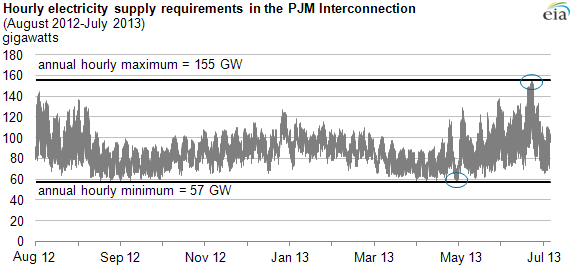
Working nuclear plants have to close 38 days every 17 months for refuelling and maintenance. How good are they at generating baseload then?
http://www.eia.gov/todayinenergy/images/2013.08.27/supplyreq...
[1] http://www.nrc.gov/reading-rm/doc-collections/fact-sheets/de...
With that in mind I honestly don't believe the "few hundred million $".
The reactor vessel is long gone. What remains on site is spent fuel, but there's nowhere to move that to. Cost was perhaps $0.23 billion but that's an approximate figure. Still, nowhere near the $3.5 billion per plant that German utilities have set aside.
I don't believe them that the cost of decommissioning is built in. Especially since the financiers who pay during construction aim to sell their equity. Also in the UK, recently had to pay 4 billion worth of tax payer funds to decommission. That puts the whole thing at a loss.
Also, wind, solar and other renewable are able to be produced with a much smaller capital cost, and are only getting cheaper. Many of the tech issues are being fixed. For example, critical steam is now possible with CSP and mass production is making the systems cheaper.
The production risks for nuclear are really high, because of the high capital costs. As demonstrated by this project stalling for over a decade.
Also, uranium costs are not fixed. Over the last 18 years have changed a number of times. The price difference has been 3x (not even adjusting for inflation).
Finally, many nuclear power plants have been closed down early to fix up (14% have been closed for more than a year). Including of course Fukushima, but also other ones around the world and in the USA. There was a report of 14 plants in the USA which will likely close early. That is around 14% of plants (so far) closing earlier than planned. (There are 99 plants in the USA).
If there is a problem because the high capital costs, it seems many of the plants get closed. 100 orders for plants in the USA were cancelled, bankrupting companies.