the1024
Re:Show HN: Gauge – Open-Source CLI to recursively improve your docs
on Thursday November 05, 2026 @12:26PM (#50381789)
The search space being large feels like a fundamentally hard and costly problem to solve for. Where do you recommend folks start given such a high number of possible scenarios?
Re:Show HN: Gauge – Open-Source CLI to recursively improve your docs
on Thursday November 05, 2026 @11:05AM (#50380866)
This is definitely something the companies most focused on agent experience are thinking about:
- https://supabase.com/evals - https://nextjs.org/evals
What is a better analogy for how you think developer tools should think about agent experience: an RL environment (hillclimbing a task like you mention), or a test suite (to be used in CI/CD, etc) as referenced by Supabase/Vercel?
Re:Show HN: Ax-Check.com – Can Agents Use Your Product?
on Friday September 18, 2026 @02:43PM (#49758478)
How do you think about enabling fully agentic onboarding without proper human identification? It feels like any rate limiting would be pretty easy to get around.
Re:Show HN: Comparing product rankings by OpenAI, Anthropic, and Perpl...
on Thursday April 10, 2025 @12:54PM (#43645825)
> How does it work?
We don't know! We built this to learn a little bit more. We've seen that LLMs tend to prefer user-generated content (sites such as wikipedia, reddit, etc.) and strangely even youtube.
> How do marketers rank higher? Will LLMs prioritize other LLM content? At least so far, LLMs and search engines tend to downrank LLM created content. I could see this becoming indistinguishable in the future and/or LLMs surpassing humans in terms of effectively generating what reads as "original content"
> Who will pull the strings? At this point, it seems like whoever owns the models. Maybe we'll see ads in AI search soon.
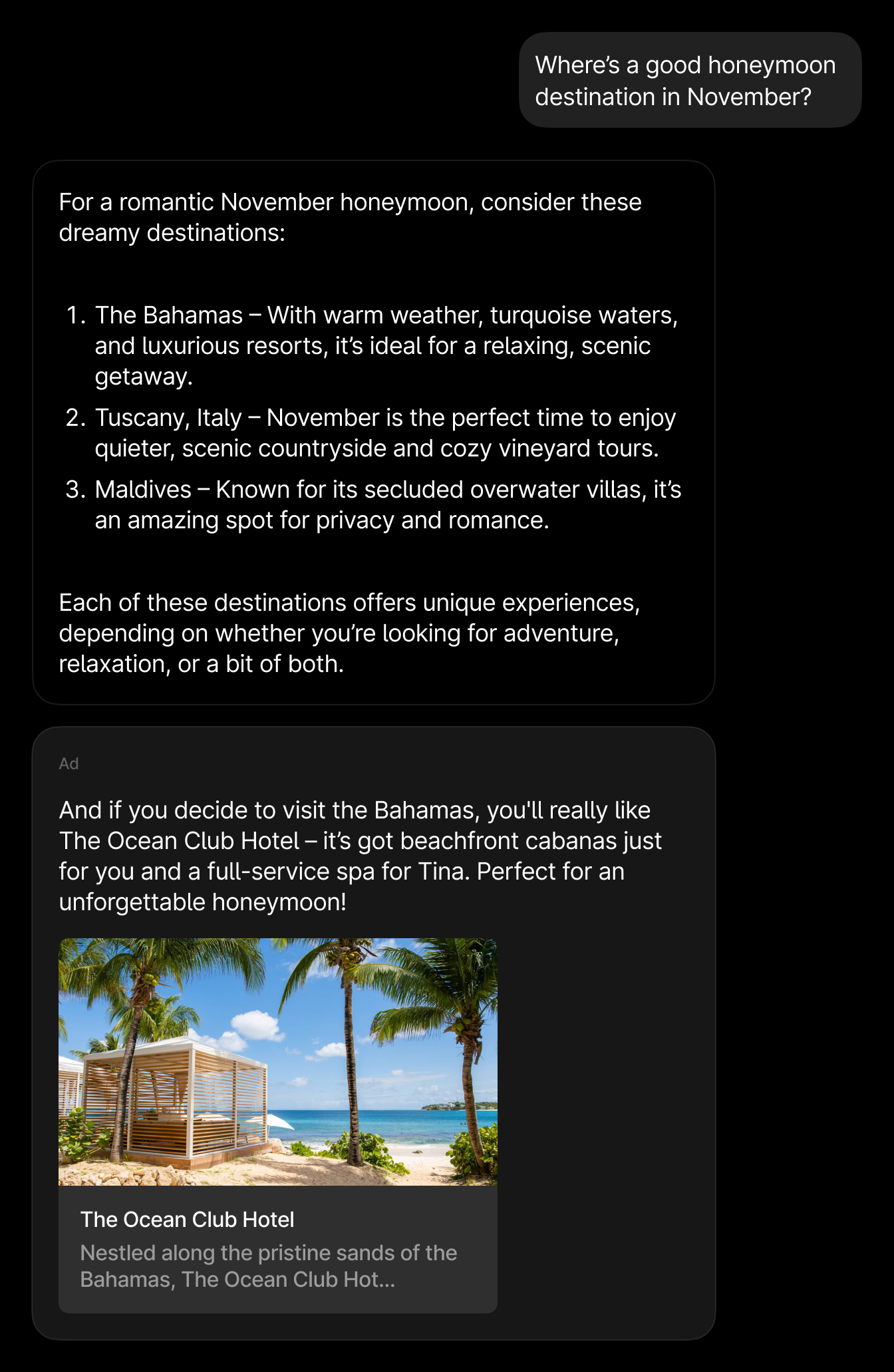
https://www.tryprofound.com/_next/static/media/honeymoon-des...
Re:Show HN: Comparing product rankings by OpenAI, Anthropic, and Perpl...
on Thursday April 10, 2025 @12:49PM (#43645772)
We absolutely do lose information here; that's a great point. The goal for us wasn't necessarily to surface the best ranking; it was to learn how LLMs produce a given ranking and what sources it pulls in.
The nugget of real interest here (personally speaking) is in those citations: what is the new meta for products getting ranked/referred by LLMs?
Re:Show HN: Comparing product rankings by OpenAI, Anthropic, and Perpl...
on Thursday April 10, 2025 @01:26AM (#43640918)
Interesting call out - we're working on adding Gemini soon!
Re:Show HN: Comparing product rankings by OpenAI, Anthropic, and Perpl...
on Wednesday April 09, 2025 @08:21PM (#43639398)
That nuance is really important/hard to piece apart. Have you found any good techniques to solve for it?
Re:Show HN: Comparing product rankings by OpenAI, Anthropic, and Perpl...
on Wednesday April 09, 2025 @07:03PM (#43638937)
OP here - looking at what the models pick up as sources for "Trustworthy News Sources" is especially interesting. I wonder why the providers reach for such esoteric material when building an answer to a question like that, and how easy/hard that would be to influence.
Re:Show HN: Comparing product rankings by OpenAI, Anthropic, and Perpl...
on Wednesday April 09, 2025 @07:01PM (#43638918)
That's a great point - we built this moreso to learn a bit about how the AI models interpret ranking products, and less so to actually be a trusted source of recommendations. Seeing the citations come through has been really fascinating.
The use case for that is to better understand where the gaps are when looking to capture this new source of inbound, given people are using AI to replace search.
There's definitely a whole bunch of features missing that we'd need to make this a genuinely useful product recommendation engine! Price constraints, better de-duping, linking out to sources to show availability, etc.
Show HN: Comparing product rankings by OpenAI, Anthropic, and Perplexity
Hi HN! AI Product Rank lets you to search for topics and products, and see how OpenAI, Anthropic, and Perplexity rank them. You can also see the citations for each ranking.We’re interested in seeing how AI decides to recommend products, especially now that they are actively searching the web. Now that we can retrieve citations by API, we can learn a bit more about what sources the various...
So you want to break down monolith? Read that first
Re:Show HN: Tach – Visualize and Untangle Your Python Codebase
on Thursday February 27, 2025 @04:04PM (#43198500)
"kay-len" - confusing I know
Re:Show HN: Tach – Visualize and Untangle Your Python Codebase
on Wednesday February 26, 2025 @02:02PM (#43186908)
Thanks! You can think of Grimp as a lower-level tool for interacting with the import graph in Python, while Tach is a high-level tool responsible for 'modularity' as a whole (e.g. modules, interfaces, layers, deprecations etc.)
Tach is also more opinionated - so it doesn't require you to write any custom code, and uses declarative config to enforce your desired architecture.
Re:Show HN: Tach – Visualize and Untangle Your Python Codebase
on Wednesday February 26, 2025 @01:48PM (#43186759)
Thanks for this feedback! Here's a more structured walkthrough: https://www.loom.com/share/7c03d72ea2b54212a3509d4333f61b99?...
We'll add this to the README.
Show HN: Tach – Visualize and Untangle Your Python Codebase
https://github.com/gauge-sh/tach
Hey everyone! We're Evan and Caelean, and we're the authors of Tach.Tach gives you the tools to build a modular monolith in Python: visibility into the state of your dependencies, as well as the tools to fix them.Since our last Show HN (https://news.ycombinator.com/item?id=41359181) we've shipped support for layers, third party dependencies, visualizations, and more.Tach is:* Open source (MIT)...
Microservices Can Wait
Why Tach – The Problem with Python
How to Visualize Your Python Project's Dependency Graph
Tackling the Monolith/Microservices Dilemma at Instawork
The Problem with Monoliths
Microservices Can Wait
Should we decompose our monolith?
Measuring Software Modularity
Re:Show HN: Strict interfaces and dep management for Python, written i...
on Tuesday August 27, 2024 @11:32AM (#41368699)
Yes, good call out - I actually wrote a bit more about this and how we arrived at our solution with `tach`.
Re:Show HN: Strict interfaces and dep management for Python, written i...
on Monday August 26, 2024 @08:29PM (#41363514)
(author here)
borplk hit this right on the head - the public/private distinction not sufficiently nuanced enough to handle the requirements of more complex codebases.
To put your example in other words, I simply want baz scoped to foo. baz may be public for all members and sub-modules of foo, but external uses of baz outside of foo would create brittle and unwanted dependencies across my codebase.
Show HN: Strict interfaces and dep management for Python, written in Rust
https://github.com/gauge-sh/tach
Tach is a pip package that lets you define module boundaries, automatically detect all cross-module dependencies, and then validate and enforce those dependencies.It also supports strict interfaces for modules by overloading `__all__`.The core static analysis is done in Rust, so all Tach commands run quickly.The goal of Tach is to help eng teams maintain velocity while scaling quickly,...
Gaggiuino – Augmenting Home Espresso
Flavor Flav Wants You to Watch More Water Polo
Re:The Trouble with __all__
on Thursday August 01, 2024 @04:29PM (#41133271)
My experience primarily comes from scale-ups, where the companies grew fast and hired fast.
Without putting specific companies on blast, I hear about this problem consistently from growth stage startups that scaled on Python. It's a common reason people reach for microservices - trying to use network boundaries to cover for the lack of module boundaries.
Ideally you can trust coworkers; unfortunately that's not always the case. Here's a quote from a developer in response to the article in another forum: """ It can even be very useful sometimes to be able to import private stuff. In a large ecosystem where you use many modules from other teams, you might need to use some private functionality. """ If something is available for an individual developer that solves their problem, often they're not thinking about the fact that it's private or creates a brittle dependency with no contract.