tbe
tbe on Hacker News
> More sensible, IMHO, might be to bolt the FreeBSD user space unto the Linux kernel.
Chimera Linux is doing something like this, although without aiming for the full BSD experience, just utilising its core userland [1]. The project is in an alpha stage.
1: https://chimera-linux.org/about#alternative-userland
Would muxfs be easily portable to other operating systems, or does it rely on non-standard APIs?
I have two accounts in my name, one for me personally and one for work. I got the offer on behalf of my employer, and was like; what would this even mean for this account? I'm pretty sure I would take the offer had it been for my personal account.
> From the wizard's hat hangs something with various initials, maybe a tape, a tail(1) or a strip(1).
Hah, why is the cat(1)'s tail(1) missing from the drawing? Talk about missed oppertunity!
Not at all since "case _:" is assigning to a variable you do not care about.
Are there any standalone Android RSS readers? What about for iOS?
You missed the second sentance. The length of the translated string is less critical for a tooltip compared to a toolbar filled with buttons.
Imagine when an app is to be translated to 20 languages. Only the original language had the luxery of having a voice in how many buttons fit on the toolbar.
An elegant protocol for a more civilized age.
(I'm sorry, just had to do that.)
Posted by
tbe on Friday October 04, 2019 @03:41PM
from the ask-hn dept.
What do others feel are the best maintained Linux software repositories today? Example candidates are:
* Debian
* RHEL
* Slackware
* pkgsrc
* Nixpkgs
* Guix
From a quality, quantity and security updates perspective. Packages should preferably not be substantially modified from upstream.
That's why Rhapsody was absolute peak for me. Haiku might beat it, though I'm probably stuck on Linux anyway.
> How are you going to play music you've added in the last three years, but not heard for a month, from the "Latin" genre, with two or more stars, using only the file system?
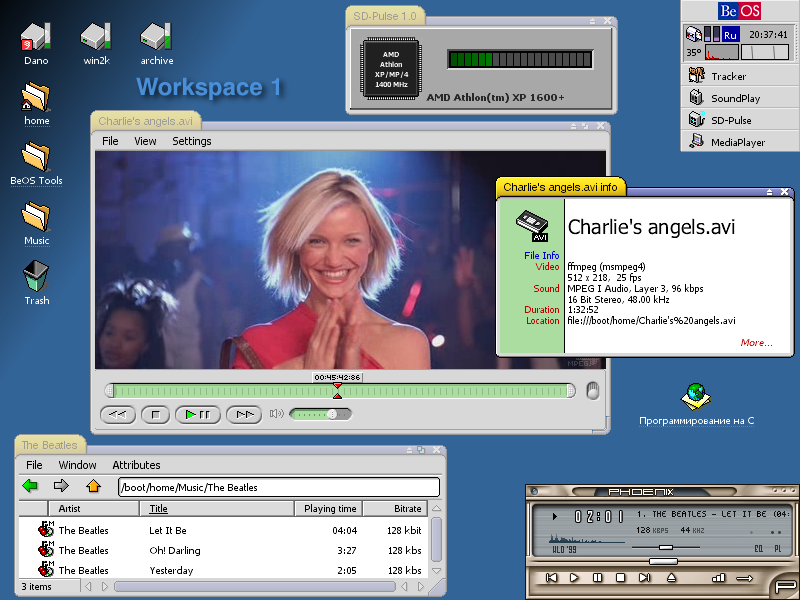
BeOS actually solved this 20 years ago with its file system BFS. Haiku is an open source reimplementation of BeOS that recently progressed from (high quality) alpha releases to its first beta.
Maybe it's less of an issue because your window manager doesn't need to connect to ssh servers or even do any kind of heavy lifting.
Ok, good to know, thanks. The point still stands that the receiver's client probably doesn't bother styling the message. I mean even if GMail, say, was persuaded to do it, Outlook for instance wouldn't.
That would be nice if it was standard for clients to display text/markdown rendered as styled text. This would require an actual standard for the markdown syntax though. Without the rendering, markdown is just text/plain.
Are there any mail clients that will send both the markdown source and the rendered HTML as a multi-part message?
> f=$(mktemp) && ssh-keyscan korell > $f && ssh-keygen -l -f $f && rm $f
> Unfortunately ssh-keygen does not support input from stdin, so this example is slightly more complicated than it should.
Any shell that supports process substitution can fix this for you with something like;
ssh-keygen -l -f <(ssh-keyscan korell)
That would mean two stages of password query, which I think might be a con. Also, the file names would either not be encrypted in the git repo or not be compatible with e.g. Android app I guess.
Thanks for the autofs hint, will try it and see how that works out re unlocking.
For this reason I'm thinking of switching from gpg to encfs. It has an option for auto-unmounting after a period of unactivity. It would also play well with programs that need to read password from a file.
Has anyone else here had the same thought? This guy seems to at least;
https://github.com/equivrel/password-store-encfs/blob/master...
Edit: spelling
The very first web browser had editing built in. That's why HTTP has the concept of verbs in the first place! Otherwise GET would probably be implicit. Forms and POST came later, but PUT and DELETE was part of the original idea behind the web.
I totally agree that browsers should allow editing. Even if you are not authorized to PUT the page back to the server, it would still be useful to be able to edit before you print or save the page locally.
I really have no idea why we were robbed of this capability! It was probably just laziness from the people who wrote mainstream browser and httpd implementations.
Yes, for X11 the client/server roles are backwards so I shouldn't have included it in the list.
I want to use my TV as a VNC/RDP client, and either buy a wireless keyboard for it, or just let it act as a passive display.
This. Shouldn't there be an app for my SmartTV to let it connect to a VNC/X11/RDP server?
Knowing what it's like to write an HTML rendering engine in Rust is especially useful since the purpose of this language in the first place is to write the next generation Mozilla engine.
This reminds me of Bedrock Linux, which allows you to run multiple linux distros on a single kernel instance. It does so using good old chroot, but has an implementation that is capable of breaking out of the chroot when entering a new one. This way the different environments become more integrated in that a RHEL binary can call a Debian binary and so on, creating a sort of super distro which is itself quite small and simple.
And then, even if all of the servers involved in delivering your mail communicate securely, the reciepent is going to reply in plain text, quoting your entire message...
I wish there was a way to do this search only on the currently visible part of the page. Installing a hit-a-hint type of addon would then be less of a prerequisite for me to use the browser.
Have not tried itmyself, but you could check out osxmonad :)
I would also like an invite if possible. Email in profile. Thanks :)
Does not work in Safari on Snow Leopard.
That last sentence reminds me of a quote from Ivan Sutherland:
When asked, "How could you possibly have done the first interactive graphics program, the first non-procedural programming language, the first object oriented software system, all in one year?" Ivan replied: "Well, I didn't know it was hard."