nynyny7
Dhrystone Benchmark. History, Analysis, "Scores" and Recommendations (2002)[pdf]
How to reverse engineer an analog chip: the TDA7000 FM radio receiver
AWR6843AOP – Single-chip 60GHz radar sensor with antenna on package, DSP and MCU
Non-intrusive instruction tracing for Raspberry Pi RP2350
Proprietary silicon ICs and dubious marketing claims? Let's fight those [video]
EstyJS 2.0 (emulator for the Atari ST, written in 100% pure JavaScript)
Re:Windows Bluescreen and Boot Loops (update: caused by a Crowdstrike ...
on Friday July 19, 2024 @05:23AM (#41004046)
Crowdstrike marketing slogan on their website: "A radical new approach proven to stop breaches". I'll give them that: Putting all Windows computers within a company into an endless BSOD loop is a very radical approach to stop breaches. :)
Re:Atari Falcon030
on Friday March 22, 2024 @02:56PM (#39793648)
As a sidenote, there is even an open-source recreation of the TOS operating system for the Atari 16/32 bit computers called EmuTOS that is in active development to this day. It just had a new release a few days ago: https://emutos.sourceforge.io/. And this new release happens to have better support for the Falcon video chip.
SidecarT – Atari ST/STE/Mega Cartridge Emulator on Raspberry Pi Pico Steroids
Re:i386 Assembly Language trick for storing data in .text
on Thursday November 09, 2023 @02:23AM (#38202124)
I don't get the purpose, at least of his minimal example. The author says he wants to make his code position-independent, i.e., so that it can be executed from everywhere in memory (without relocation). But that is defeated by the...
mov edx, print
... in the example.
Re:A C64 MP3 Player
on Saturday February 18, 2023 @10:23AM (#34847534)
As other commenters have pointed out, this is a C64 controlling an MP3 player.
People old enough to remember the late 1990s / early 2000s might recall that back then it was popular, too, to hook up an external MP3 decoder, e.g., to the parallel port; so that the PC's CPU would not be at 100% just for playing MP3 music.
Re:Why 10BASE-T1S Is the Missing Ethernet Link for Automotive Communic...
on Thursday February 16, 2023 @03:06PM (#34825087)
10BASE-T1S is more of alternative/replacement/upgrade to CAN and CAN FD, which use a single wire pair as bus, too. And automotive 100 MBit/s and 1 GBit/s Ethernet are also single-pair. (But they are point-to-point and therefore more expensive, as the article explains.)
Re:Why 10BASE-T1S Is the Missing Ethernet Link for Automotive Communic...
on Thursday February 16, 2023 @02:51PM (#34824776)
Exactly. A few dollars is an enormous price saving the automotive industry.
Re:Why 10BASE-T1S Is the Missing Ethernet Link for Automotive Communic...
on Thursday February 16, 2023 @02:33PM (#34824486)
You'd be surprised how much the reduced cable cost matters to an OEM.
Re:Why 10BASE-T1S Is the Missing Ethernet Link for Automotive Communic...
on Thursday February 16, 2023 @02:29PM (#34824424)
Not really. There is no ring, neither physically, nor logically. It's based on CSMA/CD, like the "good old" coaxial cable Ethernet.
Re:Why 10BASE-T1S Is the Missing Ethernet Link for Automotive Communic...
on Thursday February 16, 2023 @02:15PM (#34824175)
There isn't the connector for 10BASE-T1S or other Automotive Ethernet standards such as 100BASE-T1. OEMs (= car manufacturers) will often define their custom connector. E.g., the Ethernet signal might just occupy two pins on an much bigger ECU connector.
ET4000 ISA graphics card: Undocumented register / Newer data sheet available?
Re:The 1040ST
on Sunday January 29, 2023 @08:27AM (#34567872)
... and nowadays, retro-hobbyists can add USB(!) ports to the 1040ST: https://wiki.newtosworld.de/images/f/fd/Lightning_ST_IDE_USB...
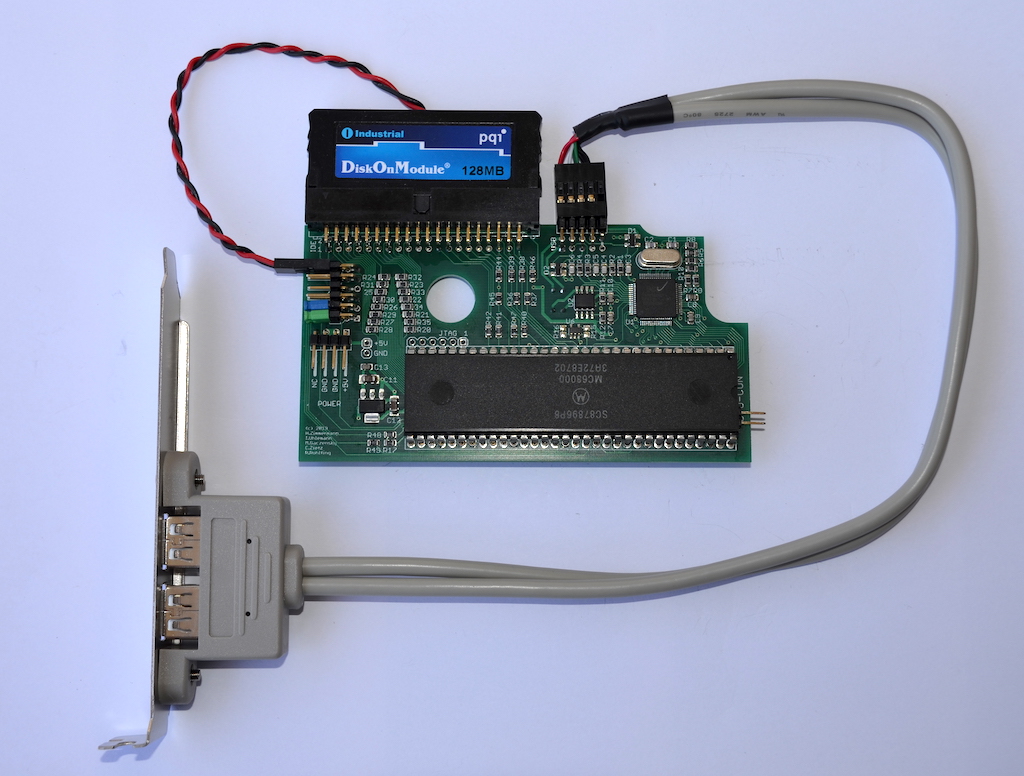
Re:The 1040ST
on Sunday January 29, 2023 @05:21AM (#34566744)
As for "there seem to be quite a few different Atari 1040ST board designs" noted in the article. There is actually a huge number of different board layouts. Look at the entries for "STF" or "STFM" in this overview: https://temlib.org/AtariForumWiki/index.php/Atari_ST_motherb....
As for why Atari redesigned the board so many times: no idea.
PicoWifi ‒ An inexpensive and easy-to-use WiFi dongle for Ataris with USB
BigPEmu – Atari Jaguar Emulator
Re:A 74xx-Defined Radio (2021)
on Wednesday July 13, 2022 @03:52PM (#32087945)
When I had my "I want to build my own SDR" phase ;) ca. 15 years ago, I also used analog switches as a switching mixer - with a PLL running at 4x the desired frequency so I could utilize dividers to get nice 0°, 90°, 180°, 270° LO signals for IQ mixing. Brings back memories...
An Intro to x86_64 Reverse Engineering
Re:Raspberry Pi Pico: What is this code doing in its boot ROM, line 442?
on Sunday April 10, 2022 @06:35AM (#30975897)
The quoted description is correct. The boot ROM loads code from flash: the "second stage" loader. That loader then (usually) configures the RP2040 to execute the actual application directly from flash.
But the "Easter egg" function discussed in this HN thread is not inside any code loaded/executed from flash. It is inside the boot ROM (as I've repeatedly stated); and that is indeed read-only memory, i.e., it cannot be modified except by manufacturing a new chip revision.
Re:Raspberry Pi Pico: What is this code doing in its boot ROM, line 442?
on Sunday April 10, 2022 @06:05AM (#30975751)
What are you trying to say here? Please have a look into the RP2040 data sheet to understand what "boot ROM" means. It is not programmable!
https://datasheets.raspberrypi.com/rp2040/rp2040-datasheet.p...
"A 16kB read-only memory (ROM) is at address 0x00000000. The ROM contents are fixed at the time the silicon is manufactured."
Re:Raspberry Pi Pico: What is this code doing in its boot ROM, line 442?
on Sunday April 10, 2022 @05:20AM (#30975557)
And here is code to run it on the actual hardware (i.e., Pi Pico or similar boards): https://gist.github.com/czietz/c37eab1e4623ad5f619e7acf84ee3...
Also returns 42.
Re:Raspberry Pi Pico: What is this code doing in its boot ROM, line 442?
on Sunday April 10, 2022 @04:32AM (#30975346)
It is in the boot ROM; not in flash memory.
Re:Raspberry Pi Pico: What is this code doing in its boot ROM, line 442?
on Sunday April 10, 2022 @03:48AM (#30975187)
As it is in ROM (inside the RP2040), removing it might involve a Focused Ion Beam machine ;-)...
Re:Raspberry Pi Pico: What is this code doing in its boot ROM, line 442?
on Saturday April 09, 2022 @03:16PM (#30971065)
Okay. I have an idea. Let’s see what happens if we treat…
06: 00 B5 push {lr}
    08:  42 40          eors r2, r0
    0a:  00 2A          cmp  r2, #0
0c: 00 F0 02 F8 bl #0x14
    14:  70 46          mov  r0, lr
    16:  00 47          bx   r0
None of the previous three instructions modifies the flags. (I checked in the ARM reference manual.) Thus, “BHS” (branch unsigned higher or same) uses the flags from the “CMP R2,#0” above. _Every_ value of R2 is higher (in the unsigned sense) or same as 0. Hence, the following branch is always taken:
10: F6 D2 bhs #0
00: 11 38 subs r0, #0x11
02: C0 7A ldrb r0, [r0, #0xb]
04: 00 BD pop {pc}
0x2A is 42 (decimal)! Could this be an Easter egg; a very obfuscated way of returning 42, the Answer to the Ultimate Question of Life, the Universe, and Everything? (Remember that the Raspberry design team is from Britain, same as Douglas Adams.)