jeromescuggs
Re:Ask HN: Is Windows That Bad?
on Thursday February 23, 2023 @06:23PM (#34918256)
10 follows the 'every other windows' pattern (xp good, vista bad, 7 good, 8 bad, 10 good, 11 bad)
windows 10 + open-shell + powertools + wsl + windows terminal is a really great combination right now
for me, windows 10 essentially functions as a login shell/window manager for my linux environment that comes with the best version of WINE i've ever used https://ha.zardo.us/img/ss21022023.jpg
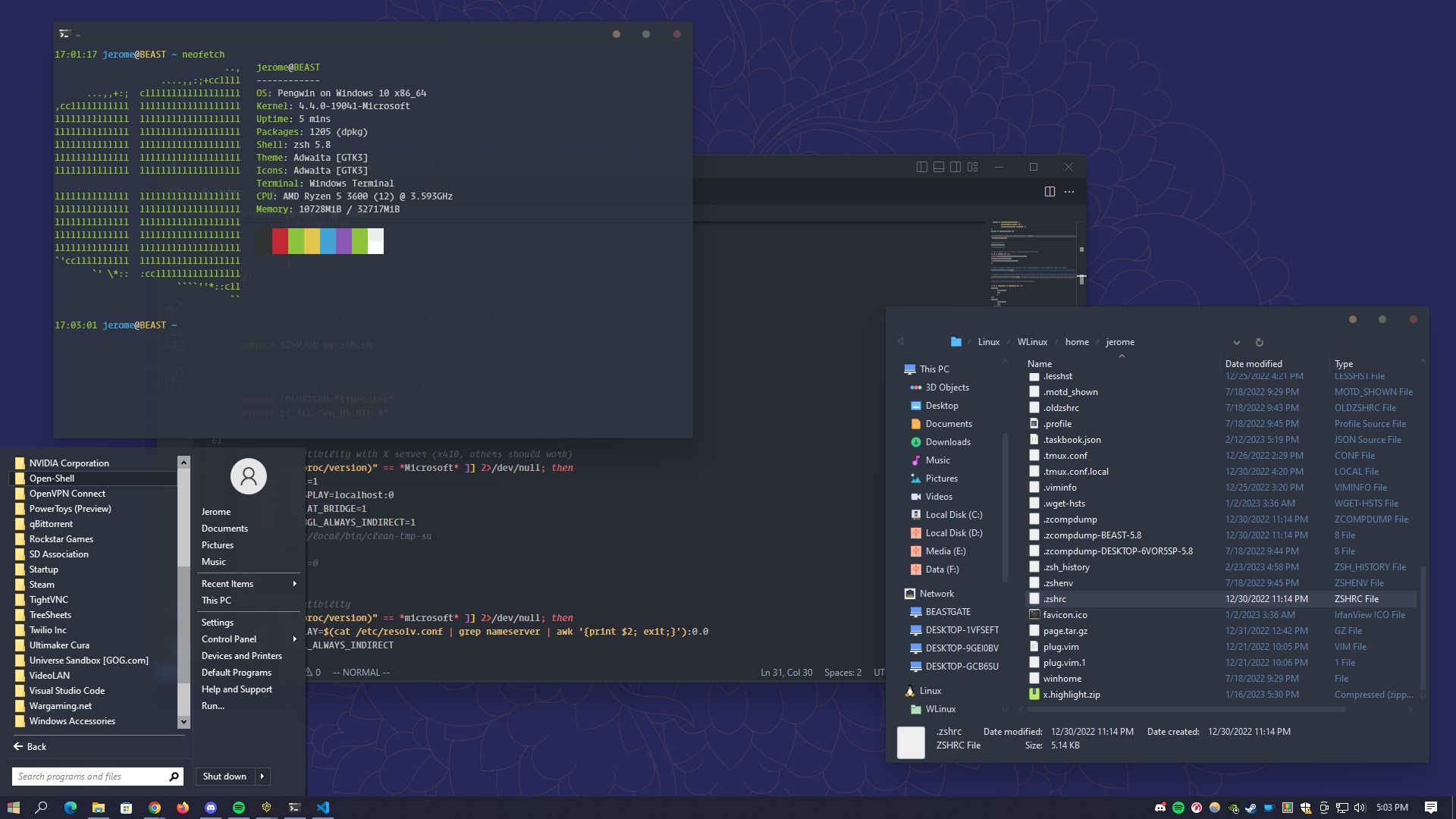
using linux via wsl is incredibly straightforward, to the point that you don't see alot of WSL-specific instructions on e.g. installation/compiling readme's.
Re:To Neovim, or Not to Neovim. Tldr: Hell No
on Tuesday February 21, 2023 @05:53PM (#34888878)
as someone who uses neovim because all my pure rice vim plugins run soooo much smoother on neovim, i'm going to go out on a limb and say that he is dramatically overestimating the representation of his demographic among neovim and maybe even vim users.
i think i read the phrase "emacs envy" more than once, i just feel like OP has a very specific audience for this post in mind
Re:Ask HN: What does your mother tell people about your work or employ...
on Thursday June 02, 2022 @10:38PM (#31603598)
"lab technician for a biopharmaceutical company"
i distill concentrates for a medical marijuana cultivator in a part of the country where it's still a real cointoss on how ppl her age feel about that
Re:The US Marines Got Rid of Their Tanks. Is Ukraine Making Them Look ...
on Tuesday March 29, 2022 @10:39PM (#30850970)
i covered the same thing, here: https://news.ycombinator.com/item?id=30759775
tl;dr: the russians are demonstrating the failure of a particular strategy/theory on how to deploy and use armor, not a failure of the concept of armor itself.
Re:Ask HN: Are Tanks Obsolete?
on Monday March 21, 2022 @05:14PM (#30759775)
the "main battle tank" concept of armored warfare certainly appears outdated, but tactically speaking, the idea of using mobile/mechanized armor to support infantry is still super important
a mobile, armored vehicle capable of things like transporting infantry and serving as a mobile defensive position to fall back to, engaging enemies with direct or indirect heavy fire, serving as a command and control vehicle, etc
the line between "tanks" and IFV's seems to be getting blurrier, because the idea of a relatively heavily armored, big-gun, "breakthrough" tank really is a relic of cold war strategy. the past few decades have seen tank designs evolve to become more mobile and even capable of carrying infantry. at the same time, 'infantry fighting vehicles' are becoming more armored and carrying higher-caliber main weapons.
tactically, an armored vehicle appearing on a battlefield is still advantageous: you've immediately aggro'd the enemy forces and allowed your own infantry to breathe for a second while the enemy figures out how to deal with the armor. you could bait out hidden antitank elements. you could mount some powerful optics and a radio, and you can have a commander remain close to the elements they are directing, while relatively protected. you could use heavier armor as line-of-sight howitzers to clear urban environments.
what's changed is it's now a real bad idea to send in heavy armor as a 'spear tip' in an invasion, you want to support them with infantry, and at the point where you're forced to mix armor and infantry, your armor will begin to resemble more infantry-friendly designs. the example probably most familiar with folks is the israeli merkava tank - for all intents and purposes it's a 'main battle tank' but it can also carry 6 passengers in a rear fighting compartment, which i imagine allows for some really flexible fire-and-maneuvering.
in the context of the russia-ukraine thing, all of this flies out the window; i have no idea what the russians are doing. partly because of the fog of war but partly, from what i can gather, because their military was kinda dogshit going into this conflict. i swear to god it's like they've unlearned stuff since 1988.
Re:History's deadliest air raid happened in Tokyo during World War II ...
on Wednesday February 16, 2022 @03:52PM (#30365526)
Re:The Many Faces of Berlin U-Bahn Line U7
on Sunday April 18, 2021 @08:02PM (#26857808)
so did wes anderson have a life-changing ride on this line, or what
Re:Ask HN: Where are the Beautiful clean HTML/CSS templates?
on Tuesday November 24, 2020 @10:50PM (#25205875)
i recently sat down over a weekend and did the same after realizing that i should hammer out something i can use for myself - it dawned on me the work i thought i might be saving with frameworks was offset by the work i'd wind up doing to them - having to go through and cut out all the stuff i wound up not using, changing defaults to things i like etc.
i think a part of that was also realizing what drew me to frameworks initially was less about styling and more about the grid or flexbox etc scaffold - the most daunting part for me to this day. creating my own set of base templates helped me learn quite a bit about grids though, and now when stuff breaks i can tackle it with more confidence in where to look for the issue and how to go about fixing it.
that being said, i'm not anti-framework or anything - i relied on them alot as i learned CSS, and even now i still treat them like something akin to styleguides or catalogs of what's new/trending in webdesign
Re:I Still Use Vim
on Wednesday November 18, 2020 @04:42PM (#25142807)
drawing from my own experience, i once found myself trying to work on a client website. thanks to a series of events i was using termux from a cellphone. i grabbed my vimrc from my dotfiles git repo and that was that. took all of 30 seconds to turn someone's cellphone into an interface identical to the one i use everywhere else
Re:Ask HN: Where are the good static site themes
on Tuesday September 29, 2020 @01:49AM (#24624506)
unfortunately there isn't an easy answer here, but you could always check out individual static site projects and peruse their available themes - hugo's gallery is pretty decent
echoing the other comment: with the caveat that i've always had a basic familiarity with css/html, i wound up throwing everything out and just building my own theme up from scratch. the real headscratcher is figuring out the whole grid/flexbox div positioning stuff, but from there it's not super tough to look at website source code for ideas, and/or google around.
it kinda seems like you're shooting for a solution in which you'll find exactly what you're looking for without having to pay a designer or even put in some time on google. in my opinion, learning css was far easier than learning how to properly maintain a static site - so it kinda threw me for a loop. on top of that i'm not really sure what you mean by 'quality' and 'finesse', except that from all possible existing designs, i can safely exclude 'most of the ones of jamstackthemes.dev'
Re:Ask HN: Do You Despise Marketing?
on Friday August 21, 2020 @03:49PM (#24238253)
i mulled over this for a minute because i can't really find fault with your comment, but at the same time i look at the state of things and it seems far from ideal, or even acceptable.
my guess is there's a factor that affects the system you described: centralization. it's something i think about alot when i sort of try to look back and remember how i stayed on top of so much content back in the pre-web-2.0 times. i remember something like you describe - lotta reading copy, sure, and landing pages definitely, but the huge difference in my mind is how 'influencers' were more of a complex ecosystem of people who just sort of passed interesting links to other people. i dunno.
Re:Ask HN: Do You Despise Marketing?
on Friday August 21, 2020 @03:41PM (#24238182)
Given the replies I think it would be wise to instead perhaps use a different term to distinguish it from the sort of area bill hicks was known to loathe. A term i used to see used back in the day was 'shameless self promotion'.
Personally, 'despise' is perfectly descriptive. Fortunately I've always done dev-related stuff as a tinkerer's hobby, unfortunately my discomfort at shameless self-promotion will likely mean I won't be quitting my day job anytime soon.
Re:How the design of a WWII plane led to the concept of user friendlin...
on Monday July 13, 2020 @02:23AM (#23817645)
by 1940 it was already 4 years old :P in terms of development i assume this refers to the field of aircraft design, and i think it might not be obvious at first how dizzyingly complex modern aircraft can get. aerodynamics is already a complicated thing, but then you have to design around stealthiness. since your goal is both, physically operating such a vehicle would be almost impossible because of instability issues, so you now have to design software that will smooth out the aircraft as it flies, while still allowing the pilot to do exactly what they want, when they need to. now you have to find parts that will allow all of that to come together - powerplant, materials, etc - for example, even the paint for stealth aircraft had to be developed to help reduce radar signature, etc etc etc
Re:Narrative Collapse
on Tuesday June 23, 2020 @03:19AM (#23610801)
think of the 'cold war'. it's always framed as a 'battle of good and evil' - this is the narrative. hopefully you might agree that the reality was far, far murkier than that - more senseless maiming and killing, so to speak.
unfortunately, as we see currently, simply dismantling narrative itself doesn't seem like a solution to anything, because narratives are more or less the very thing which have driven so much of our history.
you sort of touch on the vital task: making a satisfying story out of what we're going through. the challenge is always finding ways that this story won't justify or entrench shitty elements of society. (one might even say we are in the process of challenging a narrative concerning the role of police)
Re:Narrative Collapse
on Tuesday June 23, 2020 @03:12AM (#23610763)
i highly recommend the work of adam curtis, in particular his documentary "bitter lake", and perhaps "hypernormalisation".
he was influenced by baudrillard's critiques of narrative as well, one of baudrillard's essays that always sticks with me is "pataphysics of the year 2000", in which he predicts the 'news loops' in which narratives are obliterated in the 24-hour news cycle of our information age.
in the Matrix, at the beginning of the film, Neo hides some discs in a hollowed-out copy of a Baudrillard work, which isn't coincidental - baudrillard spent alot of time talking about how narratives often were confused with reality, though this is a very simplified explanation
my favorite essays he did to critique narrative were a series he did in the early 90's: -"The Gulf War Will Not Happen" -"The Gulf War Isn't Happening" -"The Gulf War Didn't Happen"
i might be misremembering the exact titles, but the sort of point he was trying to make is that in our minds, the 'gulf war' is a story about iraq invading a country, and us saving the day. The reality of it was so much more complex, involving centuries of background involving way more participants.
Re:Anti-Ghosting
on Tuesday June 02, 2020 @02:25PM (#23394264)
this is only somewhat related, but i count my old coolermaster masterkeys S as my favorite keyboard of all time, it was nice and utilitarian and came with some absolutely fantastic keycaps - for about 80 bucks. damn shame they "updated" their product lines to appeal to gamers or something, and started taking their cues from corsair and not like, filco.
i have the misfortune of being the guy my friends, family etc call when their computers go bork and one of the little things that just really shine is the easy function-key-shortcut builtin to the board that will swap between windows- and mac style modifier layouts, it wound up being far more than some bellwhistle i initially thought it would be
unfortunately since it was my first real mech it also was something of a guinea pig. i learned to solder switches by swapping them out, and the connections are kinda janked now, and i sometimes have to wack it like an old TV to get it to register certain keypresses.
i'm currently using a durgod TKL, it's almost a suitable equal in all the areas that made me love the CM board.. but man i wish i'd been able to snag another masterkeys, even used, before the supply dried up.
Re:Ask HN: What website, from your early days on the net, do you miss?
on Sunday April 26, 2020 @12:01PM (#22988054)
mingthemerciless
i cant even explain it but
just a front page that endlessly looped random static or animated images that had a perfect mix of absurd, funny, and oddly enough aesthetic qualities
these screenshots are of images that have to be over a decade old, maybe 12-15 years? i managed to grab them from waybackmachine which was crazy because never knew anything about the site and when it disappeared i would google around and couldn't find anything about it for years. low-key started to wonder if it was even real, if i was losing my mind, heh.
i miss sites like that which existed just to exist or whatever, there wasn't any (obvious) point or information, not really even something like a copyright notice. just someone armed with photoshop, font packs, flash, and a weird sense of humor and the resources to host it online
Re:Typing inside of the default WSL terminal feels amazing (2018)
on Monday December 23, 2019 @10:36AM (#21864226)
wsltty is the most underrated app i use on the regular. i was pumped about the new microsoft terminal for all of 5 seconds, then i used it, what a letdown.
with alot of help from wsltty and autohotkey, i am quickly approaching some sort of windows+linux singularity event, https://i.imgur.com/cXykxPN.png

Re:Ask HN: Best Static Site Builder?
on Monday November 25, 2019 @12:18AM (#21625663)
thank you for this link - i want to use jekyll or hugo, i do, but i am real bad at organization and i always fall back to using a local WP install to take content and do all the heavy lifting - organizing it, styling it, etc. i get insanely frustrated sometimes trying to work with hugo, just little things that fly in the face of what is mostly a pretty straightforward program, but its those little things that really ruin the entire thing for me.
Re:Show HN: Web components to create OS-like web apps
on Monday November 11, 2019 @11:17PM (#21511479)
i'm bummed that everyone is coming here to basically post links for similar projects...
...but that is what i am doing :(
i think it's worth posting, though. i still find little things that blow me away (most recently: it has a screensaver), and afaik i don't think it's a widely-known website. i've always been kinda obsessed with the idea of making an OS-style website, but this killed the dream for me as i simply will never be able to come near this particular demonstration.
that being said... your project might be the thing that helps me reach whatever eureka! moment i need. i poked around the github a little and i'm already excited at the modular principle used - it makes the webpage-as-OS concept far less intimidating, seeing the various components broken down into their respective pieces. most of the code i've ever peeked at is always at an extremely polished level that makes it too nebulous for someone at my very modest level of experience to use as a concrete inspiration/example. thanks for sharing!
Re:Ask HN: What do you automate in your life and work?
on Monday October 28, 2019 @04:47PM (#21381475)
mobaxterm helped me get serious about security when i ran the ssh server once and used the easy menu options to view who was knocking on my doors, and... man. people think the robocallers are persistent...
i did a little screenshot ( https://i.imgur.com/HndJDqg.png ) to demonstrate how far WSL has come - though i must admit i am using the paid ($10) 'pengwin/wlinux' distro that was built specifically for WSL, basically debian with some tweaks and a config menu not unlike the 'raspi-config' menu on an RPi. i would say that it has absolutely been worth it though. it will be some time before being able to install something from a debian repository, and then open it from my windows start menu, ceases to just leave me in awe.

Re:Ask HN: What do you automate in your life and work?
on Monday October 28, 2019 @12:48PM (#21378659)
are you using it for remotely accessing linux boxes? mintty+wsl-bridge aka wsltty has really come a long way in a short time, and i'm beginning to use it even for remote work alongside using it for wsl. call me shallow but it really boils down to it looking far, far better when staring at a vim buffer for hours...
i absolutely love mobaxterm, but there's alot of cases where it seems like overkill for my purposes. that being said, nothing beats mobax when it comes to a stupid easy X server for windows. vcxserv and x410 are both nice and getting nicer, but you gotta sit down and work out kinks to make either one really useful
Re:Ask HN: What are some high quality Linux theme resources?
on Wednesday September 25, 2019 @06:15PM (#21076179)
in my experience, if cruft is a major concern in your day-to-day use of linux, you probably already have a desktop/window management environment and theme you've settled on :P
i consider myself a sort of power-casual linux user, i don't develop professionally but love to tinker and play around with it, almost exclusively for aesthetic reasons. regolith being built on ubuntu means that the second i find myself out of my element, there's always the familiar and ever-present terminal i can pull up, that responds to all the commands i already know, has the binaries and services i am already familiar with, etc.
that being said, i've taken some light dips into the wild, mainly using manjaro architect to play around with manjaro/i3 - regolith was a very awesome(lol) way to learn i3wm because i wasn't simultaneously having to also learn the ins-and-outs of a non-debian-based operating system
Re:Linux Terminal Goods
on Thursday September 19, 2019 @11:11AM (#21016923)
i really wish spacemacs didn't have that pretty lame loading screen, as a spacevim devotee i found alot of things that spacemacs does that specifically address some issues i have with spacevim.
i know the correct path forward here is, of course, diving into the guts of spacevim and tinkering until it works for me, but i will post one quirk as it will probably be some time before i will be able to write my own comprehensive plugin:
the hugofy/markdown plugins seem to all do this awful thing in which they render the markdown on the fly. it's kinda neat for basic text formatting, but my god it is an utter nightmare if you have any sort of URL's or images, because the second you key in that second bracket, it suddenly dissapears and you're left having to basically guess your way through the process of typing the url and closing out the shortcode.
if someone knows of a markdown editor that plays nice, i'd love to see it. hope im not overlooking something painfully obvious here
anyways, i picked a hell of a time to dive into the commandline, a year ago i came across scoop/chocolatey and quickly discovered WSL, and thanks to a phenomenal amount of work by some great folks (even you, Person Reading This), my desktop is not much more than the lobby i pass through before going to where the magic happens: https://imgur.com/a/iCpWZAC
Re:Ask HN: Best Blogging Platform
on Monday August 26, 2019 @07:59PM (#20804928)
wordpress always felt really overkill for what i wanted, and static site gens are fun for people who like to tinker under the hood. personally i use hugo, but i am still shopping around for something a little less convoluted. stumbled onto a super old package called blazeblogger and it'a been neat, but we will see
when i just want something i can setup with minimal hassle, i have always loved GetSimple (http://get-simple.info/) although i imagine mentioning a flat-file platform will probably elicit some reactions - flat-file meaning it doesn't use a database to store content, but instead simply stores the data, encrypted, in actual textfiles on your webserver. when i was using godaddy as a host, their mysql db's were always a bit laggy, and something like wordpress would always have that extra, noticeable pause during loading that bugged me to no end. getsimple with the blogging plugin was always faster, configuring it was easy, and i didn't have to stray too far outside my limited knowledge of html/css/php to play with the styling and theming.
Re:Ask HN: What are the first things you do on a new Windows 10 PC? An...
on Sunday August 11, 2019 @10:44AM (#20668384)
ive noticed my checklist has been slowly shrinking as microsoft sees fit to takeover alot of the typical first-run duties from the user
some months ago i realized i no longer have to go grab my gpu drivers from a website or 'fresh install essentials' backup usb
my current windows box is about a week old, and it occurred to me the other day that i didn't even have to go in and do little things like enabling the viewing of hidden files, or displaying file extensions 100% of the time etc - alot of these settings are attached to your microsoft account, if you choose to use one.
haven't tried to debloat it yet, as someone else mentioned the script you used last time might not work this time, but a decent way to make it somewhat tolerable is using classic shell to make the start menu far, far more appealing
i recently fully switched over from using ninite to using chocolatey. so far i have yet to find an application i need or want that choco doesn't have
also - and i really must beg forgiveness here - that new windows terminal... it ain't half bad... but mintty/wsltty are still the goto's for interacting with WSL
my choco install -g essentials:
firefox
speedfan
steam
vscodium / atom
ffmpeg / vlc
autohotkey
etcher
simplenote
irfanview
winamp / foobar / picard
Re:Ask HN: What tools do you use for note-taking, progress tracking an...
on Thursday June 06, 2019 @10:58AM (#20115154)
i have pretty severe adhd which causes a somewhat difficult situation where i need to keep todo lists to remain on track for even basic stuff, and the system needs to be pretty foolproof because, you know, the adhd
i dream of doing something really fancy, but i always come back to the same trio of tools:
-every morning i grab a few sheets of paper and keep them folded up in my pocket, to jot things down when needed. this covers my irl day-to-day pretty well
-for the virtual stuff i use simplenote because it's got apps on every platform i use, and failing that there's a webclient which is nice in the event i am on a computer that isn't mine.
-i really, really wanted to get a nice taskwarrior setup going, but i found that getting the server up for sync purposes to be overly complex. after alot of searching and trying-outs and whatnot the setup that remains due to its ease and portability is a little thing called dstask, which uses a private github repo as its base. setup is as simple as a 'git clone .my/repo' and a 'npm i dstask', and running the sync command updates the repo in a way that i -wish- hub's 'hub sync' command would operate.
with the speed of computing these days, i reformat and reinstall my os maybe once a week or so because it's literally faster than trying to un-break something when i manage to mangle something up. so this is a super easy thing to have to constantly re-deploy because git and npm are, naturally, some of the first things that get installed on a fresh setup
so that's how i manage to be somewhat functional and independent in my short-term type stuff. for longer projects and just to keep up the habit, i keep a pretty large amount of notebooks around, because i am prone to forgetting to grab one so my solution was to have so many that there is now one or two at just about any place i am at routinely. i have a sort of system to keep track of what i guess i would call this 'distributed notebook' but it would probably drive you insane in a sort of lovecraftian way if you tried to make sense of the clusterfuck method - like if i refer to something in another notebook i draw an arrow and depending on the orientation i know what other notebook i am referring to, because the arrow points to its physical direction relative to wherever it is i am writing.
obviously the big problem here is encryption but the first rule of encryption club is,...
Re:A Tiling Desktop Environment
on Sunday June 02, 2019 @01:56AM (#20073736)
being able to divvy up a desktop into 4 quarter panel windows on win10 with near zero effort absolutely changed my life, i think of how much time i've wasted clicking back and forth between two windows stacked on eachother, or having to manually move/size windows to be next to eachother... i dunno. i held out as long as i could before caving to a 10 upgrade out of necessity, and it's a shame that windows has built such a stigma like that because (once you go in and rip out all the junk) it's clear microsoft has decided to embrace alot of conventions paved by linux/unix/gnu/whatever - little things like recognizing shift+ins as a 'paste' command - and has really improved desktop management overall.
Re:A Tiling Desktop Environment
on Sunday June 02, 2019 @01:35AM (#20073671)
i feel like i know where you're coming from here, this isn't exactly what you're describing, but it's pretty dang close. really made the transition to window tiling far less intimidating than i imagined.