News for hackers. Stuff that matters.
Re:The inconvenient truth about malaria by ams6110 on Tuesday December 15, 2009 @07:22PM (#997765)
And malaria was only eliminated from the Soviet Union and large areas of Europe in the 1950s, after the advent of DDT.

This is an important fact that is only mentioned in this one sentence. The banning of DDT lead to millions of deaths in tropical areas (an "unintended consequence"). Limits on CO2 emissions and the resulting impact on energy production, manufacturing, and agriculture may well have unforeseen consequences, which will, like the DDT ban, probably affect developing nations more than anyone else.

Re:The inconvenient truth about malaria by spamizbad on Tuesday December 15, 2009 @08:13PM (#997862)
DDT is still legally used to the quantity of 4000+ tons a years. I fail to understand how it was "banned", as it's still widely used in countries like India and several African countries. What actually happened was a bunch of guidelines were established for its use, which any sovereign nation can ignore with little consequences. The fact that the west decided to outright ban the stuff isn't that big of a deal given the fact that there aren't terribly many Malaria deaths in the United States or Norway.

And those restrictions were put in place for good reason: For DDT to be effective in wide areas (rather than targeted spraying indoors) you essentially need something potent enough to disrupt the entire Entomological portion of the eco-system, which works its way up to small mammals, which can eventually impact certain key predators.

One infamous example this occurred in Borneo in the 1950s. The WHO responded to a malaria outbreak on the island by spraying DDT. It abated the malaria problem but completely disrupted insect life which lead to numerous problems culminating in roofs collapsing from an overpopulation of thatch-eating caterpillars, along with killing of mammalian predators that ate lizards (which ate DDT-laden insects). This caused an overpopulation of rats which started spreading typhoid and plague. The rat problem was ultimately solved by airdropping cats.

Re:The inconvenient truth about malaria by patio11 on Tuesday December 15, 2009 @08:51PM (#997915)
which any sovereign nation can ignore with little consequences

This is contrary to fact, because a) African nations are dependent on foreign aid, and donor organizations both will not fund DDT and will quietly threaten other funding if you choose to spray it and b) the prospect of African agricultural exports being barred due to "contamination" by DDT residues acts as another de-facto ban on DDT, since it threatens crippling economic sanctions for using it.

(Oddly enough, the crop most often at "risk" is tobacco -- because God forbid your cigarettes have harmful chemicals in them. There is an absolutely priceless quote from a chemist saying that he's be more concerned that you got nicotine in his DDT than getting DDT in your nicotine.)

Sources:

http://www.africanagricultureblog.com/2008/07/malawis-tobbac...

Re:The inconvenient truth about malaria by spamizbad on Tuesday December 15, 2009 @09:31PM (#997970)
Is there any nation that has had aid withheld explicitly because of their violations of DDT use? India shirks WHO regulations like crazy (including but not limited to those pertaining to DDT) but received billions in aid during 90s, before they were a nuclear power. And it certainly hasn't slowed down their position in global trade. Heck, their human slavery problem furrowed lots of brows but never amounted to any sanctions that I'm aware of.

What I'm trying to say here is if the hammer is going to come down on your country, it's likely doing things waaaay worse than revamping its ecosystem with pesticides.

Re:The inconvenient truth about malaria by patio11 on Tuesday December 15, 2009 @10:02PM (#998013)
s there any nation that has had aid withheld explicitly because of their violations of DDT use?

Yes. Many nations have been told, in so many words, that if they continue spraying DDT they can go find health funding elsewhere.

http://www.nytimes.com/2004/04/11/magazine/11DDT.html?pagewa...

The above article cites Mexico, South Africa, Belize, and "[m]any African scientists and health officials" as having been pressured in this manner.

Re:The inconvenient truth about malaria by spamizbad on Tuesday December 15, 2009 @10:34PM (#998061)
That quote pertains to acquiring funding exclusively for programs that will use DDT, and basically says that donors will be reluctant to fund something that involves spraying DDT. Unless the only people who bother to give any money to these programs are misinformed bleeding-heart environmentalists, I'm not sure how much of a barrier that is. Nothing is stopping say, the Cato Institute from starting a DDT spraying initiative to fight malaria.
Re:The inconvenient truth about malaria by dangrover on Tuesday December 15, 2009 @10:17PM (#998039)
Interestingly enough, bedbugs are making a resurgence too because of this: http://en.wikipedia.org/wiki/Bedbug
Re:The inconvenient truth about malaria by travisp on Wednesday December 16, 2009 @09:24AM (#998788)
It's not banned, but strongly discouraged by the Western world that already got rid of malaria via DDT.

According to the NYT, DDT isn't being used in many countries that could use it, with deadly consequences.

http://www.nytimes.com/2004/04/11/magazine/what-the-world-ne...

From the NYT:

But various factors, chiefly the persistence of DDT's toxic image in the West and the disproportionate weight that American decisions carry worldwide, have conspired to make it essentially unavailable to most malarial nations. With the exception of South Africa and a few others, African countries depend heavily on donors to pay for malaria control. But at the moment, there is only one country in the world getting donor money to finance the use of DDT: Eritrea, which gets money for its program from the World Bank with the understanding that it will look for alternatives. Major donors, including the United States Agency for International Development, or Usaid, have not financed any use of DDT, and global health institutions like W.H.O. and its malaria program, Roll Back Malaria, actively discourage countries from using it.

Re:The inconvenient truth about malaria by Tichy on Tuesday December 15, 2009 @08:04PM (#997841)
Somehow I doubt that Malaria ever was the same big problem in Europe as it was in Africa. Wasn't Malaria the main thing impeding Europeans in Africa? They should have been used to Malaria if it had been so common in Europe.

If Malaria was in Europe, perhaps it was at a much smaller scale?

Re:The inconvenient truth about malaria by patio11 on Tuesday December 15, 2009 @08:38PM (#997893)
Malaria used to be as big a problem in over 60% of the continental United States, and the south of Europe, as it is in sub-Saharan Africa. It was stopped with widespread mosquito habitat destruction and chemical abatement.

Here is a map the CDC produced which displays, in graphic detail, how these efforts succeeded.

http://www.cdc.gov/malaria/images/graphs/us_malaria_old_map....
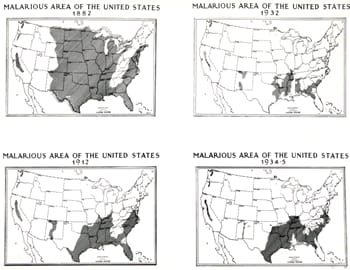
There is, currently, no significant portion of the continental United States in which malaria is a major health conern. If there was, we would start spraying absolutely anything required to kill it, because Americans don't let their kids die to avoid pissing off the environmental lobby.

Re:The inconvenient truth about malaria by pyre on Tuesday December 15, 2009 @09:59PM (#998011)
> because Americans don't let their kids die to avoid pissing off the environmental lobby.

Don't point that at everyone. I'm an American, and a father-to-be. I would rather deal with the issue in a way that is morally responsible, than just "do whatever it takes to prevent any harm from coming to my child."

Re:The inconvenient truth about malaria by tptacek on Tuesday December 15, 2009 @10:06PM (#998022)
I'm an American, a father of two, and about as far to the opposite end of the political spectrum from Patrick as you can get, and if we're voting, I'm with him. Kill the damned mosquitos. I've had a kid in the hospital for something very serious before.
Re:The inconvenient truth about malaria by pyre on Wednesday December 16, 2009 @06:19PM (#999967)
It's not as simple as "kill the mosquitos." What if "kill the mosquitos" meant "burn down all the forest and destroy all of the wetlands." Are you about to destroy the world to save your child?
Re:The inconvenient truth about malaria by patio11 on Wednesday December 16, 2009 @06:38PM (#1000027)
It says a lot about me that I don't even consider this to be a difficult question: I would burn every forest, pave every wetland, and dance over every eggshell to save one African kid I have never met.

That said, it is a false choice. Look at the CDC graphs: we've already annihilated malaria on two continents. North America and Europe strike me as pretty livable. I'm quite willing to do that everywhere.

Re:The inconvenient truth about malaria by Tichy on Thursday December 17, 2009 @06:04AM (#1000802)
That sounds a bit silly though - as you said, a false choice. Surely you wouldn't want to pave over the whole continent. There are other ways to save the children than to destroy everything. It's also a question if humans have to expand everywhere.

If it all is such a no-brainer for you, I wonder what other choices you make in your life to save lives in 3rd world countries? For example CO2 consumption? To be honest, I don't buy your no-brainer attitude.

Re:The inconvenient truth about malaria by tptacek on Wednesday December 16, 2009 @11:00PM (#1000391)
I have to consider whether killing mosquitos creates a world where I'll eventually have to teach my kids to painlessly kill themselves, a la The Road, but apart from that for my own family it's an absolute no brainer.
Re:The inconvenient truth about malaria by pmorici on Wednesday December 16, 2009 @06:37AM (#998585)
Are you saying putting a child at risk of life threatening disease to save the mosquitos is acting morally responsible?
Re:The inconvenient truth about malaria by Tichy on Wednesday December 16, 2009 @08:06AM (#998673)
I don't think concern for mosquitos was the main reason for banning DDT.
Re:The inconvenient truth about malaria by patio11 on Wednesday December 16, 2009 @06:39PM (#1000032)
Of course not -- environmentalists don't value mosquitoes more than Africans. To say that would be a monstrous calumny.

Environmentalists value birds over Africans.

Re:The inconvenient truth about malaria by Tichy on Thursday December 17, 2009 @06:06AM (#1000805)
I don't know the backgrounds, but I thought that essentially having DDT in the food chain is undesirable.

Would you spray your backyard with DDT to save an African kid? Granted, if it was the only way, maybe, but overall I personally would rather not (then I would rather put up a tent for the African kid and relocate it to my DDT free backyard).

Re:The inconvenient truth about malaria by Tichy on Thursday December 17, 2009 @08:28AM (#1000949)
OK, now I have read most of the Wikipedia entry on DDT: http://en.wikipedia.org/wiki/DDT

I have to say I am speechless by the stupidity of your comment.

Re:The inconvenient truth about malaria by billswift on Wednesday December 16, 2009 @05:47AM (#998516)
Actually, window screens were as important as chemical abatement. That's why installed screens are required in much of the US for a new house to receive a "habitation permit" (in quotes because different jurisdictions use different words). And I remember an article years ago, that providing window and door screens for Africans would substantially improve their health, but nobody was interested in doing or funding it because it wasn't flashy enough.
Re:The inconvenient truth about malaria by Tichy on Wednesday December 16, 2009 @05:52AM (#998524)
Interesting, but somehow I doubt that spraying did the trick. Maybe it was destruction of the habitats. I suppose with spraying you would have to keep spraying, which I think isn't happening? Isn't DDT outlawed now?

Perhaps changes in farming also contribute (are humans the only animals that pass on Malaria, or would cows work, too?).

Also I think if I were a father, I would weigh pros and cons. Mosquitos are bad, toxic chemicals are bad, too. It might vary from situation to situation which one is the greater risk.