It's also unclear what exactly "too much debt compared to GDP" means. What number is too much, and under what circumstances?
Additionally, while Finland's debt/GDP may be "fine", for your definition of fine, Finland's economy is not doing fine, thanks to the constraints imposed by the Euro and the same austerity policies in place throughout Europe. [1] [2] Even now Finland has 8%+ unemployment and 0.8% growth. Indeed for these reasons, Finland is expected to become one of the most indebted countries in Europe. [3]
[1] http://krugman.blogs.nytimes.com/2015/06/01/the-finnish-dise...
[2] http://www.interfluidity.com/uploads/2015/07/Greekovery.png
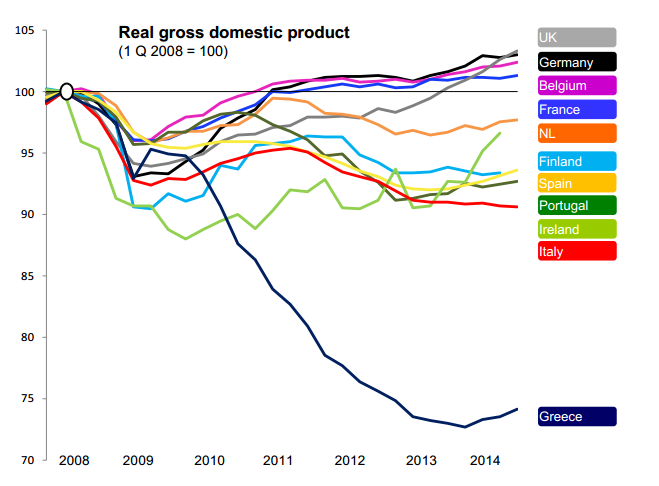
[3] http://www.bloomberg.com/bw/articles/2014-01-23/is-finland-a...
Cynics and detractors have already pointed out the corruption, cronyism, the woeful state of pension reform and rampant tax evasion.
A highly favorited comment on a different NYT piece on the Greece deal sheds light on the indifference, there:
  I was at my local tax office this morning - I figured that since most people
  here have stopped paying taxes, the timing might be good. It took me half an
  hour to do what normally would have taken a morning (most of which would have
  involved waiting on line).

  In the office I was dealing with, both wickets were open, and I could see the
  office beyond. Of the five people I could see, two were at the wickets, one was
  entertaining a succession of visitors who were not conducting business, and two
  were doing nothing. Just sitting there. Nothing.

  I was there because I have a new (British) passport. I have a password-protected
  file on the Tax Office site, but I cannot change my number myself, because every
  such transaction in Greece begins with the assumption that the client is lying,
  and therefore this sort of trivial business has to be done in person and the
  number verified. Fill in a two-page form and present the passport.

  The woman I dealt with - very courteous - entered the information in my file.
  Then she printed everything as well - several pages, nine stamps, seven
  signatures.

  Greece has been promising (to its creditors) to simplify, cut the red tape,
  reduce the Civil Service, for years, but things only get worse. Syriza re-hired
  the few that the previous government laid off, knowing they didn't have money to
  pay for them.

  This is a tiny example of why no one trusts the promises of successive
  governments. 'Give us the money now, and we'll reform later.'[1]
I particularly want to know why certain southern European countries share this brand of indifference and fatalism about their affairs. I have observed this in Portugal too.
[1] Peter Bowen a British citizen in Crete, Greece shares his thoughts
http://www.nytimes.com/2015/07/14/world/europe/greece-debt-p...
It is clearly meant according to the Maastricht criteria:
https://en.wikipedia.org/wiki/Euro_convergence_criteria
"2. Government budget deficit: The ratio of the annual general government deficit relative to gross domestic product (GDP) at market prices, must not exceed 3% at the end of the preceding fiscal year (based on notified measured data) and neither for any of the two subsequent years (based on the European Commission's published forecast data)."
"3. Government debt-to-GDP ratio: The ratio of gross government debt (measured at its nominal value outstanding at the end of the year, and consolidated between and within the sectors of general government) relative to GDP at market prices, must not exceed 60% at the end of the preceding fiscal year. Or if the debt-to-GDP ratio exceeds the 60% limit, the ratio shall at least be found to have "sufficiently diminished and must be approaching the reference value at a satisfactory pace"."
Or in easier words:
> https://en.wikipedia.org/wiki/Maastricht_Treaty
"2. Government finance:
Annual government deficit:
The ratio of the annual government deficit to gross domestic product (GDP) must not exceed 3% at the end of the preceding fiscal year. If not, it is at least required to reach a level close to 3%. Only exceptional and temporary excesses would be granted for exceptional cases.
Government debt: The ratio of gross government debt to GDP must not exceed 60% at the end of the preceding fiscal year. Even if the target cannot be achieved due to the specific conditions, the ratio must have sufficiently diminished and must be approaching the reference value at a satisfactory pace.".
Or less than 20 millions out the 330 million people living in the EURO zone.[0]
The Debt-To-GDP ratio is a mess. You can see the combined effect of austerity and crisis on some economies. And countries like France have only been twice within the target and not recently. [1]
At the end of the day, as many things with the EU, the real rule is around the interpretation of what means "satisfactory pace" and "exceptional cases" - which is regular political hidden under a layer of pseudo-righteous mathematics. (which is not unusual at all for an international treaty)
[0] http://ec.europa.eu/eurostat/tgm/table.do?tab=table&init=1&l... [1] http://ec.europa.eu/eurostat/tgm/table.do?tab=table&plugin=1...
The EU is a horrible project and a complet failure in every way.
There is no real economic study that says "3% good, 4% bad" (and it would be idiotic, really -- you need many more parameters to judge a State credit-worthiness, as Japan proves every day). It's all about politics.
It was not clear to me, but thank you for the explanation.
What insanity that the European nations would cripple their economic tools with a treaty like this. There are times when debt/GDP absolutely should be in great excess of 3%, and times when debt must be greater than 60%, and no country should require 'approval' to tackle their own economic problems.
Fortunately, I suppose, it looks like these sections of the treaty are not enforced very strongly.
Or at all, for certain countries. Germany and France routinely break pretty much any parameter, in various directions, and absolutely nothing happens.
But as soon as a minnow spends a little bit more, oooh boy...
Germany has been very strict on their own budget in the last four years and tries hard to satisfy the Masstricht criteria. For the following data, cf. http://www.tagesschau.de/wirtschaft/wirtschaftsdaten104.html
budget deficit/surplus of EU countries (% of GDP) (Haushaltsdefizite/-überschuss der EU-Länder): -3 is allowed, Germany has
  2012: +0,1 %
  2013: +0,1 %
  2914: +0,7 %
  2015 (estimate): +0,6 %
  2016 (estimate): +0,5 %
From the Maastricht criteria only "total debt (% of GDP)" (Gesamtschulden (in % des BIP)) is problematic, since there only 60% is allowed. But also here Germany is working very hard to satisfy this criterion:
  2012: 79,3 %
  2013: 77,1 %
  2014: 74,7 %
  2015 (estimate): 71,5 %
2016 (estimate): 68,2 %Media like to show "feel good metric" to put a patriotic positive spin (us good, them bad) on the result of regular political arm-wrestling between temporarily weaker countries. You won't see those metric in France however the media will use different things to achieve the same effect. The idea is to build a moral high horse so that your people can forget that over there, few people have benefited but a lot will pay.
[0] http://ec.europa.eu/eurostat/tgm/table.do?tab=table&init=1&l...
[1] http://ec.europa.eu/eurostat/tgm/table.do?tab=table&plugin=1...
"In 2003, France and Germany had both overspent, and their budget deficits had exceeded the 3% of GDP limit to which they were legally bound."
Both countries basically spent their way out of their economic downturns, then told everyone else not to do that.
Some of the issues are that the IMF wants Greece to implement the austerity stuff on a different time scale than SYRIZA plans to, and that the population is very much against those systems (which I can understand).
If the greek government would improve their tax agency so they’d have 0 tax evasion (let’s just assume that), then with the next election, a party would get elected that changes that. The reason: Currently, greece has to pay back debts, but that means people have to pay a lot more taxes, and only see the infrastructure to become worse – leading to uproar.
Greece can’t just stop spending completely, they have to improve the situation in many places, while simultaneously improving tax collection slowly.
If the Greek people lived beyond their means in the past, someday the moment will come where they have to tighten their belts. Bad luck, but they decided in the past to spend money that they don't have.
I am not saying who is wrong or who is right, but I don't think the blame falls only in one side. I'd argue that you take a risk when you lend money, and shit happens if you lend to people who can't pay.
If one looks at it that way, the whole argument about "lenders chose to lend to them, taking risk that they might not be able to pay, therefore they are to blame as well", falls wayside. This is because the risk they assumed to be taking was one of Greece "not being able to pay", not Greece choosing to not honour the deal.
Tl;dr: There is a difference between the risk of not being able to pay, and the risk of choosing to default/not pay at all.
The point is no one wants the bomb to blow up on their hands, and I get that, but meanwhile the situation in the country gets worse and worse... in the hopes that somehow the country generates more money.
Here the "ideology" starts taking place in the discussion, there are proponents of austerity, saying the confidence generated by always paying out-weights the short term losses, and there are people that say it doesn't work, and that we should somehow try something different since this strategy has been tried and failed a couple of times already. Like, hey let the guys off the hook for part of their debt (lenders knew the risk...), and let the blow generate economic pressure for growth (e.g. Get out of the euro, and let the newly minted and devalued currency be extremely attractive to buy stuff out of Greece, making their economy move).
You have to show the people at the same time that they gain something, too – for example, while you reduce corruption in tax spending, one of the first priorities should be improving performance of Police and similar public services. You can save a lot of money there while at the same time providing a better service. That leads to better public acceptance.
If that's really your theory, then Greece is not the first European country you should target.
Switzerland added a balanced budget amendment to their constitution in 2001
> https://en.wikipedia.org/wiki/Balanced_budget_amendment#Swit...
Many people consider this as the model for a similar amendment that was added to Germany's constitution in 2009
> https://en.wikipedia.org/wiki/Balanced_budget_amendment#Germ...
(which the German government takes really seriously at the moment) and Austria's in 2011:
> https://en.wikipedia.org/wiki/Balanced_budget_amendment#Aust...
A better comparison is to examine each country’s debt to government tax revenue, since that is the government’s income. This also offers a better comparison because different countries have very different levels of taxation. A country with high taxes can afford more debt than a low tax country. Debt to GDP ignores this difference. Comparing debt to tax revenue reveals a much truer picture of the burden of each country’s debt on its government’s finances.
When I compute those figures, Japan is still #1, with a debt as a percentage of tax revenue of about 900 percent and Greece is still in second place at about 475 percent. The big change is the U.S. jumps up to third place, with a debt to income measure of 408 percent. If the U.S. were a family, it would be deep into the financial danger zone.
To add a bit more perspective, the countries in fourth, fifth, and sixth place are Iceland, Portugal, and Italy, all between 300 and 310 percent. In other words, these three are starting to see a flashing yellow warning light, but only three developed countries in the world are in the red zone for national debt to income. The U.S. is one of those three.
source: http://www.forbes.com/sites/jeffreydorfman/2014/07/12/forget...
Many Scandinavian countries economies have slowed somewhat recently. Norway has been nicked from gas prices coming down since its such a big oil exporter. Even with the slow down, most countries still have robust economies.
But the US government is not a family. Neither is the Japanese government. This analogy is disingenuous and one that should be eradicated from all economic thinking.
When in debt, the rational thing for a family to do is always cut expenses to the greatest extent practicable (or to declare bankruptcy, I suppose.) This is decidedly not the most rational thing for the government to do in every situation, because it can crash the economy and actually worsen the relative debt load of the country.
The US is not in danger. Interest rates are very low, sometimes still trending into negative territory. [1] The US is a sovereign nation that issues its own currency. The US can inflate its debt away, just as it did with an almost equally large debt in the late 40s and 50s. Granted, the economy needs to be growing more than it does now; in part because of anemic growth, the Fed is struggling to meet target inflation rates of 2%.
http://www.treasury.gov/resource-center/data-chart-center/in...
Note that only major economies with a history of having a stable currency are able to finance all their debt in their own currency.
i dont get how interest can be negative - i get paid money for borrowing?!
Yes, that is how negative interest works.
I should have qualified that, though, with "real interest rates", meaning that inflation is accounted for. Rates in the US at least are nominally not negative. But the net effect is the same: a borrower with a negative real interest rate is being paid to hold your money. This implies that investors are looking for very safe places to keep their money, so much so that knowing you're going to lose a little bit is OK.
Some countries never defaulted except during wars (Italy, France), other did (Germany: 1931, 1953) and have now a decent debt/GDP ratio.
One can say much about Italian politics, but part of current Italian debt goes to repay debts contracted to pay war reparations back to the first world war.
http://www.spiegel.de/international/germany/economic-histori... https://en.wikipedia.org/wiki/List_of_sovereign_debt_crises