Here's what is going to happen: Greece will exit the Euro, issue their own currency, and debase the Greek standard of living by a drastic amount. There is no other possible outcome than for Greece to reset its economy at a much lower basis.
It's the exact same outcome as further austerity, merely camouflaged by the lie of inflation.
If you say that, it looks like we are short of Euros. I would like to remember you that just now we are in the middle of:
"The European Central Bank launched its long-awaited bid to revitalise the eurozone economy and counter deflation with a €60bn-a-month bond-buying programme that was far larger than investors had expected. " ( http://www.ft.com/intl/cms/s/0/aedf6a66-a231-11e4-bbb8-00144... )
So, we are missing some political will here, not money.
"It's the exact same outcome as further austerity, merely camouflaged by the lie of inflation."
It's not. It's the same numbers but very different outcome for the people in the street that have very little blame in all this. But, if something have been proof in all this Greek tragedy is that nobody cares about the people in the street.
The other problem with Greece is that they're the sort of nation where you have a nationalized health care system but you need to bribe the doctor to get an appointment. (And private industry is also sclerotic and more about bribing the regulators than being able to compete.) Lying to the EU about budget deficits in the past should be seen in this context.
And the other problem with Greece is that they see Merkel in this negotiating group and think "Oh, the Germans want to occupy us again like in World War II." ANGELA MERKEL IS HITLER2.0! VOTE LEFTIST! RESIST THE REFORMS!
(and according to some reputable publications on the topic of international relations, like the Wall Street Journal, word on the street in Brussels is that a lot of these countries would be happier if Greece just walks away then if they accept bailout terms at this point, because they don't trust them to actually stick to the bailout terms.)
This considered bullshit by at least Hans-Werner-Sinn and Flassbeck - 2 economists that usually don't share a lot of opinions.
Also austeritiy didn't work and made things worse: http://www.interfluidity.com/uploads/2015/07/Greekovery.png
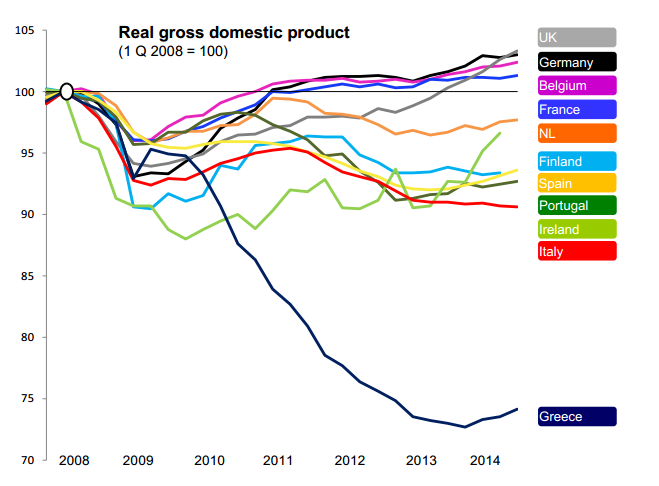
The new government wanted to change that.
Really? I'd complain quite a bit about a 25% GDP drop, regardless of whether it was "overinflated" to start with.
If that is the case, we can simply inflate it up and problem solved.
?
Public spending of GDP was 46.9% in 2008 and 49.3% in 2014.
Really, the brainwash is probably on the other side. Everybody talks about austerity, yet public spending has been growing steadily after WW II pretty much everywhere, even after 2008.
http://www.tradingeconomics.com/embed/?s=greecegovspe&d1=200...
In what way do actual Euro amounts make comparisons impossible? I'd say Euro amounts are much clearer, because they tell you about government spending without conflating the economic state. GDP vs spending implies that spending hasn't dropped, when in fact it's actually dropped by something like 30% since 2008. The fact that the economy has also contracted drastically in that time doesn't mean spending wasn't cut.
> Second, the graph you linked shows similar level of spending as 2001 and I am not aware of any austerity claims during that year in Greece.
I'm at a loss for words here. This just makes no sense. By this logic, Greece can never implement austerity. No matter how deeply they cut, they'll never reach a level lower than the lowest point in history.
Further, assuming just 1% inflation per year, spending the same in 2015 as 2001 means an effective spending cut of 15%.
> Third, how much public spending do you want?
What I want isn't really relevant. The question was whether the Greek government has implemented the austerity measures they agreed to. Given the 30% contraction in spending, it seems like they certainly implemented some measures.
That's the theory. The theory could be stupid if too much government debt is what caused the downturn in the first place.
And the theory usually breaks in this way: There is a downturn. The government spends more. The economy picks back up eventually. The government continues to spend more. That means, to have any effect, at the next downturn, the government has to spend even more. And that eventually gets you to the situation stated in the previous paragraph.
And let's be realistic, Greece is like Italy. An enormous proportion of the public spending goes to pay privileges (pensions that are too high, useless public jobs, useless buildings, etc.), do you really think that money will grow the economy? Don't you think it creates much more value if left to the private sector? Of course, you need a real private sector, with clear rules for everybody, and that's exactly what they don't want to do! You see the problem here?
Most Eurozone economies are dependent on growth in government spending to generate GDP growth. With slow government spending expansion, GDP growth in the Eurozone fell to basically zero for seven years. Panic sets in when they can't expand government spending, because everything else is so dependent on it.
I don't understand why this is repeated again and again.
The reality has nothing to do with that. Greece has implemented austerity policies that no other country in Europe has implemented. Compared to the American big depression, they have lived for a longer period of time with worse economic conditions.
The recipes coming from the Troika has been implemented and the result is that they are in a deeper hole. So they say “now what?” and the answer is “keep digging”.
I am amazed how brainwashed is the public opinion.
And about where the money is going, I recommend reading this: http://www.interfluidity.com/v2/6013.html