So if you diluted it all 500 times, the problem goes away. 620,000 tons of water is about...2 supertankers. So if you mixed it with 1000 supertankers worth of water, you could safely drink it (at least as far as the tritium is concerned).
Now, where near Fukishima could we find 1000 supertankers worth of water? Right, the ocean.
tdy721 wasn't joking; dumping it all into the ocean is a perfectly sensible (and safe) solution. (Although as the article notes, it's politically a non-starter.)
From the Nautilus article, I get that there is now ~6E5 Mg contaminated water, containing 1E6-5E6 Bq tritium per liter. The overall range is ~6E14 Bq to 3E15 Bq, or between ~0.4% and ~2% of annual natural production.
So yes, it's not such a big deal.
But now I'm curious about the magnitude of other anthropogenic sources.
Something to think about is my Canadian friends used to spend enormous amounts of energy to purify heavy water for their CANDU reactors. Sending them two tankers full of the best "raw refinable ore" on the planet is likely to put smiles on their faces. Yes I'm well aware that heavy water is deuterium and 1 in 700 atoms of H2 is deuterium and 1 in 700 atoms of naturally sourced non-H1 aka mostly-deuterium is the tritium we're talking about... the point is they know how to isolate it, handle it, and have a use for it, or in relative terms they are likely the best people on the planet to do the job (not to disparage any other countries with heavy water programs, intentionally anyway).
Or send over some container ships full of canadian machinery and jets full of canadians and refine the "ore" into salable product on Japanese soil, maybe right next door, whatever.
The assumption being made is this "waste" is useless, like coal fly ash or something, rather than being the valuable ore that it is.
Politically it could be a disaster, whats going to happen to the revenue from D2 and T2 sales other than infinite screaming about infinite possibilities? Everyones going to want a cut of it and the management and accounting costs might exceed the actual revenue...
On a side note, the LFTR people say they fly ash is one practical source of Thorium for their fuel cycle.
http://upload.wikimedia.org/wikipedia/commons/1/1f/North_Pac...
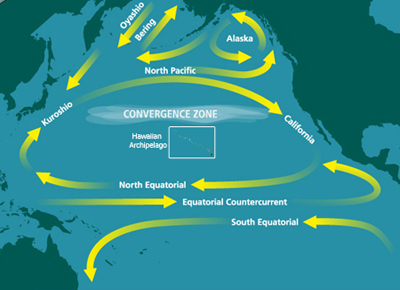
It seems like we're spending a lot of energy just to hold on to this stuff in the riskiest possible way.
And because in the ocean will harm fishes, shellfishes, corals, other valuable forms of life; and there is no more than 50 living japanese right whales in all the planet.
And because the main species targeted by fisheries in all the planet earth is the peruvian anchovy. Since Fukushima we are seeing some strange death mass events of non human anchovy eaters like sea birds, seals and whales from Alaska to Peru. The cat's food tin that we open in our kitchens is made of peruvian anchovies flour. Your beloved pets will have more probabilities to die from cancer.
And because there are maybe thousands of cases of TEPCO shamelesly saying: 'oops, hundreds of liters of our radioactive waste are dumped to the sea again, how bad luck' since 2011. We simply can not expect them to act responsibly after repeatedly lied everybody in the past. They will use this easy way out to quickly dump anything they want to the water ("oops we forget again to classify and separate radioactive atoms from the water dumped. Is such an expensive process... how bad luck")
And because all oceans are connected by sea currents and radioactivity travelling with currents and migratory fishes will reach American coasts in a few weeks.
And because animals are made of water in a 60-95%. There is much more water than fat in a human. And rain is made of water also.
And because this is not a game of probabilities. To have only a chance of 1% of finding a tiger is not the same idea as "this tiger is 99% harmless".
Hydrogen bomb tests are estimated to have created several hundred kilograms of tritium, the bulk of which went straight into the oceans. No impact on sea life has been measured.
You list a parade of horribles, but the cold fact is that there is no theory as to how any of those even might occur. Anchovies are not going to die because of a couple grams of tritium. Nor will your cat get cancer. Radiation is not magic, nor is a taboo. It's a physical phenomenon with well understood characteristics.
(And, again, even if you're right—and the entire scientific community is wrong—if 4 grams of tritium would do all that, what do you think the hundreds of kilos from nuclear tests did?)
This is just wishfull thinking. A clear and well documented impact on sea life with a lot of local extinctions can be easily checked still 50 years later, in fact. Nothing growing in the island is safe to eat currently.
http://www.sciencedaily.com/releases/2008/04/080415101021.ht...
1) Your link does not discuss tritium. Tritium is a specific substance with specific characteristics; you can't just lump it all under "Evil Radiation" and make meaningful conclusions.
2) Whatever effect tritium would have would be global. You talk about local extinctions, but we're actually looking for evidence of massive global extinctions. The early 1960s (which saw peak tritium levels) are not known for a huge spike in inexplicable extinction events.
3) Not only did the tests spread it everywhere, but ongoing runoff means that rivers have been pumping tritium into delta regions. Almost a kilogram of tritium was pumped into the Gulf of Mexico over the last 50 years. Again, no impacts from the tritium have been detected; whatever impact it might have had was drowned out by all the other much more serious crap we humans were doing.
4) Again, there's still no theory as to how tritium (specifically tritium, and not, eg, radioactive cesium or iodine) might do all this crazy stuff. I'm just pointing out that there's also no emperical evidence either, and thus, no real reason to think our entire understanding of how radiation impacts living organisms is wrong.
All of which means that people worried about the impacts of 4 grams of tritium on the Pacific Ocean are—to be charitable—innumerate. They're certainly wrong, because we've already dumped something like a HUNDRED THOUSAND TIMES more tritium into the Pacific ocean than that, and we literally have been unable to detect any impact. It's absurd to think we could even measure the impact of 4 grams.
From the analysis above it looks like this stuff is harmless once sufficiently diluted.
It's not really possible to discuss something if the only acceptable answer is "fuck TEPCO", by the way.
I don't know enough about the claimed process of purification so I could be wrong, but I'm understanding by the article that tons of radioactive saltwater are magically converted in yummy distilled water and that tritium is the only cause of concern. It reminds me the same old rethoric: "they are clever, they know how to do this, don't make questions, nature will gobble the problem and we all will be safe and happy again".
I think that is reasonable to be sceptic in this case.
Are we talking about to dump distilled pure water or saltwater to the sea?. Is a different situation. It is saltwater there is a lot of things about to care, not just hydrogen. What happened with the dissolved salts and organic matter in the radioactive saltwater?.
And of course, how we could control the real composition of the dumped water?. Just because TEPCO promises us that this time is safe?. This is also a legitimate question. Are we just sending a clear message of 'do as you please with the waste'?. This could be a huge mistake in my opinion.
There is available space in Fukushima for more tanks. Nobody lives in the area and if properly designed to be durable seems a safer option. We have the technology to design such containers.
If the question was just "should TEPCO keep paying", I'd agree.
But that's not the only question.
In the ocean, the tritiated water gets diluted, quickly, to levels asymptotically approaching ambient beta radiation. A mishap with the tanks on land however exposes the land ecosystem to potentially concentrated radiation.
It has nothing to do with technical issues. Imagine the public reaction.
The 1958 criticality accident at Los Alamos was the result of merely turning on a mixer:
https://en.wikipedia.org/wiki/Cecil_Kelley_criticality_accid...