The type of shop you're describing might be able to compete, assuming you've identified a niche product with a margin that will still exist in 6 months. Backtesting is useful, but it is so bloody hard to accurately incorporate liquidity that I place little value on simulated results when it comes to short duration trades. You really have to jump in and test live, which represents the largest barrier to entry: established shops have the infrastructure & capital to try new ideas. When I was trading, we tested half a dozen new ideas every month in addition to "production trades".
High frequency, IMO, should really be used to identify hardware intensive strategies co-located at the exchanges and utilizing telecommunications strategies not readily available to the market. For example, FPGA and dedicated microwave towers.
Lime is excellent, btw, but you really need some volume to justify them. For options at your level of capital, Interactive Brokers and long gamma trades look more attractive to me. Many would disagree and people do starve waiting for long gamma, but my memory is biased after seeing the little group next to me lose $40m in a week on a stupid short gamma "sure thing" based on back tests and other such nonsense. Oh, what a fun time that was.
Remember HFT worship at the alter of the law of large numbers, meaning they get a 51% edge and ratchet up the frequency. So a typical strategy might be 48% profitable, 40% wash and 12% unprofitable.
I took a stab at explaining why here:
https://news.ycombinator.com/item?id=9191473
If you can walk me through a situation where this works then let me know, because Michael Lewis certainly tried and failed:)
0+ orders on the other hand, now that was a profitable strategy while it lasted:)
Would avidly read the comment adding some detail to this. :)
The book you link to in that comment (_Flash Boys: Not So Fast_) is really fantastic. It strikes me as being written in a style especially congenial to nerd message board people like me: detailed, episodic, point-by-point takedown. It's like a very long Reddit comment, and I mean that in the best way.
Here is the picture I was looking for: http://www.nanex.net/aqck2/4666.html
Here you can see which exchanges use the SIP for their data feeds. Guess which dark pools the HFT guys hang out at:)
Check out:
http://www.zerohedge.com/news/dark-pool-truth-about-what-rea...
and
http://www.zerohedge.com/news/dark-pool-truth-about-what-rea...
and this nanex diagram shows pretty much all you need to know about latency arbitrage.
http://www.nanex.net/aqck2/4599/SIP,%20Direct%20Feeds,%20and...
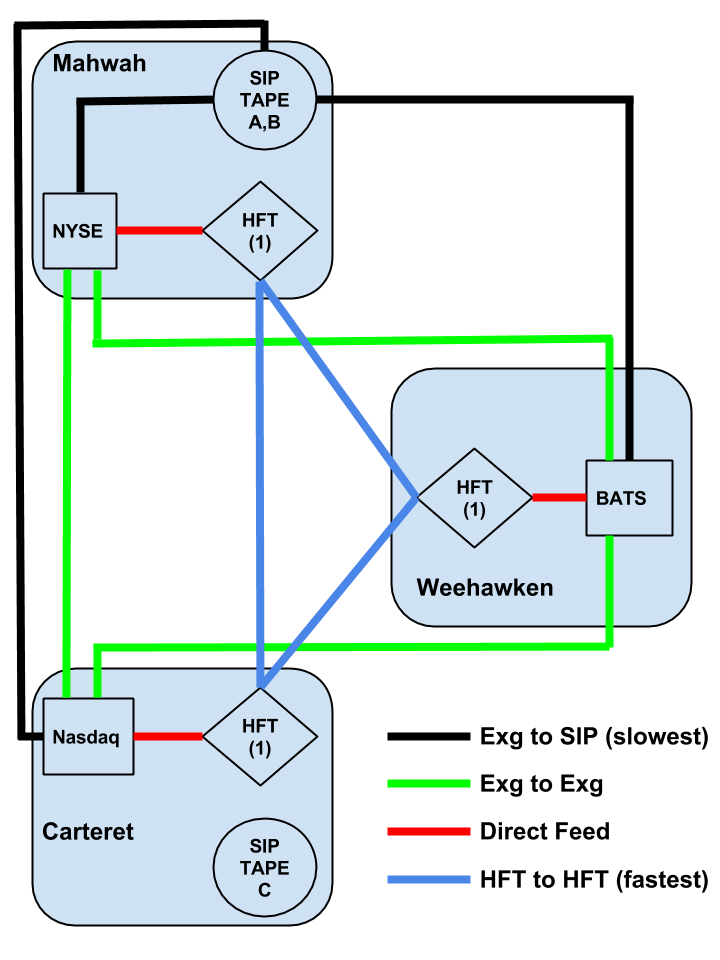
Long story short. RegNMS said people have to get the best price for their order. Now in a distributed system, which the US fragmented markets are, you know you can't know for cetain what hte state of the world is.
warning simplification ahead
Each market and dark pool has to trade at the price currently listed by the SIP. Now the sip is old and slow. Exchanges offer 2 prices sources,
- the SIP as legally requried
- a direct feed, which serious traders use.
The direct feed is faster, so by the time an exchange (A) reports a trade to another exchange(B) via the sip, the HFT guys who own their own microwave radio lines have notified their computers at exchange B, and moved their orders.
Almost as if they can see forward in time:)
I was curious about microwave radio lines so I did a little digging[1]. It appears that microwave radio can double the speeds of fiber. Though the towers are limited by distance (max ~60mi separation), HFT shops buy/rent microwave tower networks connecting cities. For example, one HFT firm owns a network of ~30 microwave towers connecting NJ to IL that transmit 1.6 ms faster than fiber.
[1] http://www.bloomberg.com/bw/articles/2014-07-24/high-frequen...
Several of the individual posts were submitted to HN: https://hn.algolia.com/?query=HFT%20in%20my%20backyard&sort=...
My pleasure:) I find there is way to much secrecy around algorithmic trading, and I do what I can to shed some light on it for newbies like your self!
Although I suppose the profits to be made by any strategy dry up pretty quickly as more shops discover it, so it does make sense to me that this doesn't appear to be done any more. I mean, isn't that what worked a few months ago doesn't work any more is the only thing most people posting about HFT can agree about? :D
I have no experience in electronic trading and my knowledge of it mostly comes from HN posts and - as you guessed correctly - Flash Boys, so please forgive my ignorance
And some order types are more or less designed to give large block traders an edge.
Most of the latency game you read about is not getting to trade, its getting the opportunity to cancel your orders. A common misconception is that HFT groups are acting as middle men. They aren't. They are the counter parties on all the exchanges, they are just updating what they are offering faster than others.
(I am not a trader or an HFT dev.)
Nowadays, I really don't see much edge in trading at all.
I would love to know what those traders you've spoken with think is profitable. I see my old bosses at Rom near the CME almost every Friday and I haven't heard a positive line from them in 5+ years.
There are other strategies that get a lot of bad press, of course, but they are not novel with respect to strategy, only speed. Deception is par for the course. And sometimes, products are just poorly designed. Leveraged ETFs, for example.
My understanding is the reason you advocate for long gamma vs. short gamma because unhedged short gamma trade (e.g., short straddle) could cause theoretical unlimited loss. Long gamma trades like long straddle or long option hedged with delta-neutral stock, you are facing daily theta decay and you are betting for either a rise in implied vol or realized vol.
However, the missing ingredient/secret sauce is (1) you have to figure out at price point you're going to take profit in your scalp; and (2) when implied volatility is considered cheap for the particular ticker you're trading. Much appreciated for your insight and let me know if I'm missing anything.
My only opinion on the matter is that you should try to stick with leading from long gamma. You can sell vol, but you'll survive longer if you keep net long gamma. As soon as you get gamma'd, you're out of business. It can go so far against you before you even realize what happened.
Some strategies that I've seen also depend on having good agreements with brokers, ie you may see an opportunity in the data, but the costs of trading tip you into the red if your guy is margining you in a different way. I don't know what Lime et al charge you, but they aren't a likely name among the people I know.
There's also a question about what exactly you'll be doing in those markets. There are guys who make money market making options over the phone, without relying on colo for anything. Sometimes they'll have a quote machine that needs to be quick to pull, but they don't see it as anything other than a bit of extra money. Other options guys are totally different, relying entirely on speed to make their dough.
Also keep in mind you are only competing with HFT in as far as what you're doing is similar, ie there's a high chance you'll both want to grab the same trade.
1) Capital in the magnitude of >$500k seems reasonable for a small operation
2) Lime Brokerage (a friend has started a hft strategy with a professor on campus and has tested out lime) is okay, I'd look into some other execution services as well
3) Yes you should be backtesting on tick-level data from multiple exchanges ideally. Be wary of lookahead bias and try to build some sort of execution model to account for how your executions might actually be filled and how your orders might affect the market microstructure
Ultimately, I wouldn't rely on pure hft and latency sensitive strategies...latency is always important but you should try to find your edge elsewhere.
I would love some comments from a seasoned HFT (tech) guy.
There are even entities that act like incubators for those entities.
I imagine HFT entities who are broker-dealer agencies have even lowered fee structure; but it sounds like simple market-making on equities is no longer an easy business to be in due to the lowered spreads and crowded competitors.
So I'm wondering if a startup funds with the rented access could compete with the big boys in the options, futures, other derivatives and even bonds space where the latency still haven't caught with the equity market yet.