Here is the picture I was looking for: http://www.nanex.net/aqck2/4666.html
Here you can see which exchanges use the SIP for their data feeds. Guess which dark pools the HFT guys hang out at:)
Check out:
http://www.zerohedge.com/news/dark-pool-truth-about-what-rea...
and
http://www.zerohedge.com/news/dark-pool-truth-about-what-rea...
and this nanex diagram shows pretty much all you need to know about latency arbitrage.
http://www.nanex.net/aqck2/4599/SIP,%20Direct%20Feeds,%20and...
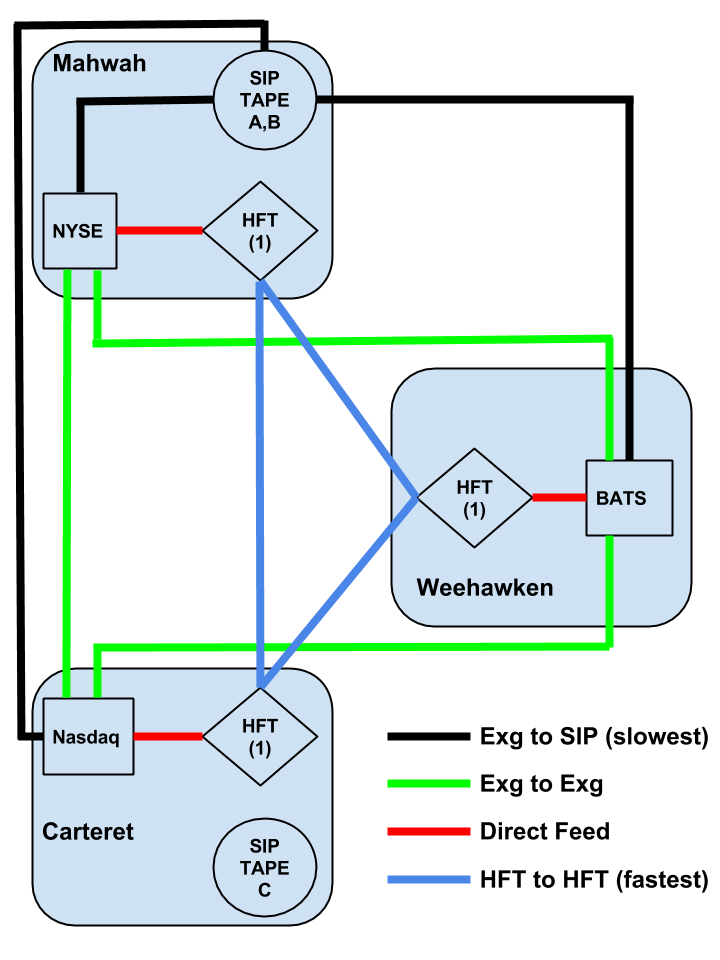
Long story short. RegNMS said people have to get the best price for their order. Now in a distributed system, which the US fragmented markets are, you know you can't know for cetain what hte state of the world is.
warning simplification ahead
Each market and dark pool has to trade at the price currently listed by the SIP. Now the sip is old and slow. Exchanges offer 2 prices sources,
- the SIP as legally requried
- a direct feed, which serious traders use.
The direct feed is faster, so by the time an exchange (A) reports a trade to another exchange(B) via the sip, the HFT guys who own their own microwave radio lines have notified their computers at exchange B, and moved their orders.
Almost as if they can see forward in time:)
I was curious about microwave radio lines so I did a little digging[1]. It appears that microwave radio can double the speeds of fiber. Though the towers are limited by distance (max ~60mi separation), HFT shops buy/rent microwave tower networks connecting cities. For example, one HFT firm owns a network of ~30 microwave towers connecting NJ to IL that transmit 1.6 ms faster than fiber.
[1] http://www.bloomberg.com/bw/articles/2014-07-24/high-frequen...
Several of the individual posts were submitted to HN: https://hn.algolia.com/?query=HFT%20in%20my%20backyard&sort=...
My pleasure:) I find there is way to much secrecy around algorithmic trading, and I do what I can to shed some light on it for newbies like your self!
Would avidly read the comment adding some detail to this. :)
The book you link to in that comment (_Flash Boys: Not So Fast_) is really fantastic. It strikes me as being written in a style especially congenial to nerd message board people like me: detailed, episodic, point-by-point takedown. It's like a very long Reddit comment, and I mean that in the best way.