I'm not sure if you ever used a PowerPC Mac when they were a mix of emulated 68k and PowerPC, but they were notoriously unstable. The mix of a lack of memory protection and emulated CPU instructions would have been the same for the Amiga and Atari ST whose OSs also lacked memory protection and safety features of more modern operating systems.
I have an Atari Falcon 030, Atari's last and best machine. It is a really really nice machine. But it was hobbled by poor software support -- it's only now that hackers are discovering what they can do with the combination of the 68030 and the Motorola 56k DSP in it (Example: Quake 3 has been ported/rewritten recently for it, using the 56k for 3d acceleration.)
I used to wonder what the world would have been like if the 68000 systems won out. But now we're seeing a world where the ARM belatedly wins out, which is kind of neat, tho ARM is arguably now as "evil" as Intel :-)
What is an interesting mental exercise is imagining what would have happened if the 6502 or 6809 architectures had expanded and done well. Those architectures had insanely fast interrupt processing and very fast (single CPU cycle) memory access. Some really neat machines could have been made if they'd continued to advance them, gotten past the 64k memory address limit and into high clock rates. Western Design stopped at the 65c816, a 16-bit variant of the 6502. Something faster and funner than the Amiga could have been built with a 32-bit 6502 descendant and chipsets similar to what was in the Amiga. That would have been really neat.
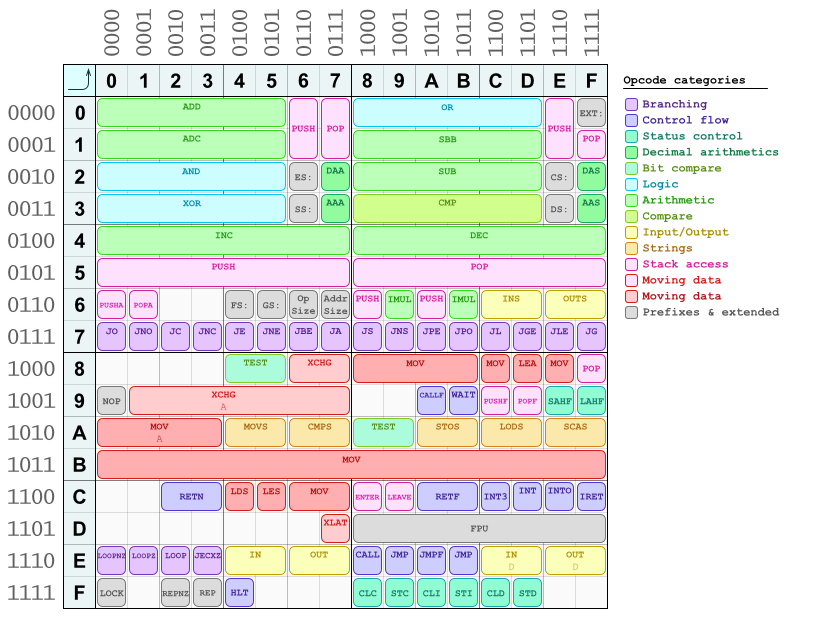
I think one of the factors could be that 68k is a bit harder to decode than x86 - while the instruction set is more orthogonal, the encoding has less structure; compare http://goldencrystal.free.fr/M68kOpcodes.pdf (68k) with http://i.stack.imgur.com/07zKL.png (x86).
very fast (single CPU cycle) memory access
That was possible only because at the time, memory was faster than the core and could keep up. Modern CPUs run the core at several times memory speeds, and there is latency involved due to physical constraints.
If the 68k family had continued to evolve past the 1994s 68060, I'm sure they could have just dropped backwards compatibility to some of the more complex addressing modes, or just devoted less silicon to them, and making what remains faster. Kinda like happened with the ColdFire version of the 68k family.
What really killed the 68000 was the move to RISC, in particular Apple's move to PowerPC. That took away any hope of future evolution (they even managed to release the 68060 after that, but that was it) and collapsed the high-end 68K business.
The Motorola Series 900 machines were interesting - I had one under my desk at work for quite a while. They had stackable units, including one that contained a SCSI 3.5" floppy drive that was way faster than regular ones. We also had a DG unit with the m88k.
> That was possible only because at the time, memory was faster than the core and could keep up. Modern CPUs run the core at several times memory speeds, and there is latency involved due to physical constraints.
That begs the question: Would we be better off if CPU clock speeds were set such that the memory could keep up again, and we software developers learned to work within real constraints again, rather than expecting the CPU makers to keep working miracles to deliver ever more performance? I have no wish to go back to programming in Applesoft BASIC or 6502 assembler as I did in my childhood and early teenage years. But programming a 32-bit processor clocked to match the speed of memory, in C++ or Rust, wouldn't be so bad.
Absolutely not, because of the locality principle. As Terje Mathisen used to say, "All programming is an exercise in caching."
Locality isn't a property of a specific coding style or methodology, it's just the way programs work. No matter what kind of architecture we end up using 50 years from now, it will have a fast cache of some kind, backed up by slower memory of some kind. We'll have a different set of problems to confront in day-to-day development work, but hobbling the CPU won't be the answer to any of them.
Power efficiency is more complex, often it's better to briefly burst then get back to sleep faster, rather than drag things out at 100 MHz, but a specific answer would depend on many factors.
Memory latency is at best about 10 ns. I don't think a 100 MHz CPU would better in any way than what we have now. Well, except power requirements would sure be very low.
It was, but for some reason Hitachi didn't publicize it, and word only escaped years too late: http://en.wikipedia.org/wiki/Hitachi_6309
Wow, what is that like? I'd love to see a demo video .. know of one?
Long thread here: http://www.atari-forum.com/viewtopic.php?f=68&t=26775
They did; that's what the mc68060 was. Too little, too late and (as you say) corporate attention directed at PPC.
My first 386 dev box was purchased in 1987. Within a year of that, I was using a Compaq portable 386 (http://en.wikipedia.org/wiki/Compaq_Portable_386). 386 was a big deal because it finally got us Intel devs a flat address space... so no more trying to fit data into tiny pages (64k). 386 killed the chief advantage of 68k architecture, and for whatever reason Motorola just couldn't get the clock speed up fast enough.
There were two things that were interesting about the Amiga in 87: video toaster for doing cheap video effects (think intro sequence to Better Call Saul, not awesome demos) and gaming.
But gaming on the PC made a huge leap in 1987 when IBM shipped ALL of their new PS/2 computers with a 256 color video adapter called the VGA (seem to remember the lowest end models only doing 256 colors in 320x260 mode... but that was good enough)... Eventually TrueVision and even ATI had video cards that could do the same sorts of things (or better) than an Amiga.
So many great computer ideas died in the 80s and early 90s... but it was really evolution... most of them died because a generalized solution (i.e. VGA with video out + software) eclipsed a specialized solution (i.e. Amiga with video toaster).
Like Atari with the ST, Commodore basically failed to capitalize on the original amiga and by the early 90s PCs have mostly caught up.
While the amiga 1000 was revolutionary in 1985, AGA[1] was not that special in 1992 (especially as it wasn't particularly beneficial to 3d games like doom, which were becoming the new hotstuff).
The amiga of the 90s was the 3dfx voodoo.
[1] http://en.wikipedia.org/wiki/Amiga_Advanced_Graphics_Archite...