I guess the next OS revision you mention would be "Dano", which according to the Wikipedia article[0] was leaked on the day the company closed down. In that case, there should be quite a number of screenshots floating around, such as [1]. YellowTAB Zeta[2] was also based on Dano.
[0] https://en.wikipedia.org/wiki/BeOS_R5.1d0
[1] http://qube.ru/files/images/beos_r51d0_on_amd_athlon_xp_1600...
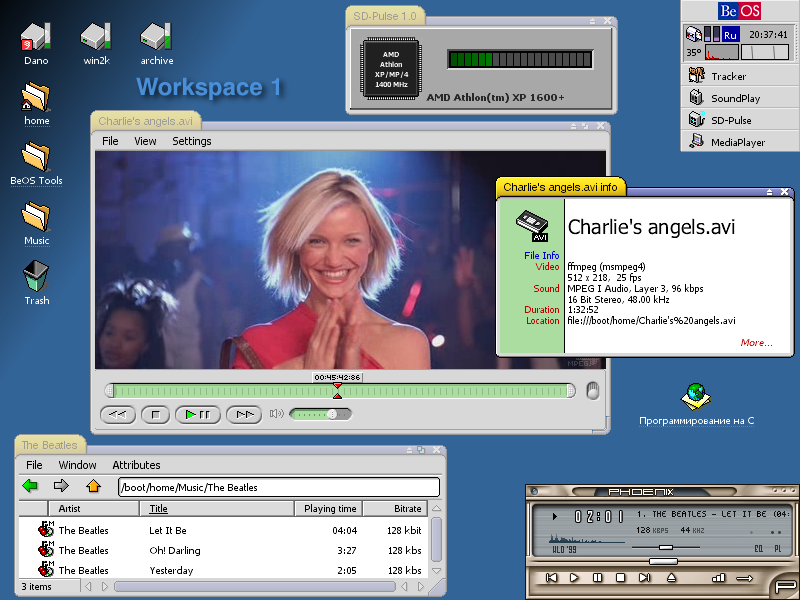
The tabs look different than I remember, but yeah, that's it.
I'm not sure what you focus on their interface work?
I'm pretty sure you could have a BeOS-like interface on Linux with very little work, Haiku's main work is reproducing BeOS APIs and making work the new kernel.
The second part is really unfortunate IMHO, but hackers gonna hack..
When Be did the focus shift, we were in the midst of the next major revision of the desktop OS (which consequently was never released). Part of that was an overhaul of the user interface, which looked more sleek and modern, and was themable. The squarish tabs were replaced with a slightly inset title bar area with rounded edges. I don't know if any screenshots of that have survived.
There were many other things that we were exploring and talking about at the time, like putting transparency and animations in the interface, but the hardware at the time wasn't up to the task yet (there weren't real GPUs with shaders like we have today; the best acceleration we could get were opaque bit-blits, which weren't supported on all cards). Had Be been able to stick around longer, the interface would have been much different.
So, personally, I don't really get cloning the original interface. A lot has happened in UI world the 20+ years since BeOS was originally written. I guess I'm not that sentimental.
That said the work the Haiku team has done is impressive. It's a cool project and I don't want to sound critical of it.