I would have thought that a better comparison would be oil wells, which cost about $500 per ft of depth, or $1.5M per km.
our total volume of mass will be about 25 m^2 1000 m = 25,000 cubic meters. If the weights are made from lead, that's a total mass of ~280,000 tons*
You seem to be assuming that the entire depth of the shaft is filled by weights. My impression was that the weight was much smaller than the shaft it fell down.
1. Digging mine shafts is dramatically cheaper than structal tunnels. They dig exploratory shafts frequently to roughly these depths for well under $1m
2. Using a disused mineshaft would have a negative cost associated with it because the security associated with keeping it safe is non zero.
It certainly appears more expensive than pumped storage, but as they say, it doesn't require a convenient mountain and lake. That makes for much more flexibility in placement, and the closer you can place the storage to the demand, the less is wasted in transmission, and the less storage you ultimately need. That said, the pumped heat storage design[1] that hit the homepage yesterday would have all those same advantages, and although the efficiency would be slightly lower, it looks much cheaper to build.
[1]: http://www.windpowerengineering.com/featured/business-news-p...
Edit: I mean that an inclined rail could be just as good as a hole, and way cheaper.
That said, how are those gravity fed porch lights doing? That seems like it would be an interesting proxy here.
That implies that you want a weight orders of magnitude more than a train (or many trains per charge "cycle" with a stockyard at each and of the mountain to store them) You're now going to need a very tough track and wheelset. They're also going to wear quickly. Probably enough to make it impractical to build and operate.
http://www.solarserver.com/solar-magazine/solar-energy-syste...
For one type [0], the safe limit is a tensile load of about 134-150 MN/m^2 (= MPa) [1]. At a density of 8 g/cm^3, the limiting length of a uniform cable is ~1.7 - 1.9 kilometers. If you have a stationary, suspended cable of this length, its own weight puts it at its maximum load; it can't lift anything else.
Steel rope on McMaster is around $10,000/ton [of rope]. So, these assumptions are a dead end.
You can't solve this by using shorter cables, because that decreases your energy capacity at the same rate. If you use cables of 1/10th the length (~100 m), you get only 1/10th the potential energy storage per ton. The cable thickness per lifted ton is constant.
[0] http://www.engineeringtoolbox.com/wire-rope-strength-d_1518....
[1] The breaking limit of rope is far higher (~700 MPa), and the breaking limit of a single wire strand -- the tensile strength -- is higher still (1,770 MPa according to [2])
For the cross section area, I'm assuming a circular rope (not accurate).
[2] http://www.gabaswire.com/en/overview/grades-of-wire-rope.htm...
This is a simple "figure of merit" for cable in this problem,
cost / (length * load capacity (N))
= cost / energy
For steel rope from [0], it looks like a lower bound of about $1,200/kWh.
[0] http://www.mcmaster.com/#standard-wire-rope/=upui3o
(E.g. item "3440T68", 5/8" plain steel, $5.16/foot for 9,080 lbf lifting capacity;
$5.16 / (9,080 lbf * 1 foot) = $1,509/kWh)
[0] http://facstaff.gpc.edu/~pgore/geology/geo101/interior.htm
You seem to have accidentally assumed that the weight will stretch the full height of the hole. Obviously this would leave it unable to move vertically.
Disclaimer, not a geologist.
Also if you expose the weight to open air and wind the whole system would be much trickier than using an enclosed shaft.
I don't think this is the case. We dig vertical holes all the time for wells, geothermal, and pilings for buildings: http://www.bdonline.co.uk/Pictures/web/r/r/g/CCTV_17_foundat...
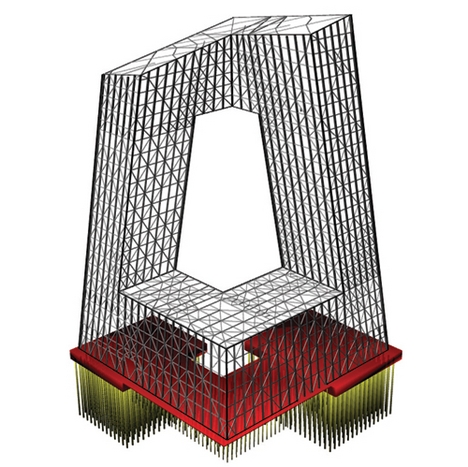
Look at all of them! For one building!
Edit: You assumed that they can both fill most of the tunnel up with lead and move that up or down 500 meters. The volume that they can fill with that is thus only half of what you say.
Couldn't you have the weight grip the sides of the tunnel with gears attached to a generator/motor (inside the weight) so the weight wouldn't rip itself apart? It would be the same machinery that ordinarily would operate the pulley at the top, just moved down into the weights (cause with this, you would need no more pulley). (To illustrate why it wouldn't rip itself apart, imagine gaps on the weight every 100 meters.)
The appeal of the cables is that they're cheap. And they're cheap because they're easy to make (all things considered). Once you start applying sophistication to the design the price gets higher, and it's already too high from having to drill the hole.
If you assume that the thing lasts forever, well, you divide $x/infinity so it's free. EXCEPT that you've got $x tied up that could be earning interest instead. So it's not $x/infinity, it's the opportunity cost on $x versus anything else out there like batteries, the grid, etc.
A subway tunnel might have a diameter of about 6 meters, so cross section = 3 * 3 * pi = 28 square meters. Digging subway tunnel through rock costs about $100M per kilometer. On the one hand, these holes would be vertical, which is harder than horizontal; on the other hand, they wouldn't need ventilation and train tracks and stuff. Let's handwave and say it's $100M for a 1 km deep hole.
Now, you can't fill the whole tunnel perfectly or the air can't escape, so our total volume of mass will be about 25 m^2 * 1000 m = 25,000 cubic meters. If the weights are made from lead, that's a total mass of ~280,000 tons or 2.8 * 10^8 kg, at a mean depth of 500 meters, so our total potential energy is 2.8 * 10^8 * 500 * 9.8 = 1.4 TJ, or 1.3 TJ net assuming you get the efficiency they claim. 1 kWh is 3.6 MJ, so you can store ~400,000 kWh at $100M capital cost (ignoring for the moment the cost of weights, generators, etc.), which is $250 per kWh installed capacity.
That's pretty good... but you also have to pay for weights and a bunch of other stuff. Bulk lead costs about $2,000 per ton on the current market, so that's $560M for the weights, which puts you back in the $2,000 per kWh range which doesn't beat lithium batteries. So you have to use iron or some cheaper material... but then you don't have as much storage capacity because the density is lower, and even with iron you're paying $400 per metric ton or $80M for all your weights. So this isn't obviously impossible like Solar Roadways, but even in the best case it won't make storage dramatically cheaper.