It kinda depends on what you think as a color. Computer monitors rely heavily on that (normal) human vision can not distinguish from eg. red-green and "true"[1] yellow, even though they are completely different from physical perspective. So a typical computer monitor does not bother to create "true" yellow and instead cheats by outputting red-green when asked for yellow.
If we had an hypothetical tetrachromat with additional cones sensitive for yellow light, her color vision would span the same range as normal (trichromat) color vision, ie cover the same piece of EM spectrum. But normal computer monitors would not be able to reproduce for her what she sees in real world.
Then there is the somewhat related discussion about violet and red-blue which is quite curious when you begin think about it.
[1] I'm using "true" color to refer light with specific wavelength
(A simple example: The color cyan can be produced by additively combining the spectra of blue and green, but can also be produced by creating photons with only the wavelength of cyan, 490-520nm according to Wikipedia. A person with normal color vision would not be able to differentiate between these two light sources, whereas a measurement device or perhaps a tetrachromat could. A computer monitor can only produce the first of these).
So the answer to your question is no, unfortunately.
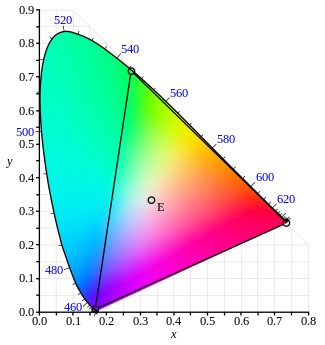
What you'll notice though is that because the diagram has a curved edge (this is the spectrum of visible light actually), no polygon can encompass all colors.
I've always thought it would be cool if someone made a CRT using two prisms (splitting light from a blackbody), such that a narrowband of light from one prism is combined with a narrowband of light from the other prism in different intensities. This would be able to reproduce all colors a human can see, assuming the ability to tune to a specific portion of the spectrum is fast enough to scan over all pixels that constitute the image.
But I suppose that a polygon could encompass all colors if it was big enough to include also wavelengths of non-visible colors.
I think it would depend on the particular mapping from 3 to 2 dimensions... it might be possible.
It surely depends on the type of colorblindness, there are many [1].
[1] http://en.wikipedia.org/wiki/Color_blindness
If you're monochromate or dichromate, I doubt that this is possible. Monochromates or dichromates are simply missing one or two color components out of three.
If you have anomalous trichromacy, you can by creating a monitor with pixels of different colors.
In any case, I don't see how it is possible to identify a tetrachromate with a trichromate (RGB) monitor. I tried to increase the contrast and change the hue of the color test to understand what was different between the apparently similar colors but I wasn't able to find any difference.
From what I understand, a modern monitor is capable of displaying the entire range of colors perceptible to the human eye. Am I mistaken about that?
So would it not be possible to create a web-based version of these "coloured discs", and then we can test ourselves.