Maybe I'll include a variable sleeping time determined by current buffer values. That way, thread synchronization would be further disorganized, and CPU power wouldn't be wasted quite as much.
In that case, it's important that mutations take place between every byte outputted tough.

Random doesn't always look random. To make matters worse, we're biased towards seeing patterns in noise: http://en.wikipedia.org/wiki/Clustering_illusion
A bookmarklet (paste in address bar) to show truly random and "evened out" dot distributions side by side. (Don't laugh at my Javascript):
javascript:"<html><body><canvas id=\"tutorial\" width=\"200\" height=\"200\">foo</canvas><-><canvas id=\"tutorial2\" width=\"200\" height=\"200\">foo</canvas><script>var canvas = document.getElementById('tutorial');var ctx = canvas.getContext('2d');ctx.fillStyle = \"rgb(000,0,0)\";for (var i=0;i<400;i++) {ctx.fillRect (Math.random() * 200,Math.random() * 200, 2, 2); };</script><script>var canvas = document.getElementById('tutorial2');var ctx = canvas.getContext('2d');ctx.fillStyle = \"rgb(000,0,0)\";for (var i=0;i<20;i++) for(var j=0;j<20;j++) for(k=0;k<1;k++) {ctx.fillRect (i * 10 + Math.random() * 10, j * 10 + Math.random() * 10, 2, 2); };</script></body></html>"
I wouldn't evaluate a generator solely on the basis of a bytemap. But these visualizations are of value.
(not confident in the credibility of this article) http://boallen.com/assets/images/randbitmap_computer.png
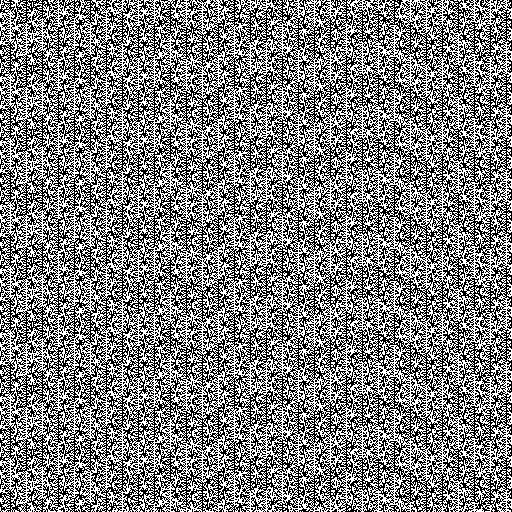
On Linux rand() doesn't suffer from the problem.
I'm not a cryptographer, but this smells extremely insecure to me. If the random seed is all zeroes this generator will generate all zeroes for perpetuity, no?
Even if you get a decent initial seed, I still strongly suspect this RNG strategy will be very statistically leaky, will tend to equilibria, and will generally be easily breakable in practice. An RGB visualization in the context of RNG means next to nothing.
Please children, don't do your own crypto.