1TB is rather a lot. My previous record was 300GB and even that seemed a bit much. But it is very convenient having everything in one place, including all the stuff that you only need occasionally but is handy to have to hand, such as old builds of the game that you can just run in situ and installers for all the tools.
(I don't know what the entire repository size must be like, but many of the larger files have a limited history depth, so it's probably less than 5-10TB. So not exactly unimaginable, though I'm sure buying that much server-grade disk space - doubtless in duplicate - might cost more than I think.)
However, Perforce does have Git integration now, allowing for either a centralized or distributed version control model. Considering the popularity of Git, I wouldn't doubt smaller Perforce-based game projects are going the DVCS route.
Also, hypothetically speaking, consider if you had a game project that would eventually grow to 1-2TB in repository size. If you spent $100 per developer to augment each of their workstations with a dedicated 3TB hard drive, you would have an awesome level of redundancy using DVCS (plus all the other advantages). I know it's no replacement for cold, off-site backups, but it would still be nice.
So, you need some central system to manage the assets so that people know "hey, don't edit this file right now because so-and-so is editing it".
Ideally you'd like to know this BEFORE you start editing. In other words, you don't want to spent 15-60 minutes editing something and only on saving or trying to check in get told "hey, sorry but someone else was editing this file so you'll have to discard your changes and start over". Some editors are better at this than others.
You could try to write something on outside of git to help with this but why when P4 already provides this?
Maybe because P4 is kind of a PITA? I used it for 10 months on a project (without any noticeable art assets, even; this was just code) and it regularly caused problems. The company had someone whose sole job was to administrate P4, and it was sorely needed.
Of course, it's been many years, and I no longer remember details about the precise problems encountered, just the overall frustration. Although the one thing I do remember is the aggravation caused when a coworker accidentally locked a file they weren't editing and then left for the day.
Like you say, games include all sorts of binary assets. Any idea how much actual code is there?
The Linux kernel is only 175MB https://git.wiki.kernel.org/index.php/GitBenchmarks#Estimate...
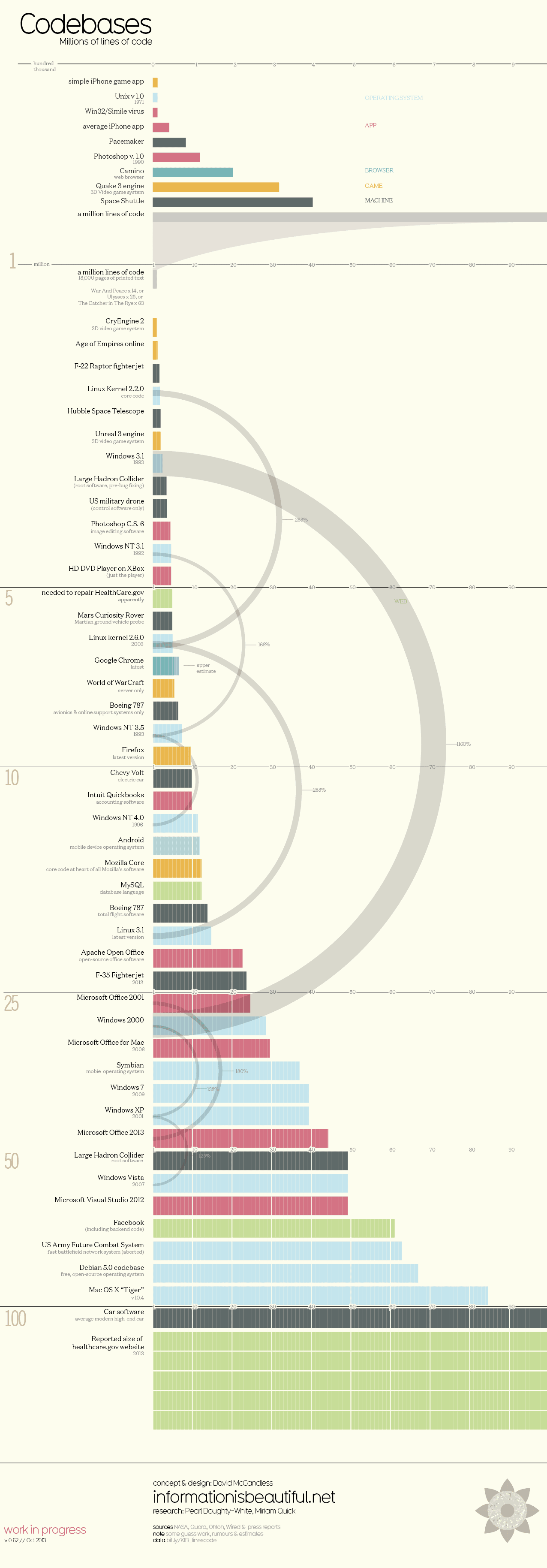
The F22 has some 1.7 million LOC http://en.wikipedia.org/wiki/Lockheed_Martin_F-22_Raptor#cit...
This graph shows some pretty big things http://dailyinfographic.com/wp-content/uploads/2013/10/1276_...
Usually game assets are in one repository (including compiled binaries) and code in another. The repository containing the game itself can grow to hundreds of gigabytes in size due to tracking revision history on art assets (models, movies, textures, animation data, etc).
I wouldn't doubt there's some larger commercial game projects that have repository sizes exceeding 1TB.