As mentioned in the other comment, the cores breached the reactor vessels, which is what didn't happen at TMI.
On the other hand, that did happen at Chernobyl (and explosively, to boot), so I'm not sure why people would be arguing that it's impossible or that it has never happened before. Unless possibly they mean that such a thing had never happened at a Western-style BWR or PWR reactor, which is at least closer to the truth.
But either way, this is all part of the problem with these debates. Pro-nuclear advocates generally say stuff which is true in a very precise, jargonistic way, which then gets either immediately mis-interpreted, or mis-interpreted 3 years later in a way which makes them out to be liars.
It would be like a computer hacker saying that it's impossible to get a security vulnerability from buffer overflow if you use a language that always manages memory, and then that managed language suffers a vuln from memory corruption instead. Laymen three years later would only remember "impossible to get security vulnerability from managed memory"...
Ehh. The flip side of this is that most of the "experts" use this kind of language to hide their uncertainties, while also overplaying their hand. It wouldn't be unreasonable for the layman to remember the phrase "impossible to get a security vulnerability from managed memory", because that's the strongest part of the statement -- the part of the statement that's intended to sell a technology. People don't remember the long strings of caveats that come later, nor should they.
My point still stands: we aren't very good at predicting failure cases, so it doesn't serve us well to focus on the caveats of a statement that begins with "this can never happen". Any statement that begins with an absolute like that is almost assuredly incorrect.
The previous sentence is "At Three Mile Island the buildings were intact, and the one melted nuclear core remained inside its pressure vessel."
The containment is outside of that:
http://www.world-nuclear.org/info/Safety-and-Security/Safety...
specifically:
http://www.world-nuclear.org/uploadedImages/org/info/BWR%203...
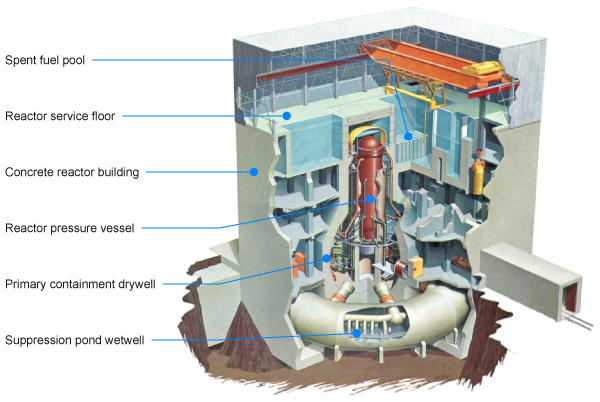
As I understand it, a lot of the environmental contamination was carried out by the cooling water they were injecting.
The thing to remember is that a massive earthquake caused this crisis. When you are dealing with seismic activity on that scale, ensuring that structures remain intact requires making assumptions which just are not readily testable.
I think the reality is: we need to make nuclear energy didn't work. TEPCO could't do it. Hopefully someone else can.
Ideally we'd put nuclear reactors way away from all natural disasters, and design them to withstand magnitude 10 earthquakes, F-5 tornadoes, Category 5 hurricanes, and, say, bombing by massive conventional munitions during wartime. And we'd have perfect, guaranteed safe forever storage of waste. Practically, it isn't clear that this is possible.
I think the reality is: we need to make nuclear energy didn't work. TEPCO could't do it. Hopefully someone else can.
The question is, do we want these things to work until they don't? Or do we want them to be guaranteed to work no matter what happens? I am not sure the latter is possible.
Well, that's a false dichotomy and representation right there.
It's possible to believe both that nuclear power isn't desirable and that fossil fuels are limited. Which from my experience a fair number of those opposed to nuclear do in fact believe.
Which rather undercuts your own credibility.
(But yes, let's talk about straw-man arguments.)
I was just covering my impressions of the original discussion FWIW.
I am not hard-core in my opposition to nuclear power. However, I have serious doubts about its safety long-run.
Heinlein said (in Glory Road, I believe), that "Everything is theoretically impossible, until it is done. One could write a history of science in reverse by assembling the solemn pronouncements of highest authority about what could not be done and could never happen."
It seems to me that this is a double-edged sword -- not only can people accomplish things that experts claimed were "impossible," but things can happen that experts claim are "impossible."
Most people are limited by our own views of the impossible and never change their views until proven wrong. Some never do change their views.
I distinctly remember the HN conversation at the time. The pro-nuclear crowd was arguing, as it was happening, that this could never occur. The cores would never breach the containment vessels, they said. Guess you folks got that one wrong.
I bring this up only because a lot of pro-nuclear arguments comes down to bold assertions from experts that certain things could never happen. Yet, here we are. A big helping of modesty seems like a good thing in this field.