Re:Another go at Go failed
by matthewmacleod on Wednesday January 08, 2014 @07:29AM
(#7023068)
Those three steps are basically:
- New technology is introduced. Nobody's really heard of it or used it, so beyond a few "Look at this new thing!" articles, nobody talks about it.
- The technology gets some penetration. New users pick it up, probably because it solves some issue or irritation they have. They write about how the technology helps to deal with it, or why it's interesting; if it didn't/wasn't, they'd probably not bother using it, and would be pretty quiet about the whole thing.
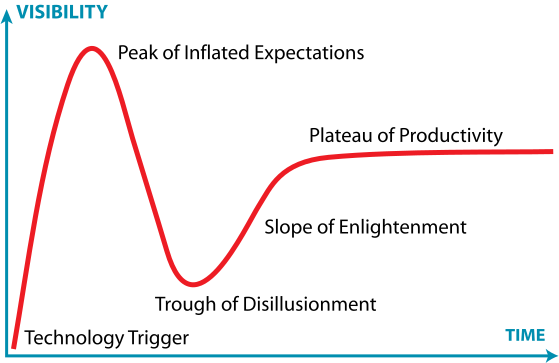
- If the technology made it this far, there is an explosion in popularity as more people pick up the tools and use the technology. Typically this results in quite a few people using it in the wrong way, or because it's the current 'hot stuff' (rather than because it will solve a particular problem), or maybe picking it up a little bit too early. Lots of these people will write about how the technology sucks, or how it doesn't solve particular problems. That's fine; it's the public knowledge-gathering phase, and although there will inevitably be a lot of negativity, other people will discover the benefits, and the technology will frequently evolve to address popular concerns.
- The fourth step, that you didn't mention, is that the technology and discussion around it becomes more "mature" - it's widely-used, everyone's more-or-less aware of the pros and cons. There will be the occasional post called "X Sucks, I'm Moving to Y!" or "Why I'm still using X and not Y".
tl;dr: that's the way it goes - it takes a while for new technology to work out the kinks and for the community to understand where and how it should be used. And while that happens, they'll talk about it.
Re:Another go at Go failed
by Tegran on Wednesday January 08, 2014 @09:00AM
(#7023452)
Once you've embedded the Hype Cycle in your consciousness, it's amazing how often new technologies follow it. Also interesting just how worked up people get at each peak and trough... :)
- New technology is introduced. Nobody's really heard of it or used it, so beyond a few "Look at this new thing!" articles, nobody talks about it.
- The technology gets some penetration. New users pick it up, probably because it solves some issue or irritation they have. They write about how the technology helps to deal with it, or why it's interesting; if it didn't/wasn't, they'd probably not bother using it, and would be pretty quiet about the whole thing.
- If the technology made it this far, there is an explosion in popularity as more people pick up the tools and use the technology. Typically this results in quite a few people using it in the wrong way, or because it's the current 'hot stuff' (rather than because it will solve a particular problem), or maybe picking it up a little bit too early. Lots of these people will write about how the technology sucks, or how it doesn't solve particular problems. That's fine; it's the public knowledge-gathering phase, and although there will inevitably be a lot of negativity, other people will discover the benefits, and the technology will frequently evolve to address popular concerns.
- The fourth step, that you didn't mention, is that the technology and discussion around it becomes more "mature" - it's widely-used, everyone's more-or-less aware of the pros and cons. There will be the occasional post called "X Sucks, I'm Moving to Y!" or "Why I'm still using X and not Y".
tl;dr: that's the way it goes - it takes a while for new technology to work out the kinks and for the community to understand where and how it should be used. And while that happens, they'll talk about it.