Rationalists are allowed to get emotional, and it's not a detriment to their cause when they do. While not every rationalist will, we need emotional people to make emotional responses, or we lose ground in these debates. We don't need to be calculated about it, but we shouldn't scorn it -- that's all.
Not picking on you, OP -- just expressing a gripe that I have.
http://plover.net/~bonds/positivism.html take this not as gospel, but as a starting point
From wikipedia's definition: Positivism is a philosophy of science based on the view that information derived from logical and mathematical treatments and reports of sensory experience is the exclusive source of all authoritative knowledge, and that there is valid knowledge (truth) only in scientific knowledge. Verified data received from the senses are known as empirical evidence.
Does global warming evidence satisfy the absolute standard of "empirical evidence" ? Well empirical evidence requires that data be produced according to the following process : 1) hypothesize 2) produce an experiment 3) accept/reject hypothesis (and goto 1, if possible)
Obviously experiments verifying global warming, or any significant part of climate theory are not possible, since we only have one earth and we can't quite produce another one with different levels. Nor are we allowed to assume that past data sufficiently isolates the factor being experimented with. Even if that were true, it is not possible to directly observe global warming without introducing potentially incorrect (or known incorrect) assumptions, like the central limit theorem.
A positivist would reject global warming, insisting only that we don't know, and that we can't know, because it's impossible to produce empirical evidence indicating either way. Since we don't even have direct measurements of the world getting warmer, only statistical proof, a positivist wouldn't even agree the world is warmer now than 100 years ago.
This sort of thing is why positivism was rejected as a viable philosophy. As your article described, this happened in programming, by the rejection of pure functional programming. But it also happened in science. The only remaining sciences that use positivism as a test of truth is first-order logic. Even second-order logic requires a less stringent standard.
(I can't find the source for the last one, but remember James Hanson mentioning it. Anyone know what I'm referring to)
Similarly, a factor such as carbonization of the oceans is very falsifiable. And experiments can measure the impacts on species individually.
We can't be certain about the future, but it seems like a fallacy to say that therefore worry is unjustified and Manichean. From my read of the evidence we've never faced a situation so objectively dire.
How could you falsify the idea "things will continue to be fine"? I'm trying to assess if falsification is a good standard to use.
Sorry, a bit in a rush but that's the main idea. Expecting no specific change is the scientific default.
The ocean absorbs excess CO2 from the atmosphere. If it absorbs it as fast as we produce it, there will not be any warming, but a lot of acidification.
If it absorbs it much more slowly, then there will be a lot of warming but little acidification. The truth is somewhere in between.
What is the basis for the assumption that any ocean acidification won't suddenly disappear, because some algae species decided it is now sufficiently widespread and easy to acquire to use it for lunch ?
Plus it won't be catastrophic at all. Some very low-level species, like algae, will adapt by changing their internal chemistry. And because we eat them (through intermediaries) we will have effectively adapted too.
And don't you believe in evolution ? If this doesn't happen, then we die, and in that case we should die. The whole point of creation is that it adapts to these sort of things. Adapt or die. Works on a large scale as well as a small one.
A rapid unexplained significant decline in global temperatures over a decade despite increasing carbon use would clearly falsify the idea of AGW.
edit: or just a theory that explains global temperature trends better than the current climate models that use anthropogenic carbon emissions. Or data that conclusively overturns the record of recent warming.
http://www.nature.com/nature/journal/vaop/ncurrent/full/natu...
No. The claim that AGW implies that mean global temperature will increase every single year is a naked straw man.
http://ete.cet.edu/gcc/style/images/uploads/GlobalSurfaceTem...
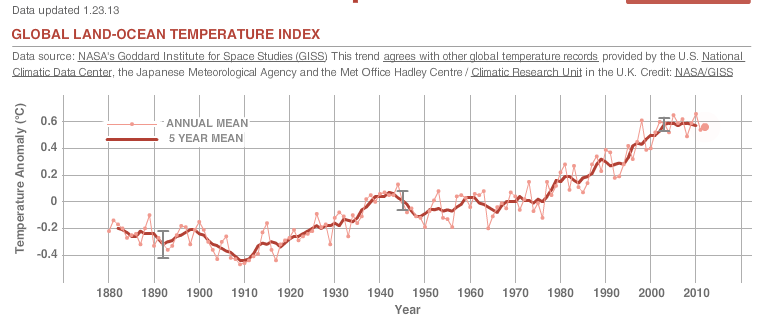
You can't stop/reverse something that's not happening, that's not even coherent.
If it's not happening you need better data showing it isn't happening or reasons why the current data is being massively misread.
If, all else being equal[1], global warming is happening and then stopped/reversed without anthropogenic carbon emissions going down then the case for rejecting AGW gets stronger. You'll need a replacement theory/model though. At what point does the new model become more convincing then the current one? Scientific consensus might be a good starting point.
[1] obviously if a bunch of volcanos or nuclear winter are responsible for the cooling that's not going to falsify the ideas behind AGW. For example, cooling in the 1940's.
"5 year period? 10? 20? 50?"
How much reversing are we talking about? We have 100+ years of warming to reverse. The fact that it's hard to easily falsify AGW isn't because AGW is unfalsifiable, it's because the science and data supporting AGW is enormous.
No need to get hostile. I was referring to two possible outcomes: (1) global warming was never occurring (2) global warming was happening, but for what ever reason stopped or even reversed.
Make sense now?
You'll need a replacement theory/model though.
Wait, what??
I. points out incoherence. {first he says show it isn't happening, then he assumes it's happening but it stops or reverses}
II. you could show warming is not happening this way (data)
III. if it was warming and then started reversing falsification might happen this way (new theory/model)
IV. additional considerations about falsification
I'm not sure absolute falsification is meaningful with this kind of prediction. We only have one system, very hard to falsify.
We can falsify elements of evidence which suggest one planetary state over another. That's about it.
Then it's not science.
1. Your language ("sin", "evil", "believe") indicates a major subjective component in what you're saying. As with everything subjective, you're probably aware that it's not provable with cold facts and logic, and it might justifiably be rejected by others' own subjectivity and take on facts.
2. A pervading feeling that the world is going to hell in a handbasket has proven seductive many times in history. Does any of this sound familiar:
"[They] claim that the current society and its rulers are corrupt, unjust, or otherwise wrong. They therefore believe they will be destroyed soon by a powerful force. The harmful nature of the status quo is considered intractable without the anticipated dramatic change"
Such world views have occurred often enough that there's a consecrated term for them: [1]. Sure, the different groups that held such beliefs differed from you in how they thought it would come to pass. But they differed from each other as well.
3. There's nothing necessarily theistic about millenarian beliefs. ("Official" churches have more often than not fought against them [3].) E.g. a lot of people in the 60s thought the apocalypse was due within two decades due to overpopulation.
4. Climate models have a simple, persuasive logic behind them. But that doesn't make them necessarily right. Malthusianism also had a seemingly bulletproof logic, yet the facts did not keep pace with it [4]. When the climate models turn out lacking precision [5], they also lose the force of scientific certainty. All we're left with is "the world is warming, we can't say how fast"; which is, of course, not a falsifiable belief [6].
[1] http://en.wikipedia.org/wiki/Millenarianism#Theology
[2] http://en.wikipedia.org/wiki/Population_bomb
[3] http://en.wikipedia.org/wiki/Millennialism#Reformation_and_b...
[4] http://en.wikipedia.org/wiki/Simon%E2%80%93Ehrlich_wager
[5] http://www.washingtonpost.com/blogs/capital-weather-gang/wp/...
[6] http://en.wikipedia.org/wiki/Falsifiability