This is actually BS. SEVERAL people alerted to the housing bubble. There are currently a couple of Housing Bubbles going on around the world right now. They are being "responded to" with the same BS as in the US, that "this time it's different" or "prices never go down". Complete and utter BS
There were MANY warnings. The idea that a certain thing can/will always increase in value is so ridiculous yet so common.
How do you identify a housing bubble? Rent/Price ratio, variation in price per area (m2 or ft2) compared to inflation. Mortgage terms going up.
You're correct, but they mostly went unheard. I remember around 2007 The Economist doing a special issue on the whole CDS thing (with a nice magazine cover and all), there were 32 pages of how great these new financial products were and about how they were "spreading risk" so that we'd have no big financial crisis to speak of in the near future.
Around the same time they also published a small, one-column article in the financial section about the house-price index which was strongly hinting (the article was) that all this was a in fact a bubble which might have nasty consequences. But people preferred to pay more attention to the nice cover and the 32 "in-depth" pages than to that small article, and that goes for most of the media and its followers.
Even worse, it was heard constantly, but ridiculed. Every other mainstream article seemed to be "Why Hysterical Morons Seem to Think That We're In a Housing Bubble, and Why They Are Idiots Who Are Missing Out On a Great Chance to Flip a House!"
http://www.amazon.com/Real-Estate-Boom-Will-Bust/dp/03855143...
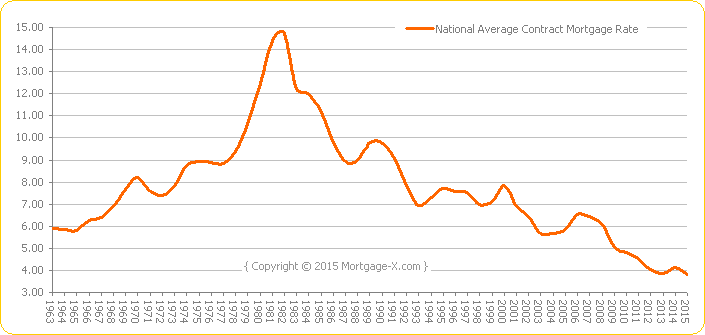
This graph, showing the 25 year decline in mortgage rates has been the biggest clue. We've been priming the economic pump for 25 years, masking systemic flaws.
Biggest warning: http://mortgage-x.com/images/graph/fhfb_contract_rate.gif
TLDR:
* Everyone remembers predictions which predict radical change and where right.
* No one remembers predictions which predict minor changes.
* No one remembers predictions which where wrong.
* There are so many wrong predictions, because there are no repercussions.
* Most experts predictions are not better than layman's guesses, some aren't better than random chance.
The same set of cognitive defects that are responsible for statements like this are responsible for belief in homeopathy and in the power of prayer to cure cancer (despite taking chemotherapy drugs).
People are remarkably bad at understanding the differential power of evidence with respect to their beliefs. That includes experts. Being right about what the evidence is doesn't mean we account for it correctly.
This quote, from the MS guy, is prompting me to work out the math on Bayesian updating in an incompletely hypothesized space, tonight, because I for one would like to know how/when I can rationally update my absolute and relative beliefs about hypotheses in response to weak evidence, and if this implies anything about how I should select for less mysterious hypotheses.
This seems like a really basic idea, but as a 31 year old, I am only now wrestling with the process of making less stupid decisions. I suspect the same is true for many of you.
And for that reason alone, I can't really hate on the Morgan Stanley guy, because in my heart of hearts, I think he's probably not the sharpest tool in the shed, and it should not surprise me that he develops confidence in other places that probably aren't warranted.
I can, however, hate on the world that allows people like this to be in a position to impact the world economy, just like I can be angry that there isn't a mandatory 'using evidence in making policy' training program for members of congress.
How cute!
If you're interested in these types of "predictions" and assigning "probability" to your predictions, and then I highly recommend reading this book:
http://www.amazon.com/Signal-Noise-Many-Predictions-Fail/dp/...
Some gems:
“Virtually no one, be they homeowners, financial institutions, rating agencies, regulators or investors, anticipated what is coming.” Nobody saw it coming. When you can’t state your innocence, proclaim your ignorance: this is often the first line of defense when there is a failed forecast.
We need to stop, and admit it: we have a prediction problem. We love to predict things— and we aren’t very good at it.
Financial crises— and most other failures of prediction— stem from this false sense of confidence. Precise forecasts masquerade as accurate ones, and some of us get fooled and double-down our bets.
Here's my take - Morgan Stanley actually have good forecastings that there is another bubble (I would argue the education system, and the failing Euro). By instilling confidence that there isn't, it makes their bet even controllable.