Can you point out a time where complicated tax forms prevented a new tax, or are we just saying it's better for people to bitch about every tax they have to pay instead of just some of them? Basically I can't see where this statement could come from.
Empirical evidence from countries where tax forms are prefilled doesn't seem to support this notion very much.
Maybe. . . but why should a person need to hire a CPA if he is, say, a construction worker who earns < $25K per year?
The actual problem is that the core tax code focuses on deductions rather than income. That is, the tax code has become more complicated over time because all the incentives are going to businesses and individuals to maximize deductions in order to attain as low of a taxable income as possible. The "maximizing deductions" side of the coin almost creates something of a stack overflow problem because of the the recursion.
I've thought for a long time; definitely time to refactor. One idea from awhile back -- http://ink.hackeress.com/2012/11/re-engineering-tax-code-par...
Consider complications like calculating depreciation for capital equipment. All the schedules aren't there because of kicks--they're there because allowing an immediate deduction for an expense that creates a capital asset usable for years is just a mathematically incorrect way to measure "net change in wealth" when considering the time value of money. Other complexity comes from using discrete sampling periods (yearly tax returns) for what is a continuous phenomenon (changes in wealth). That's where things like net loss carry-forwards comes from. Other complexity comes from the intricacies of the "net" (versus gross) part of the equation. You can think of things like childcare deductions as a sop to the fact that childcare is something people buy so they can work, and thus not consumption.
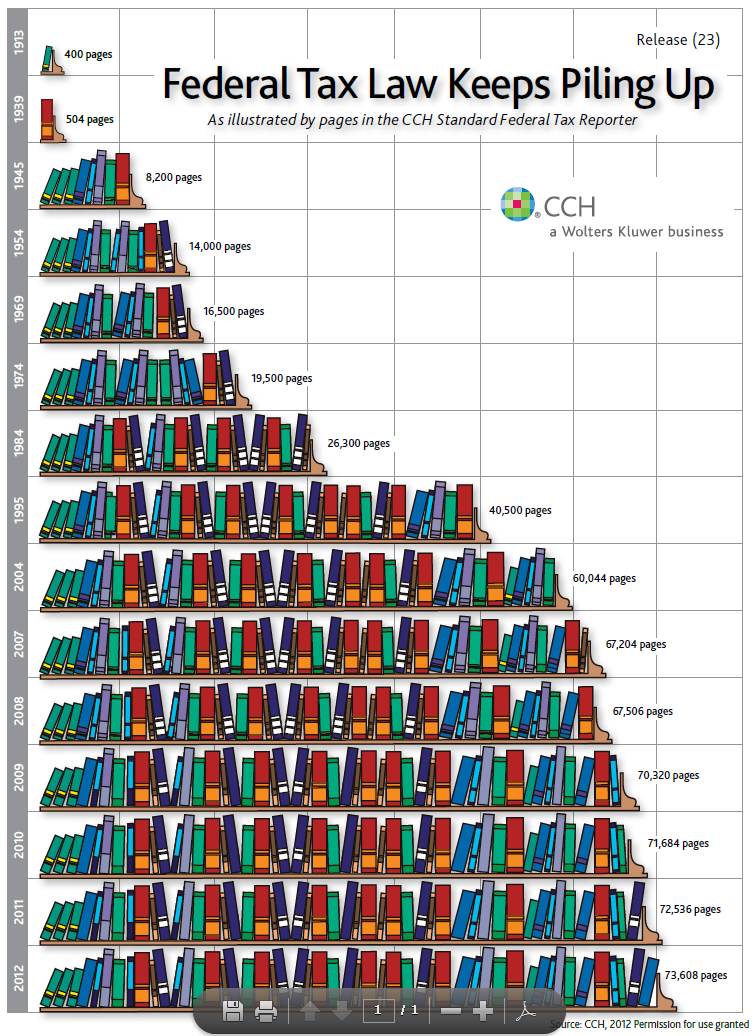
The software analogy is really apropos. I'm pretty sure Windows is over 50 million lines of code at this point, and Linux is over 15 million. That's a million printed pages for Windows, and 300,000 printed pages for Linux. In comparison, the entire U.S. federal tax code is 73,000 pages: http://3.bp.blogspot.com/-3zoNtmhcQmE/T41zkm0VE6I/AAAAAAAAFM....
Are Linux and Windows unnecessarily complex? Or is there just inherent complexity in creating an operating system that runs on everything from supercomputers to cell phones (Linux), or is bug-for-bug compatible back to the 80's (Windows)?
Don't get me wrong, the tax code should be simplified in every way possible. But when people say stuff like it only exists because "we haven't stopped to consider what might be better" that sounds a lot to me like the guy on every engineering team who wants to scrap the big, time-tested system and do a rewrite. Go to Microsoft, tell them that their system is just "patch after patch" and then volunteer to rewrite the whole thing. See what they say.
We could get rid of most of the corporate tax code that way -- and corporate taxes, as you point out, are always gonna be complex.
For those who care about progressive vs regressive - the fairtax proposal actually proposes a pre-bate to families to allow for income disparities and the affect on lower income families.
One would think it would be possible to create a similar pre-bate system to assuage concerns for a flat tax.
There's no reason why this essential feature can't be combined with a progressive (read: more humane) system by adding a gentle slope.
Personally, I don't want filing to be simpler. Every time it gets simpler to file, it also becomes simpler to add more taxes and people don't notice the difference. It's only when people have to do their taxes that they realize how screwy our system is. The 1099 independent contractors understand this one.
When you have a buggy piece of software, it's considered foolish and short-sighted to just add patch after patch after patch without stopping to consider that the underlying system itself might be flawed. Then you either scrap the system or refactor the worst/most complex pieces into something simpler and more reliable.
The tax code is IE6 circa 2002. It's still "the standard" because we haven't stopped to consider what might be better.