> Calorie Deficit
Trying to change mass by reducing energy, that might be the very most simple explanation of why calorie counting is misguided.
The more correct one would be pointing out that humans aren't dumb matter-to-energy converters. For many people, the body will happily down-clock quite hard in response to a calorie deficit; for others, it'll create irresistible psychological urges to fight the limit.
I'd probably go towards scenarios: imagine the body is a block of flats, and the municipal government decides for some reason to cut the city heating allocation for the block by half during a harsh winter.
Things that will happen include some combination of desired outcomes (people improving insulation, replacing radiators with newer ones, closing windows more) and undesired outcomes (people losing jobs and staying home and not paying bills, people starting fires indoors, tapping infrastructure to direct more heating to themselves, sabotaging neighbors, outright threatening or murdering neighbors to take their fuels, going out to the streets and rioting or attacking neighboring buildings or city council, etc.).
There's probably a simpler explanation to give, but I currently don't know an example of "self-regulating system" that most normies would understand. "Homeostasis" would be a perfect term, because it's something kids are taught about in primary education - unfortunately, as far as I know, most adults have no first clue what it means.
There will be so many studies at population level of how lower BMI correlates with people overall healthier, but that doesn't guarantee that slightly obese people would get healthier through weight loss.
Yes, none of it simple.
Also, (simplified) mass is a form of energy, so I am not following how that assessment would explain the fault with the approach.
Trying to understand what actually happens on food intake at an individual level is near impossible anyway, so keeping the explanation simple would be a step in some direction IMHO.
Neither units make sense in actual practical terms.
Calories are fine and I don't understand your objection. If you would rather use joules, some countries do that and it doesn't make any difference in practice.
That's my objection, and I look at the contorsions diet people do to justify talking in calories the same way we talked about bad smells making people ill 6 or 7 centuries ago.
I don't think we should stick to something fundamentally wrong just because it has been in the zeitgeist for a long time.
> you haven't explained what you think is better.
I think we should accept "it's complicated" as an answer to how any specific food will impact you.
Not everything needs a magic number, the existence of the number makes people fall for stupid things ("zero calories" etc.) and take the number at face value.
Health and food is a serious enough topic that bullshit numbers do more harm that good.
[0] It's the US one, but most countries are at the same level:
https://www.scientificamerican.com/article/how-do-food-manuf...
To your body it basically is a single number.
The way you fix "zero calories" is having something like the "per 100 grams" numbers and not just per serving. Or making everything round up. You have the same problem with the same solutions if you remove calories. Now it's zero sugar tic tacs and zero fat oil spray.
As far as I understand, very little of your digestive system is genetic and most of the processing will rely on bacteria you're getting from your mom, family, stuff you eat, and being constantly reshaped by your lifestyle, medications and environment.
People expect population groups to have mostly the same biome, yet in practice there's enough variables to make big differences. We now get access to food from across the world and people's diet is way less uniform than we assume. You just need to be into Kimchi or natural cheese to be getting a bunch that your neighbor won't have. And that applies to almost every category of food. The fruits you eat, the drinks you choose, where and what you get for your snacks etc.
The medication part is also AFAIK a big one, as individuals might wipe half of their gut microbe at one point and rebuilt it from there.
> they now have no idea how much fuel they're getting.
They already have no idea, we're just giving some illusion of math. Remove the number and they'll be back to their gut feeling and rough eyeballing. Which is the right approach to my eyes.
Gut feeling and rough eyeballing is so much less accurate. Feeling greatly underestimates the calories in drinks and it's easy for two similar foods to have a 2x difference in calories.
It is not intended to be anything more than a mental model for evaluating how well people you don't know understand something you don't understand yourself.
That seems completely off to me. "Eat less." is perfectly simple and it's correct. But it's not helpful.
If you mean "eat less", I promise you that eating less can overpower any tricks your body pulls.
Anyway the only big meta-analysis in this is fat versus carbs and it comes out as a wash. They cite a mild positive effect for increased protein but don't go into how certain the result is.
But there are limits on what you can meaningfully say to someone that's struggling with addiction. Describing the factors in that paper is not a big help.
> You're hyperfocusing on the subject rather than the delivery.
I'm not sure exactly what that means, but:
You made a very bold claim that if the simple explanation was accurate the epidemic would go away.
That claim is the thing I want to talk about, because of how thoroughly I disagree. The extra information about physiology doesn't come close to bridging that gap.
I'm calling food an addiction. It's relevant.
> Uh it's the entire point of the thread, but it seems you're not the only one.
You made your own claim that went beyond that article. Unless you want to abandon that claim, it's perfectly fine for me to reply to it with minimal respect to the blog post.
> Why? The physiology is complicated.
But if it wasn't complicated it wouldn't change the epidemic. That's the key thing.
> All I said was caloric deficit is oversimplified
This is clearly not true. Your words are right there.
Are you actually abandoning your original claim now? Then we can shake hands and agree, I guess!
Here's the proof of a calorie deficit working: https://i.ibb.co/F41dPj99/e53d5859da28.png
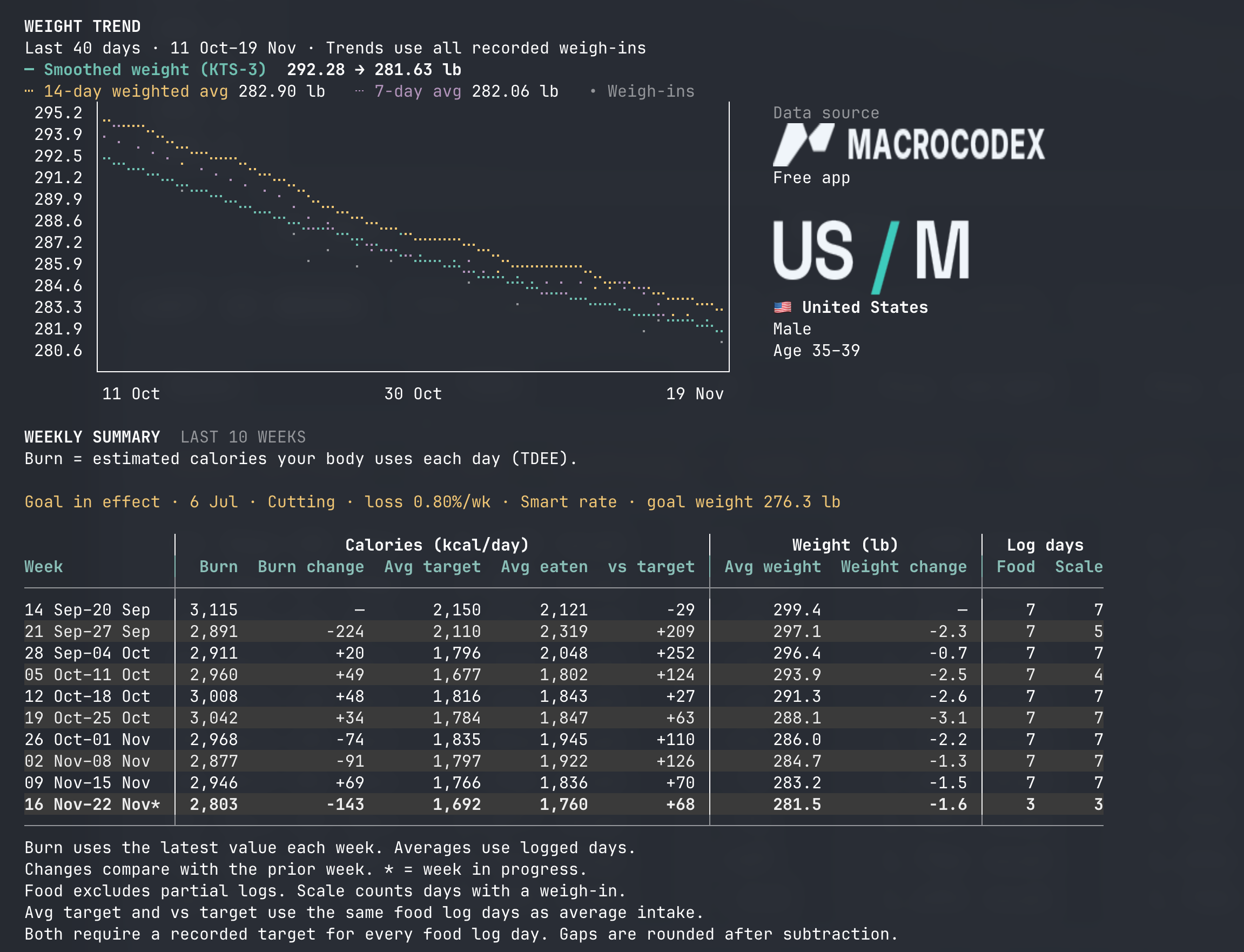
Each row in the table is a week.
Remember, you’re explaining to a five-year-old. You can’t stop a five-year-old from digging deeper and deeper. They aren’t discouraged by hand-wavey explanations.
Calorie Deficit
"Does it work on all people?"
Yes, without a doubt.
"But humans are not bomb calorimeters."
Doesn't matter; minor differences in metabolism/absorption <<< calorie deficit.
Many people know X matters, Y matters, and Z matters, but very few quantify how much X matters in relation to Y or Z.
This is why many people miss the forest for the trees.