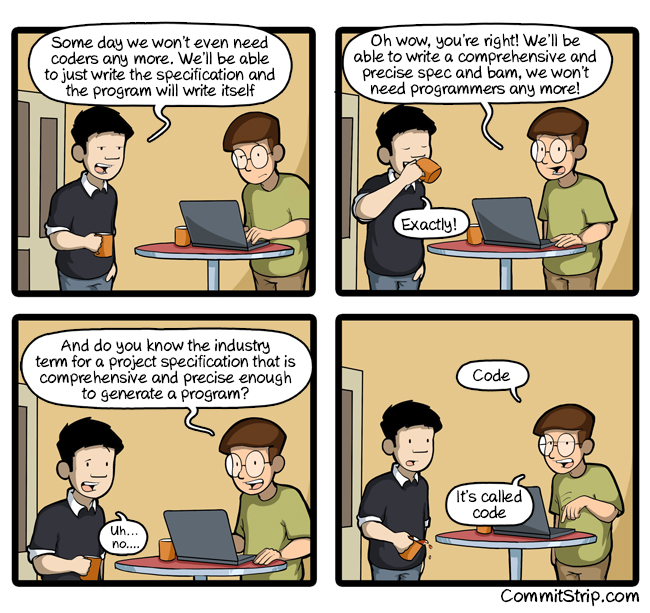
A guy with a mug comes up to a person standing with their laptop on a small table. The mug guy says, "Some day we won't even need coders any more. We'll be able to just write the specification and the program will write itself."
Guy with laptop looks up. "Oh, wow, you're right! We'll be able to write a comprehensive and precise spec and bam, we won't need programmers any more!"
Guy with mug takes a sip. "Exactly!"
Guy with laptop says, "And do you know the industry term for a project specification that is comprehensive and precise enough to generate a program?"
"Uh... no..."
"Code. It's called code."
Of course there are some systems where correctness is vital, and for those I'd like a precise spec and proof of correctness. But I think there's a huge bulk of code where formal specification impedes what should be a process of learning and adapting.
?
The UX is there, for small things it does work for me, but there is still something left for LLMs to truly capture major issues.
The problem is that it doesn't work too well for the meso-structure.
Models tend to be quite good at the micro-structure because they've seen a lot of it already, and the macro-structure can easily be promoted, but the levels in between are what distinguishes a good vs bad model (or human!).
https://medium.com/javascript-scene/sudolang-a-powerful-pseu...
I'm still struggling to move past the magic trick of guessing what characters come next to ascribe understanding of "how" and implying understanding?
Writing prompts and writing code takes about the same amount of time, for the same amount of text, plus there's the extra time that the LLM takes to accomplish the task, and review time afterwards. So you might as well just write the code yourself if you have to specify every tiny implementation detail in the prompt.