http://www.guidebookgallery.org/screenshots/winnt40
In particular: http://www.guidebookgallery.org/pics/gui/startupshutdown/spl...
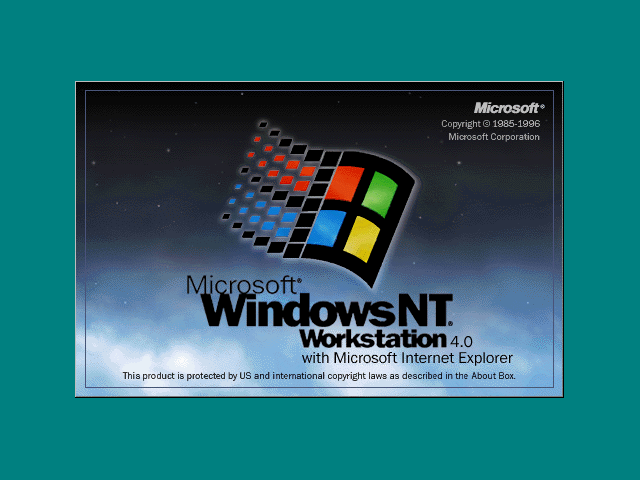
It wasn't uncommon for Microsoft to have their name mentioned 4 or 5 times on a single screen, alongside copyright symbols, trademarks, and other crap.
Trademarks are not verbs.
Correct: The image was enhanced using Adobe® Photoshop® software.
Incorrect: The image was photoshopped.
For obvious reason it went no-where.
Bic (pens) write to stop people using Bic instead of ballpoint. (Very successfully it seems, that's not a use I'm aware of.)
Hoover try to stop people using hoover as a verb too.
Google used to try to stop people using "google it" to mean "web search it".
They have to try to protect the mark, otherwise there's no point them having it.
These companies trying to stop the use of their name seem crazy to me (unless they are 'complaining' just to get some more press). So much promotion.
This happened (or at least went to court) with Hoover in the UK I think. Hoover had become the generic term for a Vacuum Cleaner and so any company could make and sell products described as Hoovers (or at least it was an open legal question).
This means it is far from crazy to defend a trademark from generic use.
The companies are worried about loss of "uniqueness" (aka. "trademark dilution"), which is a special form of protection that famous and unambiguous trademarks get. Now that the Google trademark is considered unique, you can't start a Gourmet Google Goulash restaurant, even though there is no risk of consumers being confused about who they are dealing with. The law is worried that Google's brand strength might be diluted by their brand managers not having the stage completely to themselves.
I think this whole area of law is fairly recent - Wikipedia says it grew out of anti-cybersquatting efforts in the mid 1990s.
- Aspirin - Escalator - Yo-yo - Zipper
https://en.wikipedia.org/wiki/Generic_trademark#Trademark_er...
Incorrect: The image was photoshopped.
Correct: The image was enhanced using Adobe® Photoshop® software.
Microsoft really should just have a subscript in the EULA or splash screen with "Microsoft® and the Windows Logo ™ are registered trademarks of Microsoft Inc. 1 Redmond Way, Redmond, WA, etc."
That is what startups should do as well. The best way to estalish your intellectual property is through soft enforcement, just sending out polite letters whenever somebody uses your marks in their own products. If they don't change, then pursuit further, but this works well with Facebook and in a lot of other cases.
Even in relation to operating systems it is generic - think "window manager". Because of this it is very easy to argue that Microsoft should not have been allowed to trademark such a generic term.
If they're too conservative, and legal notices are featured prominently without reason, the price is paid by Microsoft as a whole having mediocre branding, and the legal team is not accountable. But if the trademarks slip away because they've been too liberal, heads will roll.
Thus the incentives are pretty clearly stacked up for the lawyers to insist on protection that minimizes risk to a degree that hurts Microsoft as a whole.
I believe in this case I like it because the ™ slightly reinforces the 3D effect, and because it's a rather bad logo to begin with. I.e. almost any change is an improvement and the small pictograms give it a bit of an "organic" touch.
Maybe Microsoft could make the whole logo out of (R) symbols. Then the ones inserted by the lawyers will fit in.
They must think it does something? Or are people just following procedures?
But even then, what makes a hardware product different from an advertisement or a software? As far as I know, there's no legal text on the bottom of these hardware products either.
*I don't think there's a (tm) symbol there
Why does notice matter? It doesn't excuse infringement if the (R) is missing. However, if you infringe on a trademark, damages are due from the date that you know or should know that the mark is registered. So if you register a mark for your obscure brand of shoe trees or whatever, it makes sense to include the (R) wherever you can.
Now who doesn't have this problem? Apple, for one. Unless you've been living under a tree for 35 years, you know that if you sell computers with an Apple logo on the front, you're infringing on a famous registered trademark.
Yahoo also doesn't have this problem, so who knows why they felt they needed to include the (R). During the original dotcom bubble, some companies were notably overzealous about IP, so they may have gone all in at the time only to revisit it now.
maybe they couldn't for a while?
http://i50.tinypic.com/15oidfb.jpg
A clean, simple, elegant logo, completely ruined by the honking TM and (R) injected by the lawyers. The bizarre presence of two separate legalese-related sigils on a single logo makes it impossible to miss. Also makes it clear who is running the place.